Pakistan’s Oldest Vice Goes to Market
Murree Brewery’s Push Into America Lays Bare the Contradictions at the Heart of an Islamic Republic
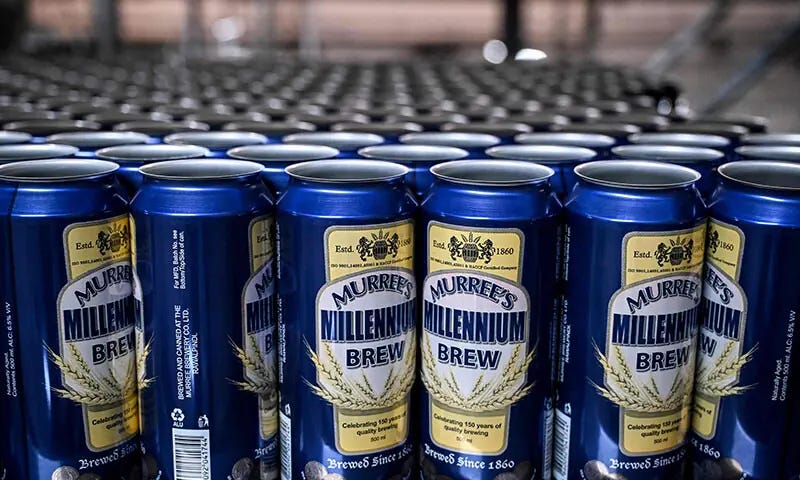
The address tells you something. Murree Brewery sits at 3 National Park Road, Chaklala Cantonment, Rawalpindi, a postal code that places Pakistan’s only legal producer of alcohol inside one of the country’s most guarded military zones. Forklifts carry cardboard boxes of beer past gates watched by soldiers of a state that bans Muslims from drinking. Over a million cans roll off the production line every month. Outside, the Pakistan Army’s General Headquarters is down the road. This is where Islamabad’s oldest and most persistent contradiction operates quietly, and where it now mounts its most ambitious commercial campaign yet: selling Pakistani beer to the United States.
Murree Brewery received official permission to export its alcoholic products in September 2025, ending a ban that stretched back nearly five decades. The first test shipment went to the United Kingdom in spring 2025. Portugal and Japan followed. Now the company has confirmed it is actively pursuing the United States and Canada. In a country where the Muslim majority is legally prohibited from purchasing alcohol, where the state’s own constitution classifies it as a vice, Islamabad’s most energetic commercial pitch toward the world’s largest economy involves beer brewed inside a military cantonment.
The Reluctant Export
To understand why this matters, you need the history.
Murree Brewery was founded in 1860 by the British to supply troops stationed in the Murree Hills. It was never meant to serve Pakistanis. It served the Raj. When independence came in 1947, the Bhandara family, Parsi industrialists whose religious identity placed them outside the reach of Islamic prohibition laws, acquired the company. For thirty years after partition, Pakistan maintained relatively liberal laws on alcohol. That ended in 1977 when Prime Minister Zulfikar Ali Bhutto, facing pressure from the religious right, imposed total prohibition. Muslims were banned from consuming alcohol. The punishment, under the military dictatorship that followed, included public flogging.
Murree survived because Minocher Bhandara, the patriarch who then ran the brewery, made a direct appeal to General Zia-ul-Haq: without legal alcohol, he argued, people would turn to dangerous homemade substitutes. The argument worked. The two men became golfing partners. The brewery continued operating, restricted to serving the country’s tiny non-Muslim minority, Christians, Hindus, and Parsis, comprising less than four percent of a population now exceeding 250 million. The company itself acknowledged that nine out of ten of its actual customers are Muslim, a fact that sits comfortably alongside the fiction that prohibition is enforced.
Exports, however, remained banned. The government’s position was explicit: an Islamic republic should not be seen sending alcohol abroad. That position held for forty-eight years.
The reason it no longer holds is economic desperation. Pakistan has spent the past several years cycling through International Monetary Fund bailouts, watching its foreign currency reserves fall to critically low levels. The country’s central bank has fought to maintain enough dollar reserves to cover basic imports. In this context, Islamabad revised its export policy in 2022, quietly permitting alcohol exports to nations outside the Organisation of Islamic Cooperation, a bloc of 57 Muslim-majority states, without making any public statement that would draw attention from the religious establishment. The formal approval for Murree to export came in September 2025. No announcement was made in mosques. No parliament debated the religious implications. The decision happened as financial decisions happen in Pakistan: quietly, under executive discretion, because the alternative was not receiving hard currency.
“The government benefits if we export,” Murree’s CEO Isphanyar Bhandara told NPR in January. He inherited the company from his father and has, like him, held a seat in Pakistan’s National Assembly. The family’s political connections and minority status have kept the brewery alive through three coups, one republic, and a constitutional order that formally prohibits what they produce. “The theory behind the export ban,” Bhandara said, “was that an Islamic country should not be seen as exporting a vice.” The theory, he noted, was theirs. They abandoned it.
America, Again
The United States is not a new target. Murree has been circling the American market for over a decade.
In 2012, the brewery made headlines in New York after Scout Willis, daughter of Bruce Willis and Demi Moore, was arrested for drinking a Murree can on a Manhattan street. The brewery’s name entered the American cultural bloodstream in exactly the wrong way: a Pakistani beer being consumed underage on the sidewalk by a celebrity’s daughter. Two years later, Murree established a flagship office on Park Avenue in Manhattan, announced plans for an American brewhouse with an initial run of 6,000 barrels annually, and began pursuing licensed distribution. None of it materialized. The Murree USA operation went quiet. Regulatory barriers, the complexity of the American three-tier distribution system, and the sheer difficulty of entering an oversaturated market stopped the effort cold.
The current push is different in one important respect: Murree now has government authorization to export, which it lacked in 2014. The company’s export manager, Ramiz Shah, has described the strategy plainly. Since 2020, Murree has exported alcohol-free products, including fruit-flavored malt drinks, bottled water, and juices, to more than a dozen countries worldwide, generating approximately $30,000 per month in non-alcoholic export revenue. Distributors in the UK and Japan who handle these products were the first to buy the beer. Shah calls this the entry model: “They are easy to target because they know us.” The American market, he has confirmed, is next on the list. Canada is also being explored.
The Drinks Business reported in February 2026 that Murree is projecting gradual export growth over the next three to four years as it builds an international foothold in what it acknowledges is a heavily oversaturated global beer market. Production is not being expanded. Bhandara has been explicit about this restraint, describing the family’s operating philosophy in terms that reveal how acutely the company understands its position: “We were always brought up with this concept: not to expand the brewery, not to increase the capacity. Keep your head down. There is an Islamic country. We don’t want to be seen as flexing our muscles while producing liquor.”
The brewery posted its best financial performance on record in 2025, surpassing $100 million in annual revenue, even as it faces new domestic competition from the Chinese-run Hui Coastal Brewery and Distillery, which began production in Balochistan in 2021.
The Bigger Picture Pakistan Would Rather Not Discuss
Here is what makes the Murree story more than a commercial curiosity.
Pakistan and the United States finalized a trade agreement in July 2025. The deal, announced by President Donald Trump on Truth Social and described by Pakistan’s Finance Ministry as a historic breakthrough, centers on energy: American oil companies will help develop Pakistan’s underexplored reserves, primarily in Balochistan and offshore. Tariffs on Pakistani exports to the US were reduced from 29 percent to 19 percent. Pakistan’s textiles industry, which accounts for roughly $5 billion in annual exports to the American market, received critical protection. The agreement covers mining, IT, cryptocurrency, and infrastructure investment.
It is, by any measure, a more consequential deal than one company selling beer. Pakistan secured it through a specific combination of transactional offerings: access to mineral reserves, counterterrorism cooperation including the arrest and extradition of a suspect in the 2021 Kabul airport attack, and a willingness to stroke Trump’s ego in ways that India, which had been Washington’s preferred South Asian partner, refused to do. Pakistan nominated Trump for a Nobel Peace Prize following his claimed mediation of the India-Pakistan military confrontation in May 2025. India refused to acknowledge any American mediation role. Pakistan got a 19 percent tariff. India got 25 percent and a public reprimand from Trump.
Within this reset, the Murree story sits as the cultural footnote that illuminates what the broader dealing actually reveals: when Pakistan needs something from the West, its Islamic identity becomes selectively available for compromise. The constitutional prohibition on alcohol exports held for forty-eight years until it became inconvenient. The export ban existed because, in Bhandara’s own words, “an Islamic country should not be seen as exporting a vice.” It was lifted because the country needed foreign exchange, not because anyone changed their view of whether the export was proper.
The optics of where Murree operates make this harder to ignore. The brewery sits in Chaklala Cantonment, the same military zone that houses the Pakistan Air Force headquarters, within reach of the Army’s General Headquarters. The soldiers who guard Pakistan’s nuclear command and control facilities are prohibited by their faith from consuming the product being produced and packaged on National Park Road. The Pakistani state is simultaneously enforcing religious prohibition at the personal level and collecting excise revenue and export earnings from the brewery that produces the prohibited substance. Both things are true at once, and neither contradicts the other in practice, only in principle.
What Happens Next
Murree’s path to American shelves is not simple. The US beer market is brutally competitive. Craft brewing has consolidated after a decade of explosive growth, major international brands from Mexico, Ireland, Germany, and the Netherlands command established shelf space, and Pakistani beer carries no cultural cachet that would drive consumer curiosity at scale. The company’s non-alcoholic distributor relationships in South Asian diaspora communities represent the most realistic entry point, namely the communities that know the brand from Pakistan, the UK, and the Gulf.
There is a niche, and it is real. The South Asian diaspora in the United States exceeds five million people. Pakistani restaurants and grocery stores operate in every major American city. The nostalgia market for a brand that is, as historian Ali Akbar Khan has described it, “a landmark” in Pakistani cultural memory should not be underestimated. Murree beer was available in Pakistani and Indian restaurants in the US in the early 2000s, when the company produced it under license in Austria. Those distribution networks, though dormant, left residual brand recognition.
Whether that is enough to build a commercially viable American operation is a separate question from whether the effort is symbolically significant. It is. A country whose state religion prohibits alcohol, whose courts have imposed flogging for drinking, whose military establishment operates in the shadow of the brewery’s production floor, is now licensing exports of its oldest alcohol producer to the most powerful country in the world. The Pakistani government issued this authorization without public debate, without clerical consultation, and without acknowledging what the export ban had represented in the first place.
Bhandara’s phrase deserves to be quoted again, because it captures the architecture of the whole enterprise: “an Islamic country should not be seen as exporting a vice.” The key word is “seen.” Not that it should not do so. That it should not be seen doing so. Fifty years of export prohibition were always, on this account, about optics rather than principle. The brewery kept its head down. The Bhandaras kept their connections. The state collected its revenue. And now, with America in the crosshairs, Murree is making its most public move yet, counting on the fact that in Washington, as in Rawalpindi, what matters is not what you believe, but what you can sell.
Murree Brewery is a publicly listed company on the Pakistan Stock Exchange. Its Rawalpindi facility is located at Chaklala Cantonment. The export policy revision was enacted in 2022. Formal export authorization for alcoholic products was granted in September 2025. The company’s first alcoholic export shipments went to the United Kingdom, Portugal, and Japan, with the United States and Canada confirmed as next targets.