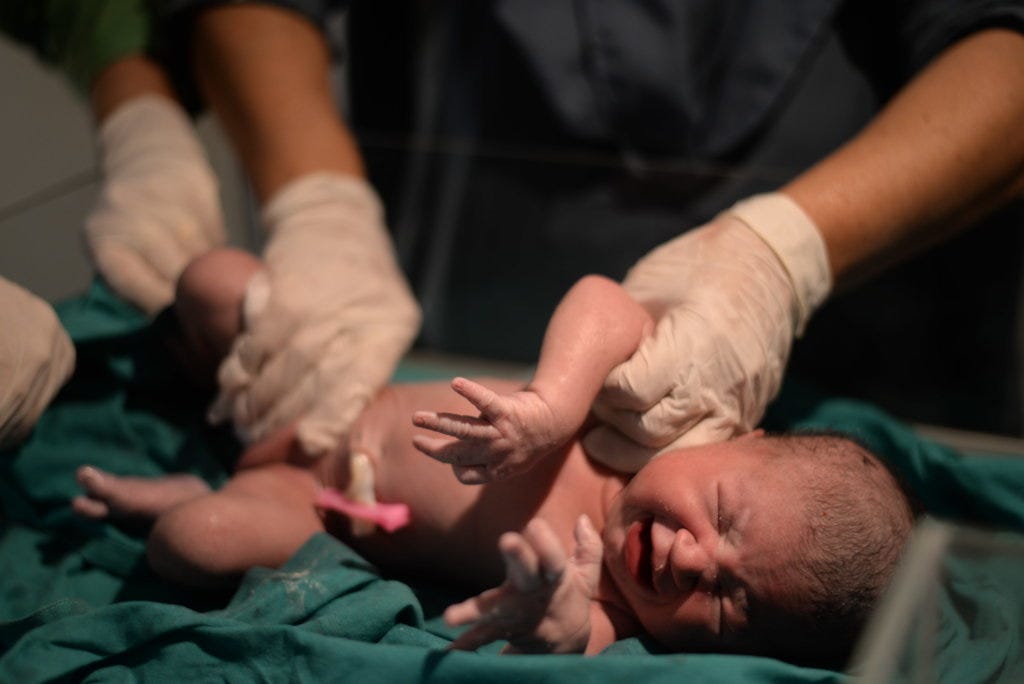
Fourteen babies died inside a federal hospital nursery while Pakistan’s own records described a health system that already knew where newborn lives were being lost.
At 6:38 on Wednesday morning, according to the Pakistan Institute of Medical Sciences, a spark inside the third-floor nursery of its Mother and Child Hospital became a fire. Fifteen newborns were in the room, one came out alive and fourteen died in the federal capital’s principal public hospital, inside the unit built for babies already too premature, too small or too sick to survive without controlled heat, oxygen and constant clinical attention. Television pictures showed firefighters reaching the nursery through broken windows and parents gathered below a blackened ward. The state had brought their children into intensive care and placed them behind a nursery door, and yet the parents found themselves outside the building trying to reach them.
The cause remains unsettled. The health minister initially blamed a blast in an air-conditioning unit. PIMS later said a nebuliser had exploded and that the oxygen concentration helped the fire spread. Members of the National Assembly’s health committee visited the hospital on 27 August and said the available CCTV footage did not establish that an air conditioner had started the blaze. The prime minister’s inquiry committee, led by retired federal secretary Shahid Khan, must provide urgent recommendations within 48 hours and a fuller report within five days. Until that work is complete, the ignition point remains unresolved while fourteen deaths are confirmed.
Reuters spoke to Javeria, who lost her newborn. She said there had been no doctor or nurse in the ward, an account the health minister denied, and said the children’s bodies were carried away “in boxes.” Mudasir, another bereaved parent, told Reuters that the building had “no fire security, no proper exits” and that all but one of the doors were closed. Hospital officials gave the Associated Press a different account: two doctors, two nurses and other staff were present, but the fire moved too quickly for them to save more than one child. The contradiction now belongs to the inquiry, along with the condition of the alarms, sprinklers, exits, oxygen lines, electrical system, staffing roster and evacuation plan.
One mother, identified by the Associated Press as Mrs Mohammad Sami, had given birth three days earlier. Her child needed intensive care, which is why the baby was in the nursery. “I have lost my child,” she said. That is the line beneath every rate and every policy document in Pakistan’s infant mortality record: a woman carried a child to a health facility, the child entered the state’s care, and the mother left without the baby.
The fire gives Pakistan’s newborn crisis a room, a clock and fourteen families, although the crisis predates it by decades. The latest United Nations Inter-agency Group for Child Mortality Estimation places Pakistan’s 2024 infant mortality rate at 48.2 deaths for every 1,000 live births. It estimates that 329,205 children died before their first birthday during that year. Of them, 248,523 died during the first 28 days of life. Pakistan lost 381,586 children before age five, and 65 per cent of those deaths occurred in the neonatal period. Fourteen babies died together at PIMS and forced the country to look at one nursery. About 681 newborns died on an average day in 2024 without producing a live broadcast from the corridor.
The official number and the children behind it
Pakistan now has two current national estimates, and the difference between them needs explanation rather than a convenient range. The Household Integrated Economic Survey 2024-25 covered 32,814 households between September 2024 and June 2025 and calculated mortality retrospectively for births in 2021 to 2023. It put neonatal mortality at 35 per 1,000, infant mortality at 47 and under-five mortality at 54. The UN group, led by UNICEF with WHO, the World Bank and the UN Population Division, modelled 2024 at 36.1, 48.2 and 56 respectively. These estimates measure different periods through different methods, and yet both records place nearly three quarters of infant deaths inside the first month.
The government presents the fall as progress, and there has been progress. The Pakistan Bureau of Statistics says infant mortality declined from 60 per 1,000 for 2014 to 2016 to 47 for 2021 to 2023, while neonatal mortality declined from 41 to 35. The UN series records a fall in under-five mortality from 140.4 in 1990 to 56 in 2024. Hundreds of thousands of children are alive because vaccination, trained birth attendance, antibiotics, better nutrition and community health work reached families that did not have them a generation ago. A serious investigation should preserve that achievement because the remaining indictment becomes clearer when the interventions are known to work.
Pakistan still records an infant mortality rate more than twice the South Asian average of 23.2 cited in the Pakistan Economic Survey 2025-26. The Sustainable Development Goal for 2030 requires neonatal mortality below 12 deaths per 1,000 and under-five mortality below 25. Pakistan’s neonatal rate must fall by two thirds in four years to reach the first threshold. Its under-five rate must fall by more than half to reach the second. The country has reduced child deaths across three decades, and yet its present rate of decline cannot meet the promise it signed.
The uncertainty surrounding national estimates also exposes a deeper problem: Pakistan does not maintain a complete civil record of the children who enter and leave the world. UNICEF’s latest country data put birth registration among children under five at 42 per cent. Its 2023 annual report found that only 35 per cent of children younger than one had been registered. Household mortality surveys therefore ask women about births and deaths and statisticians reconstruct national totals from those histories. This method is internationally established, but it exists because millions of Pakistani children have no timely civil record. A child can be born at home, die within hours, be buried by the family and never acquire a name in any state database.
The first month
The medical record is unusually consistent. Prematurity, complications during labour, birth asphyxia, sepsis and other infections account for most neonatal deaths. The 2026 UN child mortality report identifies prematurity, birth asphyxia or trauma, and sepsis as the leading preventable or treatable causes in Pakistan. WHO calculated in April 2025 that the country was losing 675 newborns and 27 mothers each day, along with more than 190,000 stillbirths each year. The later UN model places the newborn toll slightly higher. Both estimates describe conditions with established interventions.
A premature baby may need warmth, assisted breathing, infection control, breast milk support and rapid treatment with antibiotics, while a child who does not breathe at birth needs a trained person with working resuscitation equipment in the first minute and a mother with prolonged or obstructed labour needs transport, surgery, blood and a facility able to receive her before the baby loses oxygen. The tools are known and often inexpensive, and yet their value depends on where they are, whether they work, whether staff know how to use them and whether a family can reach the room in time.
The country’s own facility assessments describe where that chain breaks. A Government of Pakistan, UNICEF and Aga Khan University study of 23 public hospitals found that 83 per cent had neonatal intensive care units and 74 per cent had special-care units, but only 44 per cent had kangaroo mother care units, where premature and low-birth-weight babies receive prolonged skin-to-skin contact and supported breastfeeding. Only 13 per cent employed a neonatologist, 13 per cent had staff trained to counsel parents, and 35 per cent monitored hospital-acquired infections. None of the 23 facilities had all 21 essential medicines assessed by the researchers. Ampicillin was available in 45 per cent and gentamicin in 54 per cent. Fewer than half reported preventive and corrective maintenance of newborn-care equipment. The peer-reviewed assessment described equipment that existed on an inventory while systems for maintenance, infection monitoring, discharge support and specialised staffing did not.
A broader Maternal and Newborn Health Facility Assessment conducted in 2022 and published in 2026 reached the same institutional fault from another direction. Across the facilities surveyed, clinical guidance was available for newborn resuscitation in 8.8 per cent, kangaroo mother care in 8.4 per cent and injectable antibiotics in 10.9 per cent. The district-based assessment found that facility delivery had increased from 34 per cent in 2006-07 to 66 per cent in 2017-18, and yet the transfer of birth from the home to a building had outpaced the transfer of safe, standardised care into that building.
PIMS now sits inside this record. The health minister acknowledged after the fire that the nursery had no sprinkler system. PIMS said 26 extinguishers were available in the building. Families said doors were closed and that they tried to reach the ward through windows. One of the questions for the inquiry is brutally basic: what did the hospital possess on paper, and what could a nurse, doctor or parent use at 6:38 in the morning?
The road to the ward
Health researchers describe maternal and newborn deaths through three delays: the decision to seek care, the journey to a facility, and the care received after arrival. In Pakistan, officials often place the first delay inside “awareness” or “culture,” language that moves responsibility towards women who waited at home. The household record is harder. A family weighs the cost of transport, the possibility that a basic health unit will be closed, the price of medicines that a public facility may not have, the need for a male relative’s permission in some homes and the chance that the next hospital will refer the patient onward. Delay is often a rational response to a system that has made care uncertain and payment immediate.
Noor, a 22-year-old woman in Sindh interviewed by UNICEF after the 2022 floods, had already lost one child when she gave birth at home during the rains. Three days later, the baby stopped breathing. “I was barely eating during the rains and couldn’t breastfeed,” she said. The family buried the child a few metres from their home while the rain continued. Benazir, a mother of six in another Sindh village, told UNICEF that her family lived on one meal of bread and chilli when her husband found plantation work, while the nearest health centre was 15 kilometres away. Her nine-month-old daughter died as the family travelled towards a hospital in a wagon. These mothers did not fail to understand that their children were sick. Distance, food and money had already made the clinical decision for them.
Nasreen Bibi’s twins carry the entire referral system inside one family history. Nurses delivered the first baby at a health centre in South Punjab and referred Nasreen to Rajanpur after complications. The first child died within hours. The second survived five months but developed severe malnutrition and repeated diarrhoea. Nasreen told UNICEF that she could not breastfeed him and that he stopped breathing within days of becoming ill. She returned to field work 40 days after another delivery. Dr Ayesha Jameel, who led the Kotla Eason Health Centre, told UNICEF’s reporting from South Punjab that newborn deaths were part of the centre’s work and that many women resumed labour in the fields one week after giving birth.
The testimony from Tharparkar is even more exact because it identifies one preventable infection and one working intervention. Maloka lost her first daughter to neonatal tetanus. During her next pregnancy, Fatima, a lady health worker, crossed the desert to vaccinate her, advise her on clean delivery and provide antenatal care. The next child survived. Pakistan reported 322 neonatal tetanus cases and six deaths in 2024, but WHO specialists estimated that authorities were notified of only 30 per cent of cases. Sindh reached the elimination threshold in December 2024, while Islamabad Capital Territory and Pakistan-administered Kashmir reached it in March 2025. WHO documented Maloka and Fatima’s work, and the lesson requires no slogan: one worker, one vaccine and one visit separated two outcomes in the same family.
Nouranda, a mother in Bilal Town outside Islamabad, lost Furqan at 13 days old in 2016 and another son at seven days old in 2021. She told UNICEF that Furqan developed a high fever when he was ten days old and doctors said they could do nothing beyond asking her to pray. A lady health worker later explained neonatal tetanus and referred Nouranda for vaccination. Her daughter Fatma survived. “I wouldn’t have hesitated to get vaccinated if I knew,” Nouranda said in UNICEF’s April 2025 account. The knowledge reached her after two burials.
A ward can have walls and still lack care
Pakistan’s health system has expanded the number of facilities and professionals. The 2025-26 Economic Survey lists 1,934 hospitals, 5,746 basic health units and 336,582 registered doctors in 2025. It also records public health expenditure at 0.8 per cent of gross domestic product in FY2025 and a federal health-sector development allocation of Rs19.375 billion. Those figures sit inside the same official chapter as the infant mortality rate of 47. The state counts buildings and registrations because they are easy to put in a table, while a mother needs a functioning oxygen outlet at night, a staffed operating theatre, antibiotics in the pharmacy, blood in the bank and an ambulance that arrives before the baby stops breathing.
The financial burden follows the family through that chain. Pakistan’s Universal Health Coverage Monitoring Report, compiled by the health ministry with WHO and British support, estimated that 14.8 million people faced catastrophic health expenditure in 2024 and 11.1 million were pushed below the $2.15-a-day poverty line by out-of-pocket medical costs. A citizen pays taxes into a state that devotes less than one per cent of national output to public health, then pays again for transport, tests, medicines and private care when the public system cannot supply them, and yet the cost of the child’s death stays with the household.
The nursery fire in Sahiwal should have closed every official escape route from this argument. On 8 June 2024, a short circuit in the air-conditioning system started a fire in the paediatric ward at Sahiwal Teaching Hospital. Initial hospital statements said four, then five, critically ill babies had died for medical reasons unrelated to the blaze. Subsequent inquiries and CCTV footage led the Punjab chief minister to act over the deaths of 11 infants, most of them newborns. Dawn reported that fire extinguishers were not working, babies deteriorated after a chaotic evacuation and the hospital’s internal inquiry had declared conditions satisfactory before other inquiries contradicted it. Two years later, parents at PIMS described closed doors and absent fire protection while another administration first blamed an air conditioner and then a nebuliser.
The Sahiwal history establishes prior knowledge without deciding the cause of the PIMS fire. Pakistan’s public hospitals knew that oxygen-rich nurseries and paediatric wards required maintained electrical systems, functional extinguishers, open exits, drills and trained staff because Sahiwal had already supplied the dead. The official response after PIMS has been to order new fire-safety audits across Punjab and several federal institutions. An audit conducted after fourteen funerals documents what authorities had failed to enforce before them.
Progress that proves the deaths are preventable
There is a functioning alternative inside Pakistan’s own record. The National Newborn Survival Strategy and costed action plan for 2023 to 2028 standardised newborn-care guidance and data tools. Kangaroo mother care expanded from one pilot location in 2017 to 75 facilities, and UN reporting says more than 12,000 premature babies received it in 2024. In March 2026, UNICEF described new 24-hour birth-dose centres providing polio, hepatitis B and tuberculosis vaccines at eight sites. These programmes are small beside the national birth cohort, but they show that the state is not searching for an unknown treatment.
A cluster-randomised trial in Rahim Yar Khan tested community education, clean delivery kits, and training for community and facility health workers across 15,615 births. The study found no statistically significant reduction in perinatal mortality and a 25 per cent reduction in neonatal mortality. The trial, published in JAMA Network Open, demonstrated that household practices and trained local care could save newborns even where poverty and health-system constraints remained. Its births took place in 2012 and 2013. Pakistan has therefore possessed locally tested evidence for more than a decade and continues to operate through pilots, donor-funded islands and provincial programmes that fall short of a reliable national guarantee.
WHO’s 2025 account of maternal and neonatal tetanus gives the same answer at a larger scale. More than 140,000 lady health visitors, supervisors, lady health workers and midwives were working across Pakistan, with 17,000 lady health workers in Sindh. Vaccination and clean delivery pushed tetanus below the elimination threshold in the areas they reached, while failures in the reporting system led WHO to estimate that seven in ten cases never reached the authorities. The worker exists, the vaccine exists and the method works, and yet coverage still depends on whether a particular woman such as Fatima can reach a particular mother such as Maloka.
The children outside the ledger
The state’s incomplete birth record means its death record begins with a blind spot. Birth registration and mortality measure different facts. Still, a system unable to document most infants at birth cannot produce a complete, timely account when some of them die at home. UNICEF reported that Pakistan had the largest number of unregistered children in South Asia and globally in 2023. The rural gap can be severe: the 2017-18 Demographic and Health Survey found birth registration in Sindh at 53.8 per cent in urban areas and 6.9 per cent in rural areas, figures cited in the State of Children in Pakistan 2024.
Death outside the ledger has another documented form. The Edhi Foundation said it recovered the bodies of 375 newborn babies in 2019, double its 2018 total. Dawn reported the monthly count: 20 in January, 31 in February, 24 in March, 35 in April, and bodies in every month through December. Edhi’s spokesperson said some families left newborn girls’ bodies at its centres because hospitals would not issue death certificates easily. Earlier reporting based on Edhi and Chhipa Welfare Organisation records counted 345 newborn bodies recovered from rubbish sites and other locations in Karachi between January 2017 and April 2018, with the charities reporting that almost all were girls. Those figures come from welfare organisations rather than a national forensic register, which is precisely the institutional failure they describe.
These abandoned bodies should not be folded casually into the infant mortality estimate. Some may have been stillborn, some may have died after unsafe births, and some may have been killed; without autopsies, birth records and criminal investigations, an article cannot assign a cause to each child. Pakistan Penal Code sections 328 and 329 criminalise abandonment and concealment of birth through secret disposal of a body, but prosecution data do not match the charities’ recovery lists. The state receives the body after the child has been denied a safe pregnancy, a protected birth, a civil identity and, in many cases, a police investigation.
The organ rumour and the documented trade
Pakistan does have an organ-trafficking problem. In 2023, police broke up a network accused of removing kidneys from more than 300 people in operations conducted in private houses. UNODC cited the case in a 2024 paper on trafficking for organ removal. The documented victims were recruited for kidneys through a criminal system requiring brokers, recipients, surgeons and places to operate. Poverty supplied the bodies and medical expertise supplied the market.
No police case, court record, credible medical investigation or trafficking report establishes that Pakistani newborns are being kidnapped or killed systematically for transplantable organs. Infant transplantation requires matching, specialised retrieval, preservation, transport and a recipient team. Repeating an unsourced story about babies stripped for organs replaces a documented chain of preventable deaths with a sensational crime and gives the institutions responsible for ordinary neglect somewhere else to point.
The June 2026 placenta case shows why the distinctions matter. The Federal Investigation Agency and the Human Organ Transplant Authority arrested suspects after raids in Islamabad and an intercepted airport consignment. Investigators alleged that human placentas had been bought from hospitals, dried, falsely described as sheep placenta and prepared for export to Vietnam for cosmetic or anti-ageing products. A court later rejected four bail applications, citing the disposal rules and the quantity recovered. The final forensic and criminal findings still belong to the proceedings. The case concerns placentas expelled after birth and documents suspected hospital-waste corruption and a commercial market in human tissue; it supplies no evidence that Pakistan’s newborn mortality tables conceal transplant killings.
Prematurity kills when warmth and breathing support are absent, labour complications kill when a mother reaches surgery too late, sepsis kills when hygiene fails or antibiotics are missing, fire kills when an oxygen-rich nursery lacks safe containment and evacuation, and an unregistered death disappears when no authority records the birth, examines the body or asks what happened. These are different routes into the same public abandonment.
The PIMS inquiry will name an ignition point, assess the exits and reconstruct the minutes before the nursery was destroyed. It may assign individual responsibility. The national record already shows what the inquiry cannot contain inside one air conditioner, one nebuliser or one shift: 248,523 newborn deaths in a year, public health expenditure at 0.8 per cent of GDP, essential clinical guidance absent from most facilities surveyed, most infants unregistered, and locally tested interventions left at a scale far below the need. Pakistan knows how its newborns die and knows many of the ways to keep them alive, and yet knowing has never carried the same budget, urgency or institutional force as burying.


