
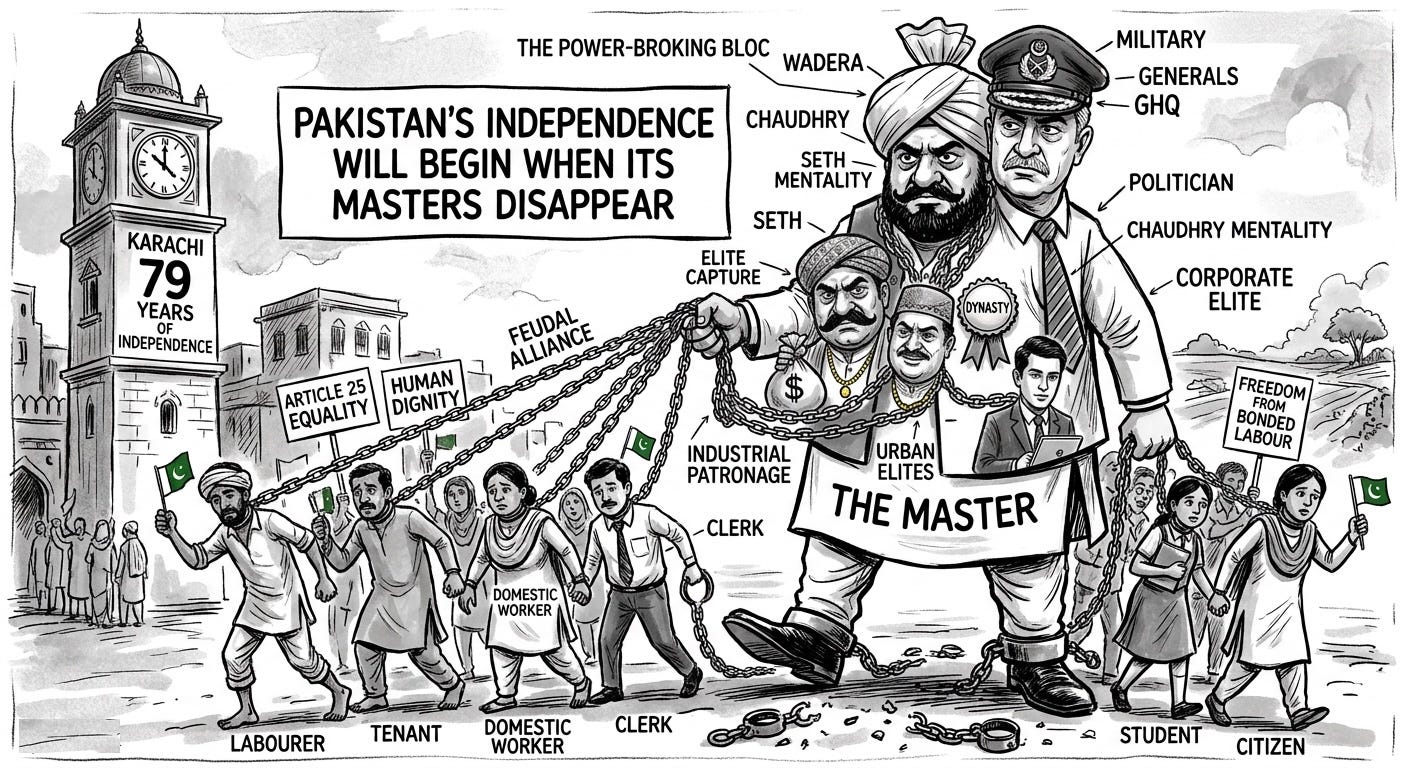
Pakistan’s Independence Will Begin When Its Masters Disappear
Seventy-nine years after independence, Pakistan’s real struggle is against the modern slavery built into the way we govern, work and treat one another.
Today marks seventy-nine years since Pakistan became independent, and you may raise the flag over your home, watch your children pin a green-and-white badge to their clothes, stand for the national anthem, quote Iqbal and Jinnah, talk about sacrifice and tell them that this country was created so its people could live with dignity. I want to believe every word of it because I love Pakistan and believe in why it was created, and perhaps that is exactly why every Independence Day hurts a little more. We celebrate freedom while millions of Pakistanis still spend their lives asking permission from somebody who thinks he owns them.
We talk about military rule, oppressive governments, corrupt politicians, corrupt bureaucrats, dishonest businessmen, feudal landlords, broken courts, police brutality and the ordinary corruption that follows you into almost every public office. All of it is real and all of it has damaged Pakistan, but these are symptoms of something far deeper, something so engraved in our minds that we often practise it without even recognising what we are doing. The real problem is the master and slave mentality.
Call it modern slavery, call it elite capture, call it feudal thinking, call it the seth mentality, the chaudhry mentality or the wadera mentality. You get the point. The title changes from one place to another, but the relationship stays the same: I am above you, you are below me, I can make you wait, I can speak to you however I want, I can deny you what is already yours, and you should remain grateful because I have the money, the land, the uniform, the office, the political connection or the family name.
This mentality exists all the way from the top of the state to the smallest daily interaction. It exists inside GHQ when the institution treats the country as something it must supervise rather than something the people own. It exists inside political parties when one family owns the party and thousands of workers are expected to obey. It exists inside the bureaucracy when a public servant behaves as if the citizen has entered his private office to beg for a favour. It exists inside businesses when the owner believes a salary has bought not only a worker’s labour but also his silence, loyalty and dignity. It exists in villages under the landlord, in cities behind office doors, inside police stations, factories, farms, shops and homes.
We gained freedom from the old master and then modernised his system. He had legal ownership and physical chains. The modern master controls the job you cannot afford to lose, the file you need signed, the land you cultivate, the police report you need registered, the promotion that depends on obedience, the party ticket that depends on loyalty or the wage that can be withheld because he knows your children need food. The chain is no longer always visible, and yet the person wearing it knows exactly where it is.
Look around Pakistan and you will see how normal we have made it. A man can spend the whole day complaining that the government treats him like dirt and then return home and treat a domestic worker in exactly the same way, a shop owner can curse the tax officer for humiliating him and then humiliate the boy at his counter, and a junior officer can absorb abuse from a senior before delivering it to the clerk, driver or guard. We look upward for a master who can protect us and downward for somebody we can control.
The system keeps reproducing itself because it gives people a small taste of power in exchange for their obedience to the much larger power crushing them. You remain silent before the person above you because somebody below can still be made to feel smaller, and the humiliation travels downward while obedience travels upward. Pakistan stays trapped between the two.
The Constitution understood this problem more clearly than many of the people who claim to defend it. Article 3 says the state shall ensure “the elimination of all forms of exploitation,” while Article 25 says every citizen is equal before the law and entitled to equal protection. Those promises form the foundation of a free society, and yet in Pakistan the law still changes its tone according to the car you arrive in, the surname you carry, the uniform beside you and the person who answers when you make a telephone call. You can read both commands in the state’s own published Constitution of Pakistan.
There is also literal slavery behind this national mentality. The International Labour Organization’s supervisory record cites an estimate by Pakistan’s National Commission for Human Rights that more than three million people are affected by bonded labour, including around 700,000 people working across more than 4,000 brick kilns. Families work against debts they may never be allowed to clear, children inherit obligations they never made, and labourers give their bodies, their years and sometimes another generation to owners protected by money, local influence and a state that rarely reaches them. Pakistan has laws against bonded labour and ratified the ILO Forced Labour Protocol in March 2025, and yet a law that never reaches the kiln cannot break the chain around the worker.
When I use the word slavery, I mean the actual bonded labourer, the domestic worker treated as property, the tenant farmer held by debt and the child working in a house while another child in that same house prepares for school. I also mean the larger national relationship that protects such treatment. The kiln sits at the extreme end of a belief running through the country, one that assigns greater worth to some lives and greater weight to some voices while teaching one group to command and another to endure.
The army must return to the barracks, GHQ must leave politics, business and civilian government, and every institution must remain inside its constitutional boundary because a country cannot be free when armed command stands above the vote. But that necessary demand cannot carry the whole solution.
If the army returns to the barracks tomorrow and the master and slave mentality remains untouched, a political dynasty, bureaucratic elite or collection of businessmen, landlords and party patrons will occupy the empty chair. We will change the face and keep the throne. Pakistan has removed military rulers, restored civilian governments, held elections and celebrated democratic victories, and yet the ordinary citizen still enters too many public offices like a servant entering the room of an owner.
The corrupt political class must also be removed, but removing individual politicians without changing how political power works will produce another corrupt class. Our parties are built around obedience. The leader sits above criticism, family members inherit authority, financiers buy access, workers provide crowds and ordinary voters are remembered when numbers are needed. A party that does not allow equality within itself cannot deliver equality to a country. It may use the language of democracy, but its internal language remains loyalty, favour and command.
The bureaucracy must be reformed, but changing forms, titles and procedures will achieve little while the official behind the desk believes he is doing the citizen a favour. The public owns the desk, pays the salary and has already funded the service, and yet people are made to wait for hours, return for days, find a reference, pay a bribe or lower their voice for a signature treated as charity.
You know exactly what this feels like because you pay tax and then pay privately for water, pay the electricity bill and then buy a generator or solar panels, fund public education and then struggle with school fees, and pay for the police before hiring a guard. You vote and watch the result of politics being negotiated somewhere you cannot enter, and you are asked to sacrifice for Pakistan again and again while the people ruling Pakistan receive their rewards first and explain your sacrifice later.
That is why the country is in turmoil. People are tired of being treated like bloody civilians, as if civilian were another word for a person who must obey, and they are tired of needing a connection for what should be a right, earning respect from the rich while respect for the poor remains optional, and watching the powerful break the law while the weak are broken by it. This anger belongs to no single party or province. It belongs to a public that has spent seventy-nine years listening to speeches about freedom while experiencing power as another form of ownership.
Some will call this a class war, and in many ways it is. Pakistan has a class system even if we avoid saying so: wealth buys distance from the consequences everyone else must bear, land buys influence, family buys access, uniform buys fear and English buys authority in rooms where intelligence should have been enough. The child of a powerful family enters life with doors already open while the child of a labourer may spend a lifetime outside those same doors.
But money alone does not explain the war. A poor man can become a master the moment he receives a little authority, and a wealthy man can reject the mentality by treating every worker as a human being with rights. The real dividing line is between those who believe dignity belongs to every person and those who believe dignity must be distributed according to rank.
Pakistan must fight the belief that strength requires somebody beneath you and that leadership means command without accountability. A worker is expected to feel grateful for wages, a voter for representation and a citizen for services already paid for through tax, labour and sacrifice, and yet each transaction describes an obligation owed to that person rather than a favour handed down by a master.
When people speak about Iqbal’s vision or Jinnah’s desire, this is where their words lead. Jinnah told the first Constituent Assembly on 11 August 1947 that Pakistan would begin with the principle that “we are all citizens and equal citizens of one State.” In the same address preserved by the National Assembly, he called bribery and corruption one of the greatest curses facing the new country. Equality and corruption were part of the same warning because corruption is what happens when one citizen acquires the power to sell another citizen his own rights.
Iqbal’s idea of khudi called for the recovery of the self, the moral strength of a person who knows his worth and accepts responsibility for it. His political thought connected equality, solidarity and freedom, and his account of Islam as a polity demanded “loyalty to God, and not to thrones”. A society in which millions depend on patrons, masters and gatekeepers cannot fulfil that vision because the citizen has been trained to surrender the very selfhood on which freedom depends.
We have turned both men into portraits on walls because portraits ask nothing from us, while their ideas demand that we change how power works. Jinnah’s equal citizen leaves no space for the wadera who owns votes, the seth who owns workers, the bureaucrat who owns files, the party chief who owns representatives or GHQ claiming ownership over the country’s direction. Iqbal’s self-respecting person cannot remain a permanent subject waiting for permission to speak.
The change must begin at the bottom because that is where every form of rule lands. A worker must be able to question an employer without losing the food on his table, a tenant must be able to challenge a landlord without losing her home, and a citizen must be able to enter a police station without searching his telephone for the most powerful person he knows. A party worker must be able to disagree with a leader without becoming a traitor, a soldier must serve the Constitution rather than the political needs of the current occupant of the chair, and an official must answer the public because public service means exactly that.
This change must enter our homes and businesses through the way we pay people, the tone we use with workers and the rights we recognise when nobody is watching. Give domestic workers contracts, rest and privacy. Stop using beta when asking for extra work and naukar when the worker asks for money. Let the junior person speak, make the senior person explain, and teach children that the person cleaning the table carries the same human dignity as the person sitting at it.
None of this excuses the state. Personal kindness cannot replace law, labour protection, unions, land reform, functioning courts, independent local government and the prosecution of bonded-labour owners. The state must break the material chains that keep people dependent. But the law will keep failing if the police officer, judge, landlord, employer and citizen all carry the master’s permission inside them.
Once this chain breaks, change can travel upward. A population that refuses slavery at work will refuse it in politics, a citizen who rejects humiliation from a clerk will reject guardianship from a general, and a party worker who expects accountability from a leader will expect it from a prime minister. A worker who knows that wages purchase labour rather than obedience will understand that taxes purchase public service rather than the privilege of begging for it.
Pushing the army back to the barracks will then have meaning because society will no longer be searching for another master, removing a corrupt political class will matter because voters will refuse to replace one dynasty with another, and bureaucratic reform will work because the citizen will enter the office as its owner. The people governing Pakistan will answer to all Pakistanis, not only the elites, patrons and institutions powerful enough to demand an answer.
I do not want another Independence Day on which we confuse the existence of Pakistan with the freedom of Pakistanis. We have the country and the flag is ours, and the love is real, but freedom will remain unfinished while one Pakistani believes another was born to serve him.


