
Pakistan’s FY27 Budget
A summarized reading of the current budget
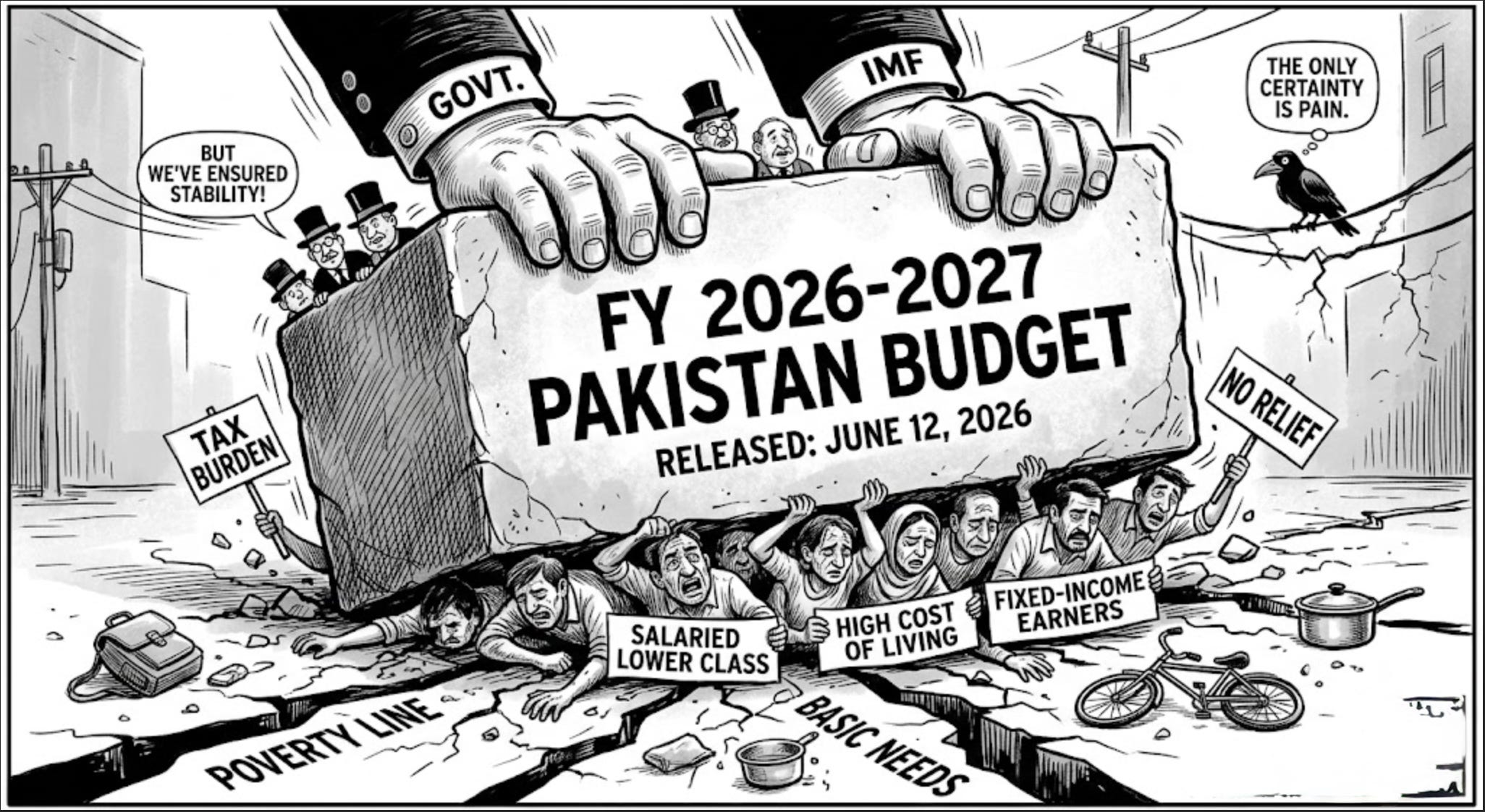
The most honest sentence written about Pakistan’s FY27 budget did not come from the finance minister. It ran beneath the masthead of Business Recorder, the country’s paper of finance and business, as the summary line under the main headline on the morning of June 13, 2026: development expenditure squeezed, defence spending up 18 percent, agriculture, retail and real estate sectors still remaining unscathed from due taxation. Finance Minister Muhammad Aurangzeb called the same document a budget of “transformation.” His friendliest newspaper read the same pages and described something else: a transfer, from the development needs of the many to the protected wealth of the few, with the military’s claim raised on top.
Aurangzeb, a former commercial banker installed as finance minister to satisfy the IMF and the markets, unveiled a Rs18.77 trillion federal budget on June 12 for fiscal year 2026‑27, his third. The markets understood it before anyone in Lyari or Lyallpur did. The KSE‑100 closed the session up nearly 2,700 points. The salaried clerk, the daily‑wage worker, the woman buying cooking oil on credit: none of them closed up anything, because the budget that moved the stock exchange was built around these people, not for them.
A reader who signed himself “KU” posted a comment under Business Recorder’s budget report within hours of the speech: announcing 7 percent salary increase for public servants but keeping quiet on private sector salaried class, professionals and daily wagers or taxing them to poverty is a wrong and unfair economic management. That is the whole budget in a single sentence, written by a man who will never be invited to Q Block. The evidence behind his sentence is in the document.
The cage built from interest
Before this budget funds a school, a clinic, a road, or a single government salary, it pays rent on the past. Of the Rs18.77 trillion total outlay, Rs8,054 billion goes to interest payments on money the state has already borrowed. Set that against what the federal government actually controls. After the constitutionally mandated Rs8,848 billion transfer to the provinces under the NFC Award, the federal government’s net revenue receipts come to Rs11,751 billion. Interest alone consumes roughly 69 paisa of every rupee the federal government keeps after paying the provinces. This is not an abstraction. It is the first arithmetic of the budget, and it governs everything that follows.
Add the compulsory items. Defence: Rs3,000 billion. Pensions: Rs1,169 billion. Interest, defence, and pensions combined: Rs12,223 billion. Net revenue after NFC transfers: Rs11,751 billion. Three line items, none of them a hospital or a school, have already exceeded every rupee the federal government collects and retains. Everything else this budget promises, the Rs1,000 billion federal development programme, the Rs1,071 billion to run civil government, the Rs2,680 billion in grants, the Rs838 billion for BISP, every road and subsidy and salary increase, is financed by borrowing more on top of the debt already consuming the budget alive.
The government publishes this without embarrassment. The Resources Breakup appended to the budget documents shows 63 percent in net revenue receipts, 21 percent from bank borrowing, 11 percent from non‑bank borrowing. Nearly a third of the budget is fresh debt, layered on a debt‑servicing bill already the single largest expenditure line in the document. The state borrows at interest to pay the interest on what it borrowed before, and the men who manage this circuit describe the outcome as “stability.” The fiscal deficit is pegged at Rs5,226 billion, or 3.6 percent of GDP, up from the revised 3 percent of the outgoing year. The primary surplus—the amount by which the state collects above its spending before counting interest, is Rs2,828 billion, or 2 percent of GDP, the fourth consecutive year of surplus and the IMF benchmark the government carries as its crowning achievement.
The only way to manufacture a primary surplus when debt is fixed and defence is rising is to compress the spending that has no institutional muscle behind it. That spending is development. The surplus celebrated as discipline in the budget speech is experienced in the village as an absence.
Here is why that arithmetic arrives at your door. When the largest share of what the government collects is promised to lenders before anyone budgets a rupee for you, the state covers the gap two ways, and it uses both. It borrows more, which raises the interest bill next year and tightens the cage further. And it extracts more from whoever is easiest to tax, which is the person whose employer deducts before they are paid. The lenders are settled first, and what you represent to this state is what remains after them.
The morning after the budget, Aurangzeb addressed the media and confirmed the mechanism. “Since we are in an IMF programme, we remain in constant consultation with them,” he said. “All discussions are being carried forward with their input. That is a requirement of being in the programme.” The budget, in other words, is a document drafted in consultation with a creditor in Washington. The interests of that creditor and the interests of a woman in rural Sindh waiting on a functioning basic health unit are not the same interests, and the budget makes no attempt to pretend they are.
Who got paid: a ledger
The super tax has had its first six slabs abolished outright. Incomes from Rs150 million to Rs500 million a year, previously taxed at rates between 1 and 7.5 percent under this provision, now pay nothing under it. For incomes above Rs500 million a year, half a billion rupees in a country where 28.9 percent of the population lives below the poverty line by the government’s own count—the super‑tax rate has been cut from 10 percent to 8 percent. The Capital Value Tax on holdings of foreign assets has been abolished, framed as an incentive for Pakistanis to bring offshore wealth into the formal economy, which is to say the holders of undeclared foreign assets have been rewarded for holding them.
The withholding tax on property purchases by filers fell from 2.5 percent to around half that rate, and on sales from 5.5 percent to 2.75 percent, in a sector where the gap between a property’s declared value and its actual market price is the oldest open secret in every Pakistani city. The tax on export proceeds fell from 2 percent to 1.25 percent. The Export Development Surcharge was abolished. The markup on the Export Finance Scheme was cut from 19 percent to 4.5 percent. The withholding tax on international debit and credit card transactions fell from 5 percent to 0.5 percent. The Federal Excise Duty on international business‑class travel was removed entirely.
Read that ledger and read who stands in it: the holder of half‑billion‑rupee incomes, the owner of undeclared offshore assets, the real‑estate investor, the exporter, the person flying business class on a foreign card. Not one of them is KU’s disgruntled private‑sector clerk, and every item is a line in the budget document, not an interpretation. Together they are the clearest statement of whose claims this state considers non‑negotiable.
The defence increase belongs in this ledger alongside those cuts. The Rs450 billion added to the military budget appears in the same document, and the finance minister, in the budget speech itself, praised GHQ as a “source of foreign exchange earnings,” cited the strategic defence agreement with Saudi Arabia as a diplomatic achievement, and credited the current occupant of the chair, by full military title, for the partnership. A finance minister named the army chief in a budget speech, and no parliamentary committee found this notable. The institution receiving the Rs3,000 billion operates a parallel commercial economy through the Fauji Foundation, the Army Welfare Trust, and the Askari network, none of which appears anywhere in the budget document, and its single largely un‑itemised expenditure line is debated in the National Assembly for a fraction of the time given to ministries a tenth its size.
The salaried relief and the floor that did not move
Salaried workers received tax cuts, and the shape of those cuts is where the deception lives. The slab from Rs600,000 to Rs1,200,000 a year fell from 5 percent to about 1 percent of the amount above the threshold. Higher up, the Rs2.2 million to Rs3.2 million slab dropped from 23 to 20 percent, the Rs3.2 to Rs4.1 million slab from 30 to 25, the Rs4.1 to Rs5.6 million slab from 35 to 29, and the Rs5.6 to Rs7 million slab from 35 to 32. The 9 percent surcharge on high salaried incomes was abolished. Business Recorder named the beneficiaries plainly: the relief went to those in middle‑ and high‑income brackets. The person earning Rs400,000 a month feels this budget most. The structure of the relief was engineered to land where those who write budgets can feel it.
The part the speech hurried past: the zero‑tax threshold remains Rs50,000 a month, Rs600,000 a year, exactly where it has sat for years, unmoved, while the Economic Survey published the day before the budget acknowledged that the salaried class has been at the receiving end of higher taxation for a number of years. Three straight years of double‑digit inflation pushed wages upward only to track the rising price of food, fuel, and rent. Every worker whose income crossed Rs50,000 a month because everything around them got more expensive has entered the tax net for the first time, in the year the government announced a relief budget. The person earning Rs55,000 a month is not a beneficiary of this document. He is its newest taxpayer, and his entry was designed to look like generosity.
The 7 percent salary increase applies only to government employees. The private‑sector worker, the professional, the daily‑wage labourer received nothing from it. The minimum wage rose from Rs37,000 to Rs40,700, a 10 percent increase on paper. At the post‑budget press conference, Aurangzeb confirmed the government would need to “talk to the private sector” about whether the increase would be honoured. In an economy where the overwhelming majority of workers are informal, paid in cash with no contract, a minimum wage announced in the National Assembly is a number that dies before it reaches the worksite.
The sector that pays nothing, certified with a green plaque
Business Recorder’s own front‑page summary named it plainly: agriculture, retail and real estate remain unscathed from due taxation, and what Aurangzeb announced instead of taxing the trader is a surrender written as a reform. FBR officials will not be permitted to enter shops for questioning or inspection. Participating traders are exempt from installing Point of Sale machines, will not be treated as withholding agents, and will not face tax audits. They display a green plaque with a verification QR code and pay 1 percent of annual turnover, applicable to those with turnover up to Rs200 million, with a minimum cash payment of Rs25,000 at filing.
A trader turning over Rs200 million a year, a substantial wholesale operation by any measure, settles the entire matter for 1 percent of turnover, with no machine recording his sales, no audit examining his books, and no officer permitted to set foot on his premises. The salaried worker has her tax deducted at source before her pay reaches her account, with no plaque, no negotiation, and no escape. These are not two different tax philosophies calibrated to different economic circumstances. They are the same tax state, showing what it is willing to compel and what it has decided it cannot afford to demand. The trader is not invisible to the FBR; he is visible and powerful, and the state has decided the confrontation is not worth the political cost, so it sells him a green plaque and describes the transaction as documentation.
Agricultural income from large landholdings remains, as it has across the entire history of this state, the untaxed reservoir of wealth, sheltered under provincial regimes that collect a fraction of what the land generates and dominated by the families who sit in the assemblies that write the exemptions. The budget speech said nothing about this; Business Recorder stated it in its headline summary, which the government published alongside a speech calling it “transformation.”
Defence at Rs3,000 billion, education at 0.8 percent of GDP
In the budget speech, the finance minister did not present the Rs3,000 billion for defence as a security provision and move on. He praised the armed forces as foreign‑exchange earners, cited the Saudi Arabia strategic pact as a diplomatic achievement, and credited the current occupant of the chair, by full military title, for the partnership. The institution receiving the Rs3,000 billion is the same institution that runs the Fauji Foundation, the Army Welfare Trust, and the Askari network as a parallel commercial economy, none of which appears in the budget document, and whose expenditure line is debated in the National Assembly for a fraction of the time given to ministries a tenth its size.
Against this, the Economic Survey released the day before the budget recorded that overall education spending in the outgoing year fell 23 percent to roughly Rs962 billion, sinking education’s share of GDP to 0.8 percent, against the 4 percent that international benchmarks recommend, in a country already carrying one of the largest out‑of‑school populations on earth. The Annual Development Programme allocated Rs46 billion for higher education and research and Rs25.1 billion for health. The single‑year increase in the defence budget, Rs450 billion, is ten times the total health ADP allocation and nearly ten times the higher education line. Against defence at around 2.1 percent of GDP, education sits at 0.8 percent. The state found Rs450 billion in fresh money for the military and let education fall to a fraction of the level at which it could conceivably function. It published both facts, in two consecutive government documents, on consecutive days, and called the combination “transformation.”
The federal development programme is held at Rs1,000 billion. Defence outweighs the entire federal development budget three to one. That ratio is the hierarchy of the Pakistani state expressed in rupees, and no budget speech rewrites it.
The provinces are told to sit on their money
The Rs8,848 billion transferred to the provinces under the NFC Award is the constitutional entitlement, not a gift. Punjab receives Rs4,402.83 billion. Sindh: Rs2,207.18 billion. Khyber Pakhtunkhwa: Rs1,443.34 billion, including the additional 1 percent for counter‑terrorism. Balochistan: Rs795.13 billion. These are the figures written into the constitution.
Now read the instruction attached to those transfers. The overall fiscal deficit of 3.6 percent of GDP is contingent, in the budget’s own language, on the provinces generating a surplus of Rs1,794 billion, a steep jump from the revised Rs1,379 billion of the outgoing year. The federal government, to satisfy the IMF’s consolidated primary surplus requirement, needs the four provinces to take in more than they spend and to park the difference. The money the provinces are constitutionally owed, the money intended to build schools, hospitals, and water schemes under the Eighteenth Amendment’s devolution framework, must instead be held as surplus so that the national books show the discipline the Fund requires.
Balochistan, where poverty rates exceed the national average and literacy and health indicators are the worst in the country, is among the governments being asked to underspend its development budget so that a primary surplus figure lands correctly in a report sent to Washington. The federal deficit is exported downward as a provincial savings requirement. The cost is paid in the provinces where the need is greatest and the political weight is least. The Eighteenth Amendment gave the provinces the money, and the IMF programme, routed through the federal budget, instructs them not to use it.
The taxes that require no vote
The budget projects Rs5,336 billion in non‑tax revenue, sourced from State Bank profits, petroleum levy collections, and state‑owned enterprise proceeds. The petroleum levy is the second item and the most important one for the person at the base. It is a charge on every litre of fuel, collected without a slab, without a return, without an exemption, and without a vote. The person on a motorcycle earning Rs30,000 a month pays it at the same rate per litre as the person in the imported SUV, and it is folded into the price of everything that moves by road, which in Pakistan is everything. The petroleum levy is adjusted upward by executive notification across the year, in the months when no budget is being debated and no opposition motion can reach it.
The government’s June cut of Rs4 on petrol and Rs2 on diesel, and its claim of Rs128 billion in fuel subsidies absorbed during the Iran war’s price spike, is the visible hand. The petroleum levy inside the Rs5,336 billion non‑tax line is the invisible one, and it is the permanent architecture beneath the seasonal gesture.
The power sector produces a parallel mechanism. Aurangzeb announced a Direct Subsidy Mechanism from January 2027, modelled on BISP: a nationwide exercise to identify, register, and verify all subsidised consumers, after which the categories receiving cheaper electricity will be means‑tested and narrowed. Some will be reclassified as ineligible, with the saving booked as circular‑debt control. The subsidy is not being delivered more efficiently; it is being withdrawn from households the state will decide no longer qualify, and those households will not read the budget document that removed them. They will read the next electricity bill.
The poverty the survey admits and the budget ignores
The Economic Survey for FY2025‑26, presented June 11, carried a number the government could not soften: the national poverty headcount stands at 28.9 percent, with rural poverty at 36.2 percent. More than a third of rural Pakistan lives below the line the state uses to define poverty. Calculations using revised World Bank benchmarks, drawn from the same underlying data, put the share of Pakistanis below globally comparable thresholds at roughly 45 percent. The distance between 28.9 and that figure is not a statistical dispute. It is a political decision about where the state draws the boundary of its own responsibility, and the government chose the smaller number.
The survey was published June 11. The budget cutting the super tax on half‑billion‑rupee incomes and abolishing the Capital Value Tax on undeclared foreign assets was published June 12. They are not documents in separate traditions. They are consecutive publications from the same government, prepared in the same building, designed to be read separately so that no single reader holds both claims at once. The state asks to be credited for the acknowledgement in one document and absolved of its choices in the next.
The BISP allocation rising to Rs838 billion, up 17 percent, is the budget’s own confession of scale. The government that cut the super tax is the same government that will spend Rs838 billion on direct cash transfers because that is what it takes to keep a portion of the poor from the precipice. The two facts occupy the same document and describe the same arrangement from opposite ends.
The fantasy at the centre of the arithmetic
The entire FY27 fiscal plan rests on the FBR collecting Rs15.264 trillion, a 17.6 percent jump over a year that ended roughly Rs1 trillion short of a lower target. The government says it will find this money through enhanced documentation, digital invoicing, and tighter monitoring of the retail and wholesale sectors. These are the same sectors the same budget has exempted from audit, from inspection, from the obligation to record sales, and from any officer’s right to enter their premises.
This is not a contradiction the government stumbled into. It is the structure of the Pakistani fiscal state rendered in a single budget cycle: exempt the powerful from the instruments that would measure them, then promise to extract revenue from them anyway. When the FBR falls short again, and the architecture of this budget makes that the probable outcome, the gap will not be recovered from the agriculture sector named “unscathed” on Business Recorder’s front page, or from the trading lobby that negotiated itself a green plaque. It will be recovered from the documented salaried worker whose modest tax relief was the headline, and from the consumer at the pump and the till, whose obligations arrive folded into prices without announcement and require no vote.
What this means at the kitchen table
The household earning Rs45,000 a month from informal work, a vegetable seller, a domestic worker, a rickshaw driver, pays no income tax and never did, so nothing in the revised slab structure touches it. What touches it is the General Sales Tax, now extended to around twenty new everyday items, levied at the same flat rate whether the household earns Rs45,000 or Rs4.5 million, folded silently into the price of what it buys. What touches it is the petroleum levy inside every litre of fuel, raising the cost of the day and the price of the vegetables that need to reach market. What touches it is the Direct Subsidy Mechanism arriving in January 2027, which may reclassify this household as ineligible for subsidised electricity, raising the monthly bill by administrative decision.
The household crossing the tax threshold for the first time because wages tracked inflation past Rs50,000 a month will pay on the Rs60,000 by which its annual income exceeds the frozen floor. The rupee amount is small, but the principle is not: the government converted this household from a non‑taxpayer into a taxpayer in the year it called its budget a budget of relief, by refusing to move a threshold it has held frozen while prices climbed, and the door it kept open was enrolment, not generosity.
The professional earning Rs250,000 a month saves a real sum from the slab reduction and the surcharge abolition. The money is real and she should take it. But the budget that delivered her that cut abolished the Capital Value Tax on her counterpart’s undeclared offshore holdings, reduced the super tax on half‑billion‑rupee incomes, and roughly halved the transaction taxes on property investments. Her relief is counted in thousands per month. His is counted in tens of millions per year. They appear in the same document so that the first becomes the headline and the second becomes the footnote.
Pakistan’s population has crossed 250 million. Nearly 75 million of them, by the government’s own gentle count, are poor. The budget that followed the survey confirming this figure cut the super tax, abolished the foreign‑assets levy, and raised the BISP allocation to Rs838 billion, which is the government’s own acknowledgement of how many Pakistanis it has rendered dependent on a direct transfer because it has declined to structure the economy in any other way.
The question this budget will not try to answer is whether any government remains in Islamabad with both the authority and the intent to ask more of those at the top. The IMF requires the primary surplus. GHQ requires 2.1 percent of GDP. The landholding class and the trading lobby require their exemptions. What survives after all of these claims is negotiated without the voter, co‑signed with Washington, and presented to the National Assembly as “transformation.”
It is the same arrangement, viewed from above.
Conclusion: a state that taxes weakness and subsidises power
Read in full, Pakistan’s FY27 budget is not a development document, not a social contract, and not even, in the ordinary democratic sense, a national plan. It is a fiscal survival text written under creditor supervision, structured around fixed claims that arrive before the citizen does: debt servicing first, defence second, pensions and state upkeep after that, and only then whatever remains for development, welfare, and the public life of the country. That is why the language of “transformation” collapses the moment the arithmetic is read straight. A state that spends Rs8,054 billion on interest, Rs3,000 billion on defence, and asks provinces to hold back Rs1,794 billion in surplus is not reorganising society for justice or growth; it is preserving an existing order under financial strain.
That order is visible not only in what the budget funds, but in what it refuses to confront. The wealthy holder of foreign assets is offered absolution through the abolition of the Capital Value Tax. The half‑billion‑rupee earner sees the super tax eased. The property market receives cheaper transaction treatment. Exporters receive relief. Traders are handed a negotiated arrangement so gentle that it comes with a green plaque and a promise that the taxman will stay outside the shop. The documented salaried class, by contrast, is praised, adjusted, and retained inside the net. The poor are not lifted out of vulnerability; they are managed through BISP. The informal worker is not relieved; he is taxed through consumption, fuel, and the rising cost of everything that moves.
That is the deeper meaning of this budget’s moral arrangement. It does not merely distribute resources unequally; it distributes state pressure unequally. Those with political leverage negotiate terms. Those without it pay automatically. The trader bargains. The landlord remains sheltered. The military receives expansion. The creditor receives compliance. The salaried worker is deducted at source. The daily‑wage household pays through GST, transport costs, electricity revisions, and the quiet disappearance of subsidy. In this system, taxation is not simply a matter of revenue. It is a map of who the state can compel and who it has decided it cannot afford to offend.
Placed beside the Economic Survey, the budget becomes even more damning. On June 11, the state acknowledged that 28.9 percent of Pakistanis live below the national poverty line, that rural poverty has climbed to 36.2 percent, and that education spending has fallen to just 0.8 percent of GDP. On June 12, it produced a budget that enlarged defence, protected elite channels of wealth, and asked the rest of the country to accept austerity disguised as discipline. Those two documents belong together. One measures the social wreckage. The other explains why it will continue.
And that is the final reading of this budget: it is not an aberration, not a one‑year mistake, and not merely a harsh but necessary adjustment. It is the Pakistani state in its clearest contemporary form, a machine that socialises pain downward and negotiates privilege upward. It borrows in order to remain solvent, taxes in order to remain credible, and cuts in order to remain obedient to the benchmarks that matter most to it. It does not ask what kind of economy would reduce dependence, broaden dignity, and tax power where power actually sits. It asks instead how to keep the books presentable while leaving the structure of power intact.
So the truest thing to say about FY27 is that it is not a budget of transformation at all. It is a budget of preservation: preservation of creditor confidence, preservation of military priority, preservation of elite exemptions, preservation of a tax culture that hunts the visible and spares the powerful. The transfer at its heart is not only financial. It is political. Risk is transferred downward. Burden is transferred downward. Adjustment is transferred downward. And once that is understood, the whole budget reads less like an economic plan than like an annual statement of who this state is for, who it can ignore, and who will once again be made to carry it.


One can be only wonder how long this state of affairs can continue. Truly insane how little regard Pakistan’s elite has for the masses or how uninterested they are in implementing economic and tax policies that would lead to real growth.