
Pakistan's Energy Dependency Was Not an Accident
Six decades of offshore failures, deferred exploration, and a circular debt that now sits at Rs 4.9 trillion, the story of how a country turns a manageable problem into a permanent condition.
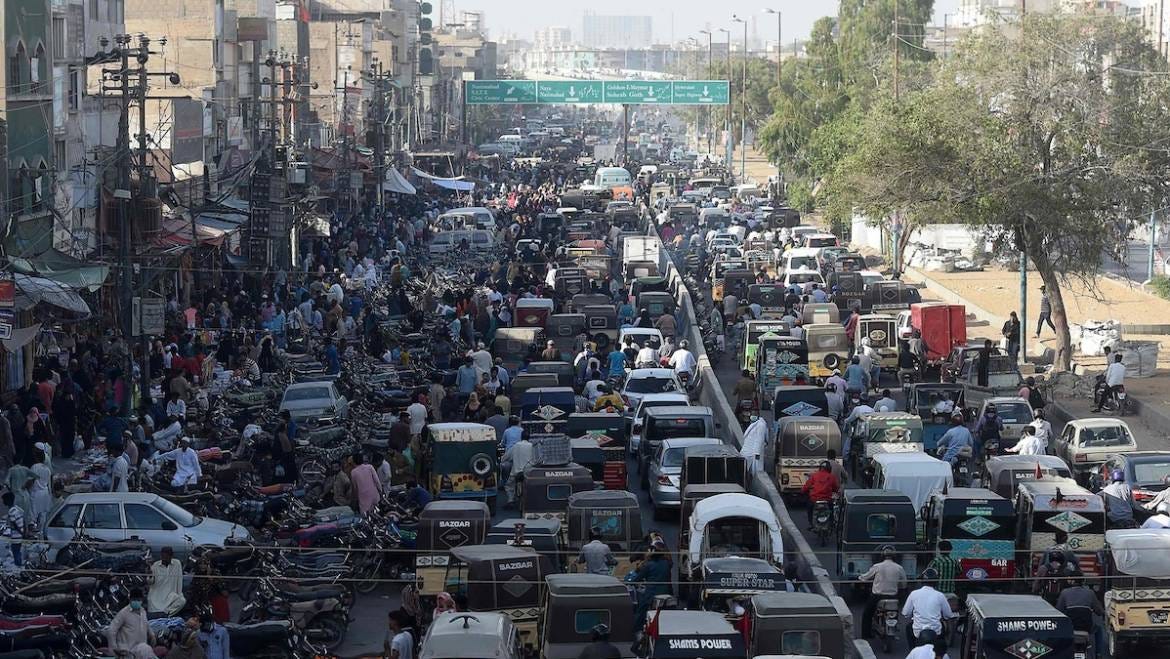
On the morning of March 10, 2026, Prime Minister Shehbaz Sharif appeared on national television to announce that Pakistan was in an energy emergency. The United States and Israel had struck Iran. The Strait of Hormuz, through which more than twenty percent of the world’s seaborne oil and sixty percent of Pakistan’s imported energy passes, had effectively closed. Two Pakistani-bound LNG carriers had turned back mid-transit on April 6 when Iranian authorities restricted passage. Petrol queues formed in Karachi. The government ordered a four-day workweek for public sector employees, closed markets at 8pm, grounded sixty percent of official vehicles, and cut fuel allowances for government departments by half. Schools were shut for two weeks. Then the prime minister addressed his cabinet and disclosed the number that made everything plain: Pakistan’s weekly oil import bill had surged from $300 million before the war to $800 million, a 167 percent increase, and the spike, he said, had “erased all the economic progress the country had made over the past two years.”
Two years of economic progress. Erased. By six weeks of a war Pakistan did not fight, in a strait Pakistan does not border, over a conflict Pakistan had no hand in starting. The prime minister delivered this as though it were an act of God, an external shock beyond any reasonable preparation. He did not explain why Pakistan, sixty-three years after drilling its first oil well, still imports more than sixty percent of its energy from the same chokepoint. He did not explain the eighteen-year gap between offshore exploration bid rounds. He did not explain the circular debt now sitting at Rs 4.9 trillion in the energy sector alone, or why the national gas utility curtails offtake from domestic producing fields while the country spends billions importing the same resource from abroad. He praised the Petroleum Minister, called the situation satisfactory, and moved to the next item on the cabinet agenda.
In April 2026, Pakistan’s monthly petroleum import bill hit $2.27 billion, the highest single-month figure in the country’s recorded history, surpassing the previous records set in 2008, 2022, and 2013. Crude oil imports alone reached $1.187 billion, nearly double the $533.9 million recorded in April 2025. Pakistan imported zero LNG that month. Not reduced LNG. Zero. The Ras Laffan complex in Qatar, source of much of Pakistan’s gas, had declared force majeure after Iranian strikes. The Strait was closed or restricted. Two fully laden Qatari LNG carriers, one managed by a UK company, the other owned by Qatar’s national gas shipping company, aborted their Hormuz transits on April 6, both signalling Port Qasim as destination before turning back.
Pakistan’s access to the strait during the crisis was not a function of diplomacy or contract. It was a function of Iranian discretion. Tehran permitted what it called “non-hostile vessels” to transit after coordinating with Iranian authorities. Pakistan negotiated access for twenty ships. Access contingent on the goodwill of a country at war is not energy security. It is managed helplessness given a formal name.
For the first ten months of fiscal year 2025-26, the petroleum import bill reached $13.517 billion, a two percent increase year-on-year even before the crisis peaked. Finance Minister Muhammad Aurangzeb confirmed in a written reply to the National Assembly in May 2026 that petroleum imports accounted for 22.2 percent of Pakistan’s total import bill during July-March of the current fiscal year. One in every four and a half dollars Pakistan spends on imports goes to petroleum. The government simultaneously collected Rs 1.342 trillion through the petroleum levy in the same period: taxing the import it has declined to replace.
The history begins sixty-three years before the queues in Karachi. The first offshore well in Pakistan’s territorial waters was drilled in 1963. It was dry. Between 1963 and 2019, seventeen more offshore wells followed. None produced commercially viable hydrocarbons. Pakistan’s last major offshore attempt before the current initiative was the Kekra-1 well in 2019, an ultra-deepwater joint venture among ENI, ExxonMobil, OGDCL, and Pakistan Petroleum Limited, drilled 230 kilometres southwest of Karachi at a cost of $100 million. The well had a pre-drill prospective resource estimate of 1.5 billion barrels of oil equivalent, which Rystad Energy listed as one of the most exciting exploration wells of the year globally. OGDCL’s own spokesman said the chances of success were between thirteen and fifteen percent, “fairly good” by exploration standards. Prime Minister Imran Khan had already told the nation, in March 2019, that Pakistan would not need to import oil if the Kekra reserves came in as hoped.
The well was drilled to 5,500 metres and found nothing. It was plugged and abandoned. Imran Khan said nothing. Pakistan’s offshore exploration went dormant. The next bid round did not come for eighteen years.
The Offshore Bid Round 2025, launched in January of that year and completing final contract signings in May 2026, offered forty blocks across the Arabian Sea. Bids were submitted for twenty-three, covering roughly 53,510 square kilometres. The Petroleum Ministry described it as “one of the most ambitious upstream energy initiatives launched in Pakistan in recent years.” The ministry did not explain what had happened to the previous ambitions of 2005, or 1989, or 1978, or 1963, all years in which offshore wells were drilled and dry holes recorded. Offshore exploration in the country had remained largely dormant since the early 2000s, according to the ministry’s own acknowledgment, because of high drilling costs, technical challenges, security concerns, and inconsistent investor interest. Not one of those conditions was new in 2025. All of them had been true for four decades and all of them reflected choices about where to invest institutional energy and public capital.
The total committed investment for the Phase-I work programme across all twenty-three blocks amounts to roughly $80 million in geological and geophysical studies. Pakistan’s petroleum import bill in April 2026 alone was $2.27 billion, a single month’s figure that broke every record in the country’s history. The $80 million is not a down payment on energy sovereignty. It is the geology homework that should have been completed in the 1990s, now being done because the alternative became undeniable when the petrol queues formed in Karachi and two LNG carriers turned back at Hormuz.
OGDCL was established in 1961, built with a $30 million Soviet loan and Soviet technical assistance. It found its first commercial oil field at Toot in Punjab in 1964. For sixty years since, the institutional structure existed: the company, the regulatory framework, the exploration licences, the seismic acquisition capacity. By September 2025, OGDCL had reported five new onshore discoveries and drilled fifteen wells for the year. The company’s board also reported something less celebrated: production could have reached 32,709 barrels per day of oil and 743 million standard cubic feet per day of gas during the period, but actual output was 30,919 barrels per day of oil and 652 million standard cubic feet of gas. The difference was not geological. Sui Northern Gas Pipelines Limited had curtailed offtake from the Nashpa, Qadirpur, and Bettani fields, and reduced demand from the Uch Power plant had limited output from Uch Field.
The resource was in the ground. The gas utility would not take it.
That curtailment, placed next to a $13.5 billion annual petroleum import bill, is not a technical footnote. It is the story of Pakistan’s energy governance compressed into one sentence: a country that pays hundreds of millions of dollars a month to import hydrocarbons is simultaneously leaving domestic hydrocarbons in the ground because the state utility cannot manage the financial and contractual obligations that would require it to take them.
The reasons for SNGPL’s inability are not obscure. The circular debt across Pakistan’s oil, gas, and power sectors crossed Rs 4.9 trillion as of December 2024, according to the biannual performance report reviewed by the Cabinet Committee on State-Owned Enterprises, chaired by Finance Minister Aurangzeb. State-owned enterprises in the energy sector were posting Rs 1.9 billion in daily losses. The government had injected more than Rs 600 billion in fiscal support during the six months between July and December 2024, equivalent to nearly ten percent of total revenue receipts for the same period. That Rs 600 billion was not investment in exploration or production capacity. It was debt service on the consequences of not planning, paid by the exchequer while the import bill accumulated separately on the external account.
The circular debt is not new. It has been building since the 1990s, when successive governments entered long-term power purchase agreements with independent power producers based on imported fuel, denominated in dollars, with guaranteed capacity payments regardless of whether the power was dispatched. The Bhutto government signed contracts. The Nawaz government signed contracts. The Musharraf-era government signed contracts. The PTI government inherited Rs 1.6 trillion in circular debt in August 2018 and left Rs 1.6 trillion more when it departed in April 2022. The PDM coalition that followed added Rs 1.7 trillion more before handing the same system to a caretaker government and then, effectively, to itself again. By January 2024, the gas sector alone accounted for Rs 3.022 trillion of the total circular debt, according to Business Recorder’s reporting on that year’s IMF consultations.
When Pakistan adopted its petroleum governance framework, it adopted the extraction model: a state company, licensed concessions, production-sharing agreements with foreign operators, and regulatory structures borrowed from the Anglo-American petroleum law tradition. That model was designed to extract a resource and pay royalties. It was not designed to build domestic refining capacity, domestic technical expertise in subsurface modelling or deepwater drilling, or the kind of long-term institutional investment in data quality that separates countries that find oil from countries that drill dry holes for sixty years.
Pakistan has been asking the royalty question. It should have been asking the sovereignty question since 1947, and intermittently had the capacity to do so. The onshore basins of Sindh, Balochistan, KP, and Punjab are not the Permian. But they are not empty either. Proven oil reserves climbed to 243 million barrels in the year ended June 2024, up from 193 million a year earlier, and the increase came not from a single discovery but from redefined reserve estimates in existing fields: Pasakhi, Thora, Sono, Rajian, Bolan East, Kal, and Kunar all recorded substantial increases. That the reserve base grew by fifty million barrels in one year through better estimation of known fields is not a triumph. It is evidence that the previous estimates were poor, that the data infrastructure was inadequate, and that Pakistan had been drilling and operating in formations it did not fully understand.
The LNG experiment, chosen over accelerated domestic exploration in 2013, closed the trap. When gas shortages began biting seriously during the second Nawaz Sharif government, the administration chose to build import terminals and sign long-term LNG purchase agreements rather than commit to the decade-long investment cycle that serious onshore exploration required. The logic was speed: LNG could flow within two or three years; new domestic exploration might take a decade. The LNG infrastructure was built. The exploration calendar slipped further. Pakistan then found itself in 2026 unable to import a single LNG cargo in April because the export infrastructure of its primary supplier was under bombardment and the transit route was controlled by a country at war. The decade skipped in 2013 is now the decade being attempted in 2025, with the external debt position $130 billion deeper and the fiscal space for exploration capital narrower than it has ever been.
The most recent onshore results offer a genuine data point that deserves honest accounting. In January 2026, OGDCL’s Baragzai X-01 well in Kohat district produced 4,100 barrels of oil per day and 10.5 million standard cubic feet of gas per day from the Datta Formation, the first such discovery from that formation in the area. The same well subsequently yielded 3,100 barrels per day and 8.15 million standard cubic feet from the Samana Suk and Shinawari formations, then a further discovery from the Kingriali and Lumshiwal formations. Multiple formation discoveries from a single exploratory well are significant, and the Nashpa Block in Kohat has become the most productive new exploration area in Pakistan in recent years. OGDCL also spud four wells in the six months ended December 2024 and secured seven new exploration blocks in the latest onshore bid round. A shale programme, previously limited to a single test well, is being expanded to five or six wells in 2026-27, with estimated production of three to four million standard cubic feet per day per well if successful.
These are real results. The piece does not deny them. Baragzai X-01 at peak production adds approximately fourteen to fifteen percent to Pakistan’s domestic crude output, according to analyst estimates. The country’s domestic oil production runs to roughly 56,000 barrels per day against total demand of around 500,000 barrels per day. Domestic production covers roughly eleven percent of consumption. The April 2026 record import bill arrived in the same month that multiple Baragzai discoveries were being announced and celebrated as milestones.
The shale programme is being launched in 2026-27. Pakistan does not have the established technical capacity for unconventional extraction at scale. The specialized drilling and completion techniques, the subsurface data density required to optimize multi-well unconventional programmes, and the experienced workforce to execute them: these take years to build. Pakistan is attempting to acquire this capacity now, at the moment when the energy import bill is most crushing, when the circular debt is deepest, and when every rupee of exploration capital competes with debt service, IMF quarterly reviews, and the $800-million-a-week emergency of a war nobody in Islamabad planned for.
There is a detail in the current crisis that fits nowhere in the government’s public framing and should not be allowed to pass without record. In May 2026, Pakistan Today reported that smuggled Iranian petroleum products had again begun entering Pakistan’s market in larger volumes, following the Hormuz disruption and the spike in global prices. According to that report, roughly 5,000 tonnes of high-speed diesel are currently being smuggled into Pakistan each day, against total domestic demand of 22,000 tonnes: twenty-three percent of national diesel consumption is arriving through informal channels from across a border with a country whose energy infrastructure was just bombed. The Balochistan government is reported to have publicly suggested allowing the sale of smuggled Iranian diesel in the province at Rs 280 per litre. The government is losing an estimated Rs 475 million per day in petroleum levy and customs duty on these volumes.
Pakistan is covering nearly a quarter of its diesel demand with fuel it cannot officially acknowledge, from a country it is simultaneously attempting to mediate for, brought across a border it has never controlled, because the formal supply chain failed. The government collected Rs 1.342 trillion in petroleum levy between July 2025 and April 2026. A quarter of the diesel that kept trucks and tractors and generators running in those months came through Balochistan on roads the state does not govern.
Imran Khan is not in power. He is in Rawalpindi Central Prison. The government that replaced him signed the LNG deals of 2013. The government before that let offshore exploration lapse after the 2005 Shell dry hole. The government before that signed the IPP contracts of the 1990s. What they share is not ideology or party. What they share is the preference for arrangements that produce immediate revenue, maintain foreign creditor confidence, and defer the institutional work that building domestic energy capacity requires. The IMF programme, now in its thirteenth arrangement since 1958, has never had a conditionality clause requiring Pakistan to expand domestic exploration at a defined rate. The Gulf deposits that have repeatedly provided liquidity cushion to the State Bank have never been contingent on Pakistan reducing its import dependence. The system as constructed rewards managed dependency and penalises the long investment horizons that energy sovereignty demands.
The queues at the petrol stations in Karachi in March 2026 were not a surprise. Every analyst who tracks Pakistan’s energy sector knew that a Hormuz disruption of any duration would produce exactly this: a government scrambling for Iranian transit permissions, emergency austerity that shuts markets and schools, a prime minister on television announcing that years of economic progress had been undone in weeks, and an import bill breaking records set in 2008 while domestic exploration operates on a five-to-six-well shale pilot programme. The only people for whom it was a surprise appear to have been the governments that created the exposure.
The question the evidence raises, and cannot yet answer, is whether the 2025 offshore bid round and the expanded OGDCL exploration programme represent a genuine institutional shift, a decision by the planning apparatus to treat energy sovereignty as a multi-decade project requiring sustained capital and technical investment regardless of which government is in office, or whether they are the latest iteration of announcements made when the crisis is acute, celebrated as milestones, and then quietly deprioritised when oil prices ease, the IMF tranche arrives, and the Gulf deposits are renewed. The answer will not come from press releases. It will come from whether SNGPL stops curtailing offtake from Nashpa and Qadirpur, whether the shale programme survives the next budget cycle, and whether the offshore bid round of 2025 is followed by another in 2027 rather than 2043. Every previous government made the same choice at the same moment. The architecture of the choice has not changed.


