Pakistan's Economy Stabilized. The People Didn’t.
The country avoided default. Thirty million more Pakistanis fell below the poverty line. Both things happened at the same time.
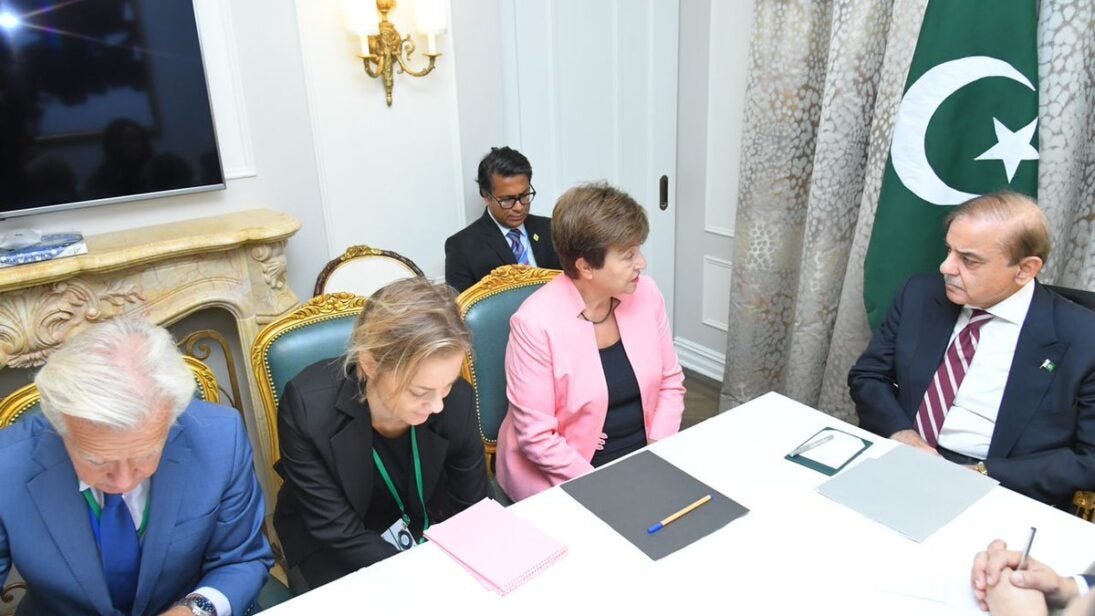
On Thursday, February 19, Julie Kozack stood at the IMF’s weekly press briefing in Washington and said what Pakistan’s government had been waiting to hear. The Fund’s Director of Communications confirmed that Pakistan’s policy efforts under the Extended Fund Facility had, in her words, “helped stabilise the economy and rebuild confidence.” She noted a primary fiscal surplus of 1.3% of GDP. She cited the first current account surplus in fourteen years. She confirmed that an IMF staff team would arrive in Islamabad on February 25 to begin the third review of Pakistan’s $7 billion programme, with roughly $1 billion in fresh disbursements on the table if the visit goes smoothly.
It was a good statement. Carefully worded, factually grounded, and delivered with the measured optimism the Fund reserves for programmes it considers to be on track.
Somewhere in Islamabad, a ministry official forwarded the quote to his WhatsApp group with three fire emojis.
On a plastic stool outside a dhaba off Karachi’s Tariq Road, a chai wala who has watched the price of milk nearly double in three years, whose gas canister now costs more than half a day’s earnings, and whose two sons are filling out Gulf visa forms, had no comment. He was busy.
Outside a tandoor near Lahore’s Ichhra Bazaar, a roti wala who has raised his price from twelve rupees to twenty-two in eighteen months, who buys flour in smaller quantities now because he cannot afford to stock up the way he used to, and who recently let go of the young boy who used to help him stack the bread because the margin no longer stretched that far, had no comment either. He was pulling the next batch out of the fire.
In Peshawar’s Qissa Khwani Bazaar, a dry fruit vendor who has watched his sales cut in half as customers who once bought a kilogram now ask for two hundred grams and apologise while doing it, who has not taken a day off in four months because every closed day is money he cannot recover, and whose regular customers increasingly pay on credit they are slower and slower to settle, shrugged when asked about the IMF review. He did not know what the IMF was. He knew what flour cost.
At a roadside tyre repair shop on Quetta’s Sariab Road, a puncture wala who has seen the cost of every tool, every patch, every canister of compressed air go up while the men who stop for repairs negotiate harder than they ever did before because they too have less, and whose landlord just raised the monthly rent by three thousand rupees citing inflation, had one thing to say when told Pakistan had posted a current account surplus: “Kaunsa account?”
The country has quietly split into two versions of itself, and they no longer recognize each other.
One Pakistan lives in quarterly reports and conference calls. It has a primary surplus, easing inflation, and improving reserve coverage. It speaks fluent IMF. It is, by the metrics that Washington tracks, performing adequately. The numbers are real. Someone worked very hard to produce them.
The other Pakistan lives in the streets outside. It has a poverty rate of 29%, the worst in eleven years. Unemployment is at its highest in two decades. Nearly a third of children under five are stunted from chronic malnutrition, not from some abstract shortage of food, but from the very concrete reality that their parents cannot afford enough of it on what they earn. Its brightest young people, engineers, doctors, IT graduates, are leaving in numbers that have turned international departure gates into a kind of slow national funeral. When people with options are choosing to leave, that is not a brain drain. That is a verdict.
These are not contradictions. They are the same country, seen by two different people standing at two very different distances.
The IMF’s headline achievement in Pakistan is the primary fiscal surplus. Kozack cited it specifically. It sounds like responsibility. It sounds like discipline. In another country, with a growing economy and a broad tax base, it might be.
Here, it was built by slashing development budgets, choking off imports until factories had nothing to work with, and holding interest rates so punishingly high that a small business owner trying to borrow money was effectively being told: don’t bother. At its peak, the policy rate sat above 22%. The corner shop owner, the small manufacturer in Faisalabad, the trader in Quetta’s Liaquat Bazaar, credit was not for them. It existed on paper, at a price that made it unreachable.
Think of it this way. If a family stops buying groceries, stops fixing the roof, pulls the children out of school to save on fees, and then announces it has saved money this month, technically it has. That is what a surplus manufactured through austerity looks like from the inside. The government balanced its books. The people paid for it.
Before a single government salary is paid, before a school gets its annual budget, before a public hospital sees a rupee, more than half of every rupee Pakistan collects in taxes has already left the building. It has gone to debt servicing. Gone before the working day begins.
Pakistan’s total debt stands at 71.4% of GDP, comfortably above the 60% ceiling its own Parliament once legislated as the legal limit. That ceiling was crossed so many times by so many governments of every political colour that nobody bothers mentioning it anymore. It has become a historical relic, like a speed limit sign in a city where everyone drives as fast as they want and nobody gets a ticket.
The current IMF programme adds to that pile. Seven billion dollars over 37 months, released in tranches, each tranche requiring Pakistan to satisfy an expanding list of conditions. Over the last 18 months, the Fund has attached 64 separate conditions to this programme. Pakistan missed 11 of them before the last review. Waivers were quietly granted, replacement targets were negotiated, and the money was released. Nobody held a press conference about the missed targets. The headline was about the disbursement.
This is how the treadmill works. Pakistan has been on it since 1958, 24 IMF programmes and counting, each one stabilizing the country just enough to qualify for the next one. Not once has a programme ended with Pakistan no longer needing another programme.
It would be naive to read the IMF’s warm tone toward Pakistan without asking who the Fund ultimately answers to.
The United States is its largest shareholder. American foreign policy does not dictate Fund decisions through phone calls or explicit instructions, but it shapes the institutional atmosphere in ways that are real and historically documented. Right now, Washington needs Pakistan to remain functional and cooperative. The Shahbaz Sharif government has positioned itself carefully under the second Trump administration, offering counterterrorism cooperation, signalling openness to minerals discussions, and providing the kind of regional utility that keeps a country on the right side of Washington’s attention.
This dynamic has played out before. After 2001, IMF pressure on Pakistan eased almost overnight. During the FATF grey-listing years, the financial consequences were considerably more manageable than the rules suggested they should be. When a country is geopolitically convenient, multilateral lenders tend to find reasons to be patient. Pakistan is not being reviewed in a clinical vacuum. It is being reviewed by an institution whose most powerful member currently finds Pakistani stability strategically useful.
The Disease No Quarterly Review Can Diagnose
Twenty-four IMF programmes since 1958. The same country. The same structural failures. The same cycle of crisis, bailout, partial compliance, and return. At some point the question stops being about the programme and starts being about why the programme never permanently works.
The answer is not complicated, even if it is politically uncomfortable. Pakistan’s wealthiest people and most powerful institutions do not pay taxes that reflect their actual wealth. Agricultural income, concentrated in landholdings controlled by the same families whose members sit in Parliament and pass the budget, is functionally untaxed. Real estate and retail, dominated by capital that has grown comfortable with informality over generations, resist every formalisation effort with remarkable effectiveness. The military’s commercial empire, built across decades, operates in a fiscal space that civilian administrations have lacked either the authority or the nerve to enter.
The IMF’s own governance diagnostic, published this month as a condition for receiving the last disbursement, acknowledged all of this in careful institutional language. It called for simplifying tax policy design. That is bureaucratic language for: the tax system has been deliberately made complex to protect people with enough influence to get exemptions written into law. It called for levelling the playing field in public procurement. That is language for: contracts go to the connected, not the competent. It called for asset declaration transparency. That is language for: the people managing this country’s finances are not required to explain where their personal wealth came from.
The report was published. It will be cited approvingly at the February 25 review as proof of institutional progress. The people it implicates will return to their offices, close the door, and continue as before.
Economies are not made of numbers. They are made of decisions. Millions of small, daily, private decisions by people trying to get through the week.
The decision of a family in Faisalabad to pull their daughter out of school because the fees, on top of the electricity bill, on top of the gas, have become genuinely impossible. The decision of a factory owner in Sialkot to freeze hiring because the cost of borrowing makes expansion a gamble he cannot afford to lose. The decision of a 27-year-old software developer in Lahore to submit his Canadian work permit application, not because he wants to leave, but because he has done the maths repeatedly and the maths keep coming out the same way. The decision of the roti wala in Ichhra to let the young helper go because the numbers stopped adding up the week the flour price jumped again.
None of these decisions appear in Kozack’s press briefing. None of them are captured in a primary surplus figure. All of them are the economy.
Pakistan’s investment rate has fallen to 13.1% of GDP, the lowest in fifty years. That number is the sum of all those individual decisions not to invest, not to expand, not to bet on what comes next. It is, in the most direct economic sense, a national vote of no confidence, cast not at a ballot box but through behaviour, which is the most honest vote there is.
The IMF is not wrong that Pakistan has stabilised. It would be dishonest to pretend otherwise. The catastrophic default that looked plausible three years ago has been avoided. The rupee has not collapsed. The country has made its external debt payments on time. These are real achievements and they matter, particularly to the people who would have been hurt most by a full sovereign default.
But stabilization is not the destination. It is the minimum condition for being allowed to begin the journey. And Pakistan, after two years of painful austerity and 24 lifetime IMF programmes, is still standing at the trailhead arguing about whether to start walking.
What the country actually needs has been known for decades and attempted never. A tax system that reaches the wealthy rather than crushing the salaried middle class. Public institutions that function on competence rather than connection. An investment climate that makes a factory owner in Karachi feel safer betting on Pakistan than on a flat in Dubai. A political culture in which the rules apply to everyone, including the people who write them.
None of that is on the February 25 agenda. The agenda has performance criteria, structural benchmarks, and disbursement schedules. All of those things are real and necessary. None of them are sufficient.
So when the headlines arrive next week, when the reviews go smoothly and the money is approved and the officials on both sides say the right things at the right cameras, allow yourself two reactions at once. Genuine relief that the floor held. And a refusal, clear-eyed and stubborn, to mistake the floor for the ceiling.
The IMF has confirmed Pakistan is stable. The chai wala on Tariq Road, the roti wala in Ichhra, the dry fruit vendor in Qissa Khwani, and the puncture wala on Sariab Road are all still waiting for the part where stable starts to mean something in their lives.