
The coalition produced by the disputed 2024 election wants to rewrite Pakistan’s rules before the country has settled whether that coalition won the right to govern.
Form 45 is the scorecard of a Pakistani election. At every polling station, officials count the votes in front of candidates’ agents, record the result on that sheet and sign it. Every constituency result must be built from those signed numbers. A voter may never hold the page, but on February 8, 2024, it carried the simplest promise a democracy can make: your vote will be counted as it was cast.
Pakistan failed that test. Mobile service was suspended across the country, the electronic results system failed, FAFEN observers did not receive copies of Form 45 at 28.4 per cent of the polling stations they observed, and the form was not displayed outside 29.4 per cent of observed stations. Discrepancies appeared between polling-station records and consolidated results in contested constituencies. The Commonwealth Observer Group later found an unlevel playing field and institutional decisions that damaged the election’s credibility, transparency and inclusiveness. PTI-backed independents still won the largest bloc in the National Assembly, and yet a PML-N-led coalition formed the federal government that now wants to redesign the state.
Nearly 60 million Pakistanis did their duty. They stood in line, cast their ballots, collected and photographed result sheets, waited through the communications blackout and then watched the political arrangement form somewhere beyond their reach. The beneficiaries of that arrangement are now asking the same people to trust them with new provinces, new fiscal rules, a possible presidential model and another constitutional package whose text they have not published. Before you allow a team to rewrite the rules of the contest, you ask how it took the field. Pakistanis are entitled to ask the same question.
On August 21, the Election Commission agreed in principle to Punjab’s proposal to hold local-government elections between December 15 and January 15. The dates are almost comically late for a province that has spent years speaking about taking government to the doorstep. Punjab said delimitation was complete, that it needed time, that examinations and fog had to be accommodated, and that it had approved Rs12.52 billion for the exercise. The Election Commission had to restate the constitutional point: Article 140-A requires elected local government. Its own annual report describes the familiar mechanism of delay: governments alter local-government laws after terms expire, then cite those changes as the reason elections cannot be held. The federal government declined the commission’s proposal to close that loophole in August.
The same week, Islamabad began debating a grander cure. Interior Minister Mohsin Naqvi called the existing governance structure collapsed and urged political parties to settle the creation of new provinces or administrative units. The next day, ISPR gave the proposal institutional weight. Its spokesman called the military a “primary stakeholder” in security, said good governance was required for national stability, asked whether four provinces could still serve 240 million to 250 million people and endorsed an “administrative reset” if politicians pursued it through constitutional means. New provinces, a changed National Finance Commission award, a stronger Article 140-A and a presidential system now fill political television, YouTube panels, X posts and diaspora WhatsApp groups. The frustration behind these proposals is real. Pakistan is too large, its provinces are too remote from many of their people, and a resident of Layyah, Khuzdar or Mirpurkhas knows that the state moves faster in Lahore, Islamabad and the cantonments. But no country is repaired by changing the formation while keeping the same selectors, the same patronage and the same refusal to accept the public’s verdict.
The promoters of constitutional redesign keep moving past the first test. A government that cannot conduct timely local elections under a duty already written into the Constitution has supplied no reason to believe it will surrender money, staff and decisions after it redraws the map. Its record points the other way: power travels upward, accountability arrives after the damage, and every failure becomes the sales pitch for another structure controlled by the people who ran the last one.
Pakistan needs reform, but reform has a scorecard: power must move closer to the citizen, public money must follow it and the voter must be able to remove the person who fails. A legitimate argument about distance, population and municipal failure becomes cover when authority moves towards the Centre while elected local institutions remain the last item on the timetable. Punjab’s proposed election window supplies the answer: the Constitution gives the instruction, the political class declines to obey it, and a resident whose complaint sits somewhere in a government portal still cannot find an elected person whose job depends on answering it.
ISPR did not publish a provincial map, endorse a presidential system or claim authority to write the amendment. Its public intervention was more consequential because it supplied the doctrine within which every option would be judged. Governance was defined as a condition of national security, the existing four-province federation was placed under review and the military identified itself as a stakeholder in the answer. Once an institution with command over coercive power declares the civilian structure relevant to security, its preference enters the room before any constitutional text does.
The language also disclosed what GHQ considers defective. The ISPR spokesman returned to the National Action Plan adopted after the 2014 Army Public School attack and argued that its fourteen-point agenda depended on good governance. He then connected Pakistan’s population to the number of provinces. The sequence turns an old democratic failure into a security calculation: provincial governments have failed to administer territory, their failure obstructs counterterrorism and a new territorial arrangement can therefore be justified as part of national stability. Parliament is formally left to choose the model, but it chooses after the institution has defined both the threat and the acceptable purpose of reform.
An unnamed senior government functionary later told Dawn that discussions inside the “power corridors” were considering three routes: new provinces, new administrative units or stronger local government. The same official said the creation of provinces could address federal problems produced by the 18th Amendment and suggested that local-government money could be sent directly by Islamabad instead of passing through provincial governments. That is the first reported mechanism linking the army-backed governance reset to the fiscal structure. New units would not only reduce the size of existing provinces. They could give the Centre more governments to bargain with, create new governors and administrative chains, weaken the four provincial blocs that currently receive constitutionally protected revenue and allow federal money to reach dependent local actors without passing through Lahore, Karachi, Peshawar or Quetta.
The exact design remains unconfirmed, so motive has to be separated from evidence. GHQ has publicly supported a review of the four-province structure. A government source has connected new provinces to the federal consequences of the 18th Amendment and floated direct federal funding for local bodies. No published military document proves that GHQ has chosen a presidential model, selected a number of provinces or prepared either draft now circulating online. The defensible conclusion is narrower and still serious: the army wants the territorial and administrative settlement reopened, regards the present provincial structure as a security problem and has placed its authority behind a debate that had previously survived as party manifestos, municipal grievances and constitutional rumour.
Pakistan has seen this method before. The military governments that took power in 1958, 1977 and 1999 all built local-government systems while national and provincial party politics were restricted. The instruments differed, but the political use was consistent: cultivate a dependent layer of local leadership, bypass provincial opponents and present controlled participation below as an answer to the absence of democracy above. Research on the 2000 Devolution Plan has found that the 1999 military regime needed a political constituency and transferred authority around the provinces while holding non-party local elections. The plan gave districts responsibilities, but the regime that designed it supplied no durable constitutional bargain with the political parties expected to sustain it.
That history does not discredit local government. It explains why the route matters. Elected councils with protected tenure, independent revenue and power over police, personnel and procurement would dilute control at both the federal and provincial levels. A federal channel that finances local figures from Islamabad while provincial parties are divided into smaller territories would produce the opposite dependency. Both arrangements can be marketed as devolution, and yet one makes the citizen stronger while the other gives the central state more doors through which to enter.
By the end of April 2026, election tribunals had decided 246 of the 374 petitions filed against the 2024 results. FAFEN found that 128 remained unresolved more than two years after polling day, although the Elections Act gives tribunals 180 days to decide a petition. Those pending cases covered seats whose occupants had already voted on budgets, laws and constitutional changes while the legal system still had not completed the promised examination of how they entered parliament.
Look at the delay from the voter’s side. You cast a ballot in February 2024. Your polling-station result is written on Form 45, and a returning officer later consolidates the constituency on Form 47. If those records conflict, the law gives you an election petition. When that petition remains undecided for two years while the returned candidate governs in your name, delay becomes a weapon against your vote. The state has neither rejected your evidence nor accepted it, and yet it has allowed the disputed officeholder to exercise the full power of a settled mandate.
The coalition points to notified results and the parliamentary arithmetic through which it formed a government. Notification gives it possession of office, but it cannot repair the broken chain between a marked ballot, the polling-station count and the power later exercised in parliament. The Commonwealth report found that restrictions consistently limited one political party, including the loss of its election symbol, and that failures in the results system widened the possibility of manipulation. The governing formula is brutally clear: occupy office, let the petitions age and call possession legitimacy.
The proposed governance overhaul therefore lands in a country where the people discussing how citizens should be represented have not resolved whether citizens were represented in the parliament doing the redesign. A government with disputed authority may still pass a lawful bill, but every permanent transfer of power carries the stain of the unanswered vote.
As of August 23, no draft of a 28th Constitutional Amendment has been published before parliament. Law Minister Azam Nazeer Tarar said in May that he saw no sign of one and that no final draft existed. Pakistanis are being asked to debate the largest possible changes to their political system without being shown an authenticated document. Claims that a settled government bill already creates a presidential system, abolishes the National Assembly or divides Pakistan into a fixed number of provinces are therefore unsupported.
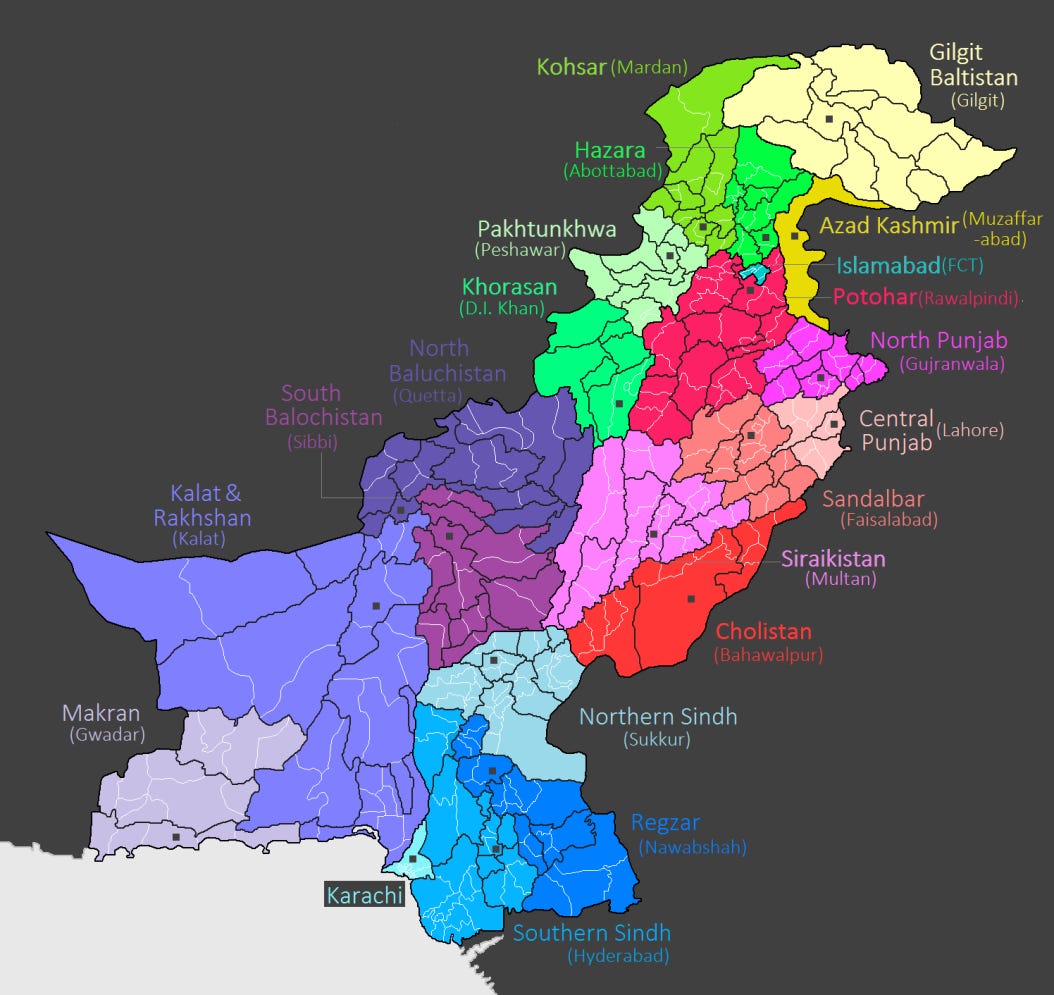
Rumour can still prepare the public for a transfer of power. Minute Mirror reported on August 19 that two documents were circulating in federal circles. One proposed thirty-two provinces and thirty-three high courts, claimed that more than 40,000 government posts could be abolished and projected annual savings of Rs318 billion. The second proposed twenty provinces and two federal units, a directly elected president, abolition of the National Assembly, chief ministers serving in the federal cabinet, governors empowered to remove chief ministers with presidential approval and district nazims placed above deputy commissioners and district police officers. None of these provisions has been authenticated through a parliamentary record, an official publication or named government authorship. They belong in the article because they show the structure being imagined around the official call for a reset, not because they prove what the final amendment will contain.
The drafts spread because each attaches a genuine public grievance to a transfer of power. Karachi residents see a provincial government that collects from the city and denies its elected mayor adequate authority. South Punjab sees development and administration concentrated in Lahore. Hazara has a long political demand for provincial status. Balochistan’s distances make administration from Quetta punishingly remote. A presidential draft can collect every grievance, promise a closer government and then place chief ministers inside a federal cabinet while governors retain the power to remove them. The citizen is offered proximity, but the Centre receives command.
The scale of the online response shows how quickly the absence of a text has become part of the mechanism. A May video asking whether the proposed amendment would shift power towards the army chief or create a new system drew more than 60,000 views. Another discussion of the NFC, Article 140-A and the 18th Amendment drew more than 64,000. On Reddit, Pakistanis examining the August draft focused less on the number of provinces than on who would control them: one commenter asked what purpose a province served if its chief minister answered to the president, another compared the proposal to the presidential rule and “Basic Democracies” of the 1960s, while others argued that dividing provinces would break the territorial strongholds of PTI and PPP and open space for establishment-backed parties. These comments are public suspicion, not proof of a military plan. Their value lies in the institutional questions the rumours have forced into view.
The same social discussion contains a real constituency for smaller provinces. Contributors point to the gap between Karachi and rural Sindh, between central Punjab and Rajanpur, and between former FATA and the rest of Khyber Pakhtunkhwa. They argue that new provinces would gain Senate representation, receive NFC allocations and force political parties to compete in regions ignored by existing provincial capitals. That case cannot be dismissed because the army has entered the debate. It must instead be protected from the army’s preferred method: a constitutional package prepared outside public view, enacted by a parliament carrying unresolved election petitions and designed before citizens know where authority, money and coercive power will sit.
Named reporting by Dawn in May found that discussions around a possible package included the National Finance Commission award, constitutional protection for local government and the possible return of curriculum, population welfare, mines and minerals to the federal government. Article 160(3A), inserted through the 18th Amendment, prevents a province’s share of the divisible pool from falling below the previous award. The Planning Ministry has since supplied the fiscal case in official figures: about Rs8.2 trillion of federal revenue passes to the provinces, nearly half of federal expenditure goes to debt servicing, about a quarter goes to defence and the Centre faces expenditure of roughly Rs17.5 trillion. The government presents the imbalance as an alignment problem between resources and responsibilities. The protected claims above are left intact while the constitutional share below becomes the object of reform.
The interior minister says more units would bring facilities closer to citizens. Put that claim through a performance test. Participants at an August 12 policy discussion, including representatives of the major parties, said new provinces would not solve a service-delivery failure if political, administrative and financial power remained trapped above the local level. PTI’s Salman Akram Raja noted that even a divided Punjab would still leave provinces of about 40 million people. If power stops at the provincial capital, a smaller province only shortens the distance between one ruling elite and another government building.
Pakistan already has a constitutional route from a provincial capital to a street. Article 140-A requires every province to establish local government and devolve political, administrative and financial responsibility to elected representatives. Article 32 directs the state to encourage local institutions with representation for peasants, workers and women. Both provisions can operate without a new presidential system or years of constitutional suspense, but they require provincial and federal rulers to give up a measure of control over contracts, land, postings, development funds and the daily patronage through which political power is maintained.
Real local power is measured in responsibility. A mayor with a protected term, a known budget and authority over sanitation can be judged by the people living beside an overflowing drain; a parent can ask why the school gate stayed shut and a shopkeeper can demand the name behind a garbage contract, while a provincial minister protected by distance can always say the file is elsewhere. Democracy begins when authority and accountability stand in the same place.
The government did not need a draft amendment to pass the laws it considered urgent. On August 20, the National Assembly passed the National Command Authority Amendment Bill 2026 and the Defence Forces of Pakistan Bill 2026. The official explanation for the NCA legislation says it brings the 2010 act into line with the 27th Constitutional Amendment. The Defence Forces bill formalises an integrated command arrangement across the services after the 27th Amendment’s changes to Article 243.
Parliament found time to enact the legal architecture of military command while the elected tier closest to ordinary Pakistanis remained delayed. The state left no ambiguity around a command structure it considered important, and yet it treated municipal representation already required by the Constitution as negotiable. Governments always find time for the institutions they fear and money for the institutions they protect. The citizen is told to wait.
Pakistan’s governance crisis includes the civilian-versus-military struggle and the performance of every protected institution receiving public resources and legal insulation. A sanitation worker, a parent at a public school and a woman waiting outside a basic health unit encounter that performance through a missing teacher, a medicine counter without stock, a road that takes a season to repair and a local official who cannot decide anything without a call to the provincial capital. In Rawalpindi, water projects once handled by the district council are now being routed through tehsil councils and WASA under Punjab’s new local-government system, but for the household, the agency holding the file matters less than whether water comes through the tap.
The leadership asking citizens to trust another redesign must answer for the system it already controls. A speech about devolution means nothing when the election that makes devolution real is postponed, because leadership is judged by the institution it builds and the power it is willing to give away.
Pakistan’s fiscal record gives the governance discussion its material meaning. The federal government’s own Budget in Brief puts FY2026-27 current expenditure at Rs17.495 trillion. It assigns Rs8.054 trillion to interest payments and Rs3.001 trillion to defence affairs and services. Federal health affairs and services receive Rs23.796 billion; education affairs and services receive Rs117.748 billion. Provincial budgets carry much of Pakistan’s health and education spending, so the federal lines cannot describe every clinic or school, but they establish the order in which the federal state meets its obligations.
Debt and defence absorb the largest claims before a government department asks why a dispensary has no doctor. The Centre then says provincial transfers leave it too little fiscal space and directs public anger towards the National Finance Commission. Taking more from the provinces that run schools, hospitals and local infrastructure would leave the federation’s protected claims untouched. The ruling order refuses to cut privilege, so it cuts the distance between its hand and the public purse.
The real constitution is experienced at the kitchen table. A family pays tax through electricity, petrol, mobile use and every formal purchase; it pays again for private tutoring when the school fails, a water tanker when the tap fails, a clinic when the basic health unit fails and a generator or battery when the grid fails. Pakistanis finance the state and then privately replace it. They are asked for sacrifice while debt, defence and administrative continuity remain protected, and yet the same ruling class tells them that a new provincial boundary or a new title for the executive will cure the failure.
The IMF’s April review of Pakistan’s programme asked for fiscal consolidation while committing the authorities to improve the coverage and generosity of Benazir Income Support Programme payments and health and education expenditure. Judge any reform by where the rupee goes. If a package gives the Centre a larger share of the divisible pool, transfers more subjects out of provincial hands and leaves local bodies without secure resources, it pushes the person at the bottom farther from the decision that determines her school, clinic and water supply. A system that demands taxes but denies representation has abandoned public purpose.
The 18th Amendment transferred authority from Islamabad to the provinces, but the provinces stopped the transfer before it reached the citizen. They failed to raise enough own-source revenue, allowed local bodies to decay and reproduced the Centre’s habits in smaller capitals. Sindh, Punjab, Khyber Pakhtunkhwa and Balochistan all concentrate contracts and authority. A provincial government that demands autonomy from Islamabad while denying it to its cities and districts is defending its own little ruling order.
Pakistan is being offered a false tactical debate between preserving large provinces and creating smaller ones. The Constitution already provides a route through regular local elections, protected tenure, direct fiscal authority, transparent municipal procurement and representatives who can be removed by the people using the service. That route threatens the patronage system because it takes development money away from provincial favourites and gives citizens a person they can judge. Merit frightens every order built on selection from above.
Punjab supplies the performance record. The Election Commission says local polls should be held within 120 days of the expiry of a local government’s term. Punjab has proposed a window stretching into January 2027 and sought phased polling. Examinations, fog and logistics can be managed by a serious administration; the province’s record of redesigning the local-government framework, dissolving or delaying elected bodies and placing administrators where voters should be shows a political choice. Enforceable dates, independent finances and consequences for delay are the only meaningful answer.
On August 23, Punjab’s Local Government and Community Development Department approved a Rs3.22 billion annual budget for the Local Government Board. Of that amount, Rs1.5 billion was assigned to pensions, Rs753 million to employee salaries and Rs60 million to the families of deceased employees. These are legitimate obligations and the board budget is not the full account of municipal spending, but the sequence is instructive: the administrative body has a budget, officers and payroll while the public is still waiting for the elected councils that are supposed to direct local power, so the machinery exists before the representation it was built to serve.
New units should face the same test. A Saraiki province, Hazara province or metropolitan authority could answer real demands for recognition and representation, but if its chief secretary answers upward, its development budget depends on discretionary releases and its local council can be dissolved when it becomes inconvenient, the citizen receives another layer of letterhead. The machinery changes its stationery while the woman carrying water home and the shopkeeper sweeping sewage from his threshold remain outside the decision.
The presidential-system argument gives Pakistan a large constitutional drama while protecting the institution that already holds decisive power. Pakistan tried presidential and quasi-presidential arrangements under military rule. The 1973 Constitution adopted parliamentarism after concentrated authority helped break the country apart. Replacing a prime minister with a president cannot make power accountable when the forces that select, remove and constrain civilian leaders remain beyond the public vote.
The proposal has acquired force because the parliamentary order is discredited. The public sees legislators exercise a mandate while 128 election petitions remain unresolved, coalition partners object before voting with the government and parties praise democracy while avoiding local elections. People naturally look for one leader they can elect directly and dismiss directly. But a captain can be held responsible only when the team is chosen on merit, the rules apply equally and the result is honoured. Concentrating authority in one civilian office while the real selectors remain unaccountable produces another face for the same system.
A directly elected president cannot rescue a state when the budget, appointments, security policy and legal immunities that shape power sit outside meaningful public control. The office would give citizens a clearer target for anger while leaving them without a ward councillor, a working clinic or an enforceable right to see where the municipal budget went. Pakistan has powerful offices and weak restraints; it needs independent institutions strong enough to make every office obey the law.
Pakistanis should impose a simple standard on anyone asking them to replace the system. Publish the text, identify every article to be changed, state which tier will lose or gain money, specify what percentage of the budget must reach elected local bodies, disclose the transition cost, accept an election calendar that cannot be revised for provincial convenience and put the rules for procurement, audit and removal of administrators inside the bill. A leader confident in his plan shows the plan and accepts the test, while a demand for more power with no accounting deserves no trust.
Pakistan needs administrative reform because its population, service failures and regional disparities have made the present arrangement indefensible. New provinces can form part of a democratic settlement where people demand them and constitutional procedure is respected. Strong local government is overdue, and the National Finance Commission can be debated openly. But constitutional change earns legitimacy through a transfer of authority, money and accountability to the people who live with its consequences. It cannot begin with another settlement among those already in power.
Corruption begins when public purpose disappears from the design. The state treats citizens as a revenue source and service delivery as a slogan, a province delays the election required to give people a say over their own streets, and the Centre seeks fiscal relief from the bottom before it examines institutions whose claims are treated as permanent. The same citizen whose national vote entered a contested result is denied the local vote that could decide who clears the drain outside the house. This is how a nation loses self-respect: the people meet every obligation while the ruling order excuses itself from every test.
The measure is whether the vote counted at the polling station survives the journey to the final result, whether a mother can hold an elected representative accountable when her child’s school closes, whether a shopkeeper can see who received the garbage contract and whether public money returns as public service. Pakistanis have fulfilled their side of the arrangement. They stood in line, cast the ballot, paid the tax and carried the private cost when the state failed, and yet the order that failed them now asks to write rules that could make its own power harder to remove.


