Islamabad is amplifying a peace process Tehran says is not happening, while the war it is volunteering to end has produced the largest fuel price shock in Pakistan’s history and a remittance collapse that has not yet arrived but will.
Muhammad Ramzan works twelve hours a day on a motorcycle in Karachi delivering food for an international chain. On a good day he makes Rs1,000. On the night of March 7, petrol went up by Rs55 per liter. His daily fuel consumption is three liters. The increase costs him Rs165 extra per day, which is 16.5 percent of what he earns when work is full and nothing breaks.
The IMF mission arrived in Islamabad that same week. Its statement praised Pakistan’s “broadly aligned” implementation of the Extended Fund Facility through end-February and noted that discussions would continue “to more fully assess the impact of recent global developments on Pakistan’s economy.” The government calls the war in Iran a global development. Muhammad Ramzan calls it Rs165.
The war began on February 28, when American and Israeli strikes killed Iran’s Supreme Leader Ali Khamenei and most of the country’s senior security leadership. Iran closed the Strait of Hormuz. Pakistan imports approximately 80 percent of its energy from the Gulf. Brent crude surged past $100 a barrel, and on March 10 Prime Minister Shehbaz Sharif announced emergency austerity measures: a four-day workweek for federal and provincial employees, a two-week school closure, in-person government meetings banned, weddings capped at 200 guests and one main dish, ministers restricted to economy class for foreign travel. Petrol and diesel prices rose by more than 21 percent in a single week, the largest fuel price increase in Pakistan’s recorded history.
The fuel increase transmitted immediately into freight costs and from freight into food. Pakistan’s food and non-alcoholic beverages basket accounts for 35 percent of the Consumer Price Index. The Sensitive Price Indicator, the sharpest measure of what the urban poor actually pay, rose 6.44 percent year-on-year in the week ended March 11. Khalid Waleed of the Sustainable Development Policy Institute told Al Jazeera that trucking costs had begun climbing and would feed into everything from flour to fertilizer. The wheat harvest begins in April. Every combine harvester, thresher, and truck that carries grain from field to mill runs on diesel. What that harvest costs to bring in is now priced against a war Pakistan did not enter.
The State Bank held $16.5 billion in reserves as of mid-March, against an oil import bill that had already reached $10.71 billion for the seven months from July 2025 to February 2026. Writing in The News International on March 21, former State Bank acting Governor Murtaza Syed projected what a sustained disruption at $100 per barrel would produce: the food and fuel import bill surging 40 percent to $35 billion, remittances falling a quarter to $27 billion, and external financing needs rising by $20 billion. Syed described Pakistan as being in its least favourable macroeconomic starting position by historical standards. The external financing gap, under his projections, exceeds the reserve buffer entirely.
Pakistan has approximately 4.9 million workers in Gulf Cooperation Council countries, accounting for 96 percent of its overseas migrant labour. In fiscal year 2024-25 they sent home a record $38 billion in remittances, nearly 10 percent of GDP. That figure has been covering the current account gap for years, masking the failure to build a domestic industrial base that generates foreign exchange independently. The Sustainable Development Policy Institute described this configuration as a dangerous trap: idle factories, high unemployment, and an export sector that has not grown to match the economy’s needs, while the country’s solvency runs on men working abroad.
Three Pakistani workers have been killed in the UAE since the fighting began, one struck by debris from a drone strike. Workers who can leave are trying to leave. The majority cannot afford to, because their income stops the day they do. Gulf governments are now redirecting spending toward restoring bombed energy infrastructure and shoring up internal security. Construction projects, which absorb the bulk of South Asian migrant labour, are cut first. Saudi Arabia had already scaled back Neom before February 28. When the pipelines that have employed Pakistani workers for two decades contract, the remittances contract with them, and unlike an oil price spike, a fall in employment does not reverse when a ceasefire is announced.
Since 1958 Pakistan has entered 26 IMF programs, the highest of any country, totalling over $34 billion. That record is the answer to a structural question: the economy was built to be managed from outside. When a shock comes, the remittances are threatened, the IMF imposes conditions that compress domestic consumption further, and the government looks for diplomatic leverage to generate the goodwill that keeps the program alive. The Asian Development Bank identified Pakistan as one of the economies that would experience “comparatively stronger macroeconomic effects” from the war, noting that “higher oil prices tend to transmit rapidly into inflation and exchange rate pressures through widening current account deficits.” The Centre for Global Development placed it on its watch list, citing fuel import dependence, public debt, and thin reserve buffers. Pakistan may need to roll over approximately $1 billion in outstanding bonds in the near term.
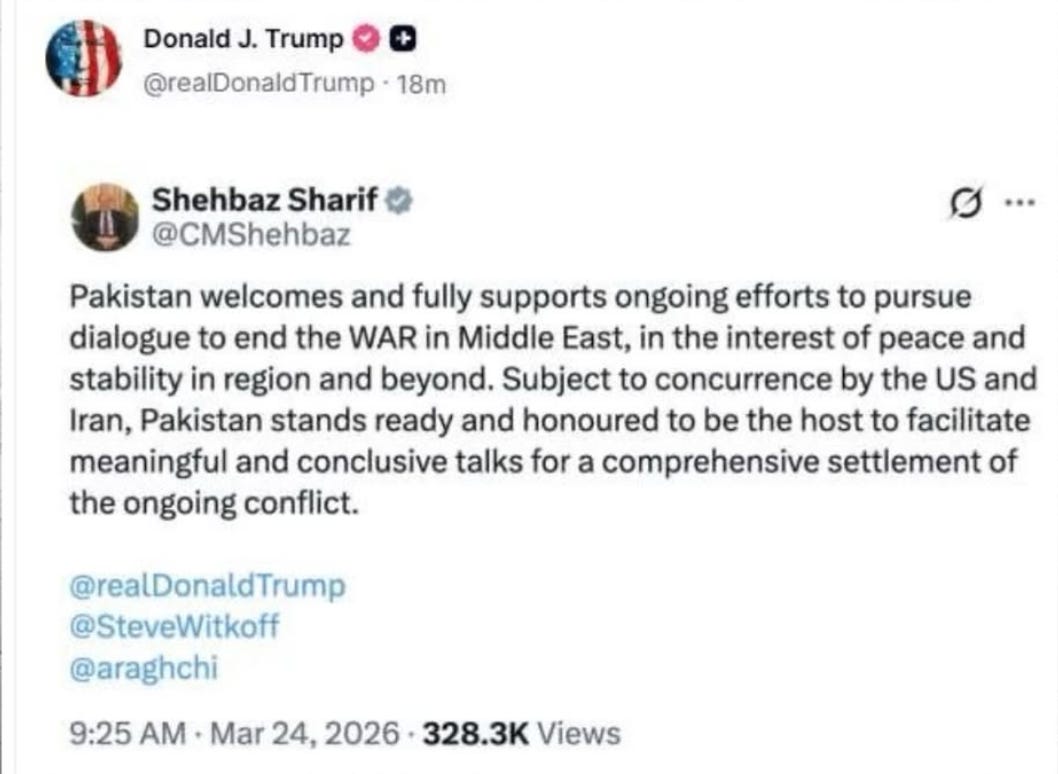
On March 23, Army Chief Field Marshal Asim Munir called Donald Trump. The following day Sharif called Iranian President Masoud Pezeshkian, while Foreign Minister Ishaq Dar held separate calls with his Iranian and Turkish counterparts. Dar told Arab counterparts in Riyadh that Pakistan was leading mediation efforts. Sharif then posted to X that Pakistan “stands ready and honored to be the host to facilitate meaningful and conclusive talks for a comprehensive settlement of the ongoing conflict,” tagging Trump, Steve Witkoff, and Iranian Foreign Minister Abbas Araghchi. Trump reposted it on Truth Social. The Express Tribune called it Washington’s tacit endorsement. Pakistan Today called it Pakistan “taking the lead.”
That same morning Trump had posted on Truth Social in all capitals that the US and Iran had held “very good and productive conversations” and a deal was near. The Dow jumped more than 1,000 points. Oil prices dropped $17 in minutes. Then Iran’s parliament speaker Mohammad-Bagher Ghalibaf denied that any negotiations had taken place and called Trump’s claims “fake news” designed to “manipulate the financial and oil markets.” According to the Financial Times, roughly 6,200 Brent and WTI futures contracts with a notional value of $580 million changed hands in a single minute at 6:49 a.m. New York time, approximately fifteen minutes before Trump’s Truth Social post went live. Nobel Prize-winning economist Paul Krugman described the exploitation of national security information for market profit as treason. Iran’s state media called the entire episode a ploy to buy time for military planning.
Pakistan had delivered the US’s 15-point ceasefire plan to Iran. Iran’s regime information council called it a wishlist of battlefield objectives the US had not achieved. Press TV said Iran does not accept a ceasefire at all, only an end to the war on its own terms. As of March 26, two vessels had crossed the Strait in the previous 24 hours, against a normal daily figure of 150 to 160.
Sharif had previously praised Trump publicly and nominated him for the Nobel Peace Prize. Those videos resurfaced in March.
Pakistan’s mediation credentials are real. The country shares a 909-kilometer border with Iran, according to the Survey of Pakistan, hosts Sunni and Shia communities with ties to every fault line this war is running along, and needs the Strait to reopen more urgently than almost any other country. Iran’s new Supreme Leader Mojtaba Khamenei referenced Pakistan by name in his Nowruz message. Trump said months ago that Pakistanis “know Iran very well, better than most.” The back-channel is active: Pakistani officials have been relaying communications between Tehran and Trump’s envoys Steve Witkoff and Jared Kushner, and the US’s 15-point plan was sent through Pakistan.
But the activity is not the same as progress, and Islamabad has been performing the former as though it constitutes the latter. Iran has consistently denied direct negotiations. The IRGC, which has consolidated power since Khamenei’s death, has communicated conditions through Middle Eastern intermediaries that are maximalist: full recovery of losses, lifting of all sanctions, international legal guarantees against US interference. Trump, asked whom he is negotiating with after US-Israeli forces killed most of Iran’s senior leadership, said it is “a little tough, we’ve wiped out everybody.” The Pentagon has deployed thousands of troops from the 82nd Airborne Division to the region. Two vessels crossed the Strait on March 24.
Pakistan’s problem is not that it is mediating. It is that it is advertising. The daily X posts, the tagged diplomacy, the public declarations of readiness, none of this serves a back-channel. It serves a domestic and international audience. It signals relevance to Washington, which has been a consistent Pakistani government strategy for seventy years. The question it forecloses is the one the economy is currently asking: whether the energy shock, the remittance exposure, and the IMF programs intensifying conditionality require a government that is looking at Karachi rather than performing at it.
Sharif said Pakistan stands ready and honored to host conclusive talks. He has not said who pays for the honor. The April wheat harvest will be costed against March diesel prices. The answer will come from there
Right at the time of publishing this article DPM Dar issued a statement yet again that talks are happening which is good but keep it under wraps instead of amplifying it on a daily basis.
.