
Pakistan Spends More on One Cash Programme Than On Educating 240 Million People
How the Benazir Income Support Programme, audited for billions in irregularities, took 4.5 percent of the FY27 budget while the country’s schools took 0.8 percent of GDP
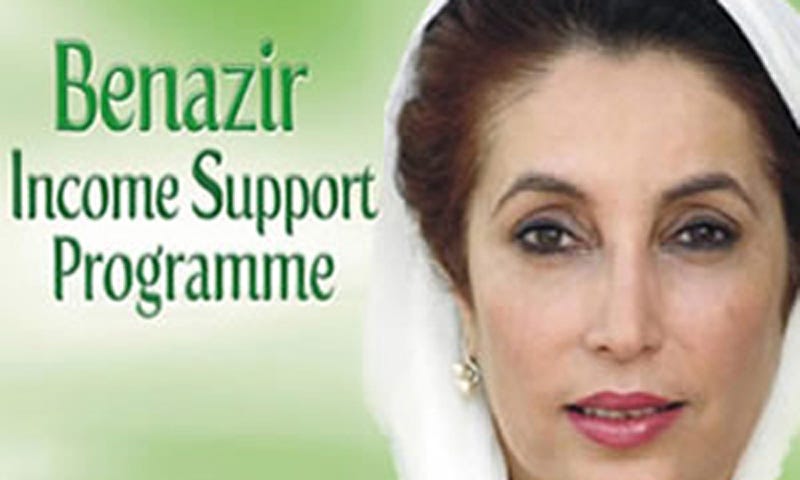
Muhammad Aurangzeb stood in the National Assembly on June 12, 2026, and announced that the Benazir Income Support Programme would receive Rs838 billion in the coming fiscal year, a 17 percent increase over the year before, and he presented the number as proof of a government that has not forgotten its poorest citizens. The number is real. Rs838 billion is roughly 4.5 percent of the entire Rs18.77 trillion federal budget, handed to a single cash-transfer programme, in a country where the government’s own Economic Survey, released the day before the budget, put the national poverty rate at 28.9 percent and rural poverty at 36.2 percent. On the surface this looks like a state finally turning toward the people it has spent decades ignoring. Underneath it is something else, and the something else has a paper trail.
The Auditor General of Pakistan’s most recent audit of BISP found Rs141 billion in irregularities in a single fiscal year. Of that figure, Rs116.95 billion was paid out to 3.077 million families who had no valid national identity cards on record, meaning the state cannot say with certainty who received that money or whether the people who received it were poor at all. A further Rs4 billion went to individuals who were already registered tax filers, people who by definition do not qualify for a programme designed for households below the poverty line. Layered on top of the identity and eligibility failures, a Public Accounts Committee sub-committee found that Rs23.68 billion of BISP funds were wrongfully transferred not to the rural women and daily-wage households the programme exists to serve, but to government officials themselves: 85 officers of grade 20, 630 officers of grade 19, and thousands more government employees below them on the pay scale. The Pakistan Peoples Party, which has owned this programme since its creation and treats it as the centerpiece of its political identity, has called the corruption allegations “completely false.” The Auditor General’s office is not a political party. It is the constitutional body whose entire function is to examine where public money goes, and it is the body that produced the Rs141 billion figure.
Now place the higher education allocation next to it. For FY27, Pakistan’s federal government allocated Rs46 billion to higher education, an increase from Rs34.9 billion the year before. Rs838 billion against Rs46 billion means BISP alone receives more than eighteen times what the federal government spends on the universities and research institutions meant to produce the engineers, doctors, and teachers a country of 240 million people will need for the rest of this century. Zoom out from the federal higher education line to the entire national education system, federal and provincial combined, and the picture does not improve. The Economic Survey for 2025-26 recorded that total education spending fell 23 percent in a single year to roughly Rs962 billion, sinking education’s share of GDP to 0.8 percent, against the 4 percent that international benchmarks recommend as a minimum for a functioning system. A programme that an independent constitutional audit found leaking Rs141 billion through unverified identities and Rs23.68 billion through transfers to its own bureaucracy is, on its own, nearly equal in size to everything Pakistan spends on educating its children.
The programme that became a party
To understand why this arrangement survives audit after audit, you have to understand what BISP actually is inside Pakistan’s political architecture. It was launched in 2008 under the PPP government of Asif Ali Zardari, named for Benazir Bhutto after her assassination, and structured from the outset as both a social safety net and a living monument to the party’s founding family. Every disbursement carries her name, every beneficiary card and SMS notification and roadside banner announcing a new tranche of payments arrives branded with the identity of the PPP’s most potent political symbol, and that branding is the design, not an accident of it. A cash-transfer mechanism that reaches millions of households several times a year under a brand belonging to one political family is a permanent, state-funded campaign infrastructure that renews itself on a quarterly disbursement cycle, paid for by the federal treasury rather than the party’s own resources.
The PPP has governed Sindh continuously since 2008 and has used federal coalition arrangements to protect BISP’s budget and institutional position through governments of every other political complexion. When the PTI government attempted to rebrand the programme as the Ehsaas programme between 2019 and 2022, the rebranding survived exactly as long as the PTI held power, and the name reverted the moment a PPP-aligned coalition returned. The institutional memory of BISP is not a memory of a welfare bureaucracy slowly improving its targeting and oversight over eighteen years. It is the memory of a political asset that has been defended, expanded, and re-branded depending on who controls it, while the audit findings accumulate underneath, year after year, fiscal year after fiscal year, largely unaddressed.
What Rs141 billion in irregularities actually means
Numbers this large lose their texture quickly, so it is worth sitting with what Rs141 billion in a single year’s audit actually represents. It is not a rounding error in a Rs838 billion programme. It is close to one-sixth of the entire annual allocation, found in irregularities in one audit cycle, in one fiscal year. The largest single component, Rs116.95 billion, went to 3.077 million families with no valid CNIC on file. In a country where the entire BISP eligibility system is built on the National Socio-Economic Registry, a database cross-referenced against NADRA’s identity records specifically so that the state can claim its cash transfers are means-tested and verified, more than three million families received payments through an identity verification process that did not verify their identities. Either the registry’s safeguards failed at a scale of three million households, or the safeguards were bypassed, and in either case the result is the same: Rs116.95 billion left the federal treasury with no auditable certainty about who received it.
The Rs4 billion paid to registered tax filers is smaller in absolute terms but more damning about the programme’s basic logic. A tax filer is, by the state’s own definition, a person with documented income sufficient to fall inside the tax net. BISP exists explicitly for households below the poverty line, households the state has determined cannot meet basic needs without a transfer. For the same database that determines BISP eligibility to also contain the records of registered taxpayers, and for those taxpayers to then receive poverty payments, is not a clerical slip. It is evidence that the eligibility criteria the government cites every time it defends the programme’s size are not the criteria actually governing who gets paid.
Then there is the Rs23.68 billion that the Public Accounts Committee sub-committee found had gone to government officials. Eighty-five officers at grade 20, the rank just below the most senior tier of Pakistan’s civil bureaucracy, and 630 officers at grade 19, received BISP disbursements. Thousands of lower-grade government employees received them as well. These are not households that meet any reasonable definition of poverty. A grade-19 officer in Pakistan’s civil service is, in income terms, comfortably within the country’s documented middle class, often the upper end of it. For a programme funded specifically to reach the 28.9 percent of Pakistanis the state itself classifies as poor to instead be distributing money to its own salaried officer corps is the clearest possible illustration of how a welfare architecture, once captured by the institutions meant to administer it, redirects its flows inward, toward the state’s own employees, before it reaches the people it was built for.
The comparison the budget speech does not want you to make
Aurangzeb’s budget speech presented the BISP increase and the higher education allocation as two separate facts in two separate sections, the way budget speeches are built to be read: department by department, ministry by ministry, each number arriving in its own box with no instruction to compare it to the box next to it. Read them side by side and a different document appears. Rs838 billion for BISP. Rs46 billion for higher education. The ratio is more than eighteen to one. A single welfare programme, audited for Rs141 billion in irregularities including tens of billions diverted to the state’s own bureaucracy, receives in one year more than eighteen times what the federal government spends developing the universities, research institutions, and laboratories that are supposed to be Pakistan’s pathway out of the dependency BISP exists to manage.
Widen the lens past the federal higher education line to the national education system as a whole, and the comparison does not soften, it sharpens. The Economic Survey published on June 11, the day before this budget, recorded that total education spending across federal and provincial governments combined fell 23 percent in a single year to approximately Rs962 billion, the lowest share of GDP, 0.8 percent, in years, against an international benchmark of 4 percent that Pakistan has never come close to meeting in any government’s tenure. Rs838 billion for BISP against Rs962 billion for the entire national education system means one cash-transfer programme, alone, is worth roughly 87 percent of what the country spends educating every child in every public school, in every province, from Gwadar to Gilgit. A country of 240 million people, a majority of them under the age of 30, is being told by its own budget documents that keeping a politically-branded cash transfer flowing is worth almost as much to the state as educating the generation that will have to live with every decision this budget makes.
What this means for the IMF’s “social protection” line
Pakistan’s IMF programme requires the government to maintain and expand social protection spending as a condition of continued disbursements, and BISP is the line item the government points to when it needs to demonstrate compliance. This creates an arrangement in which the Fund’s own conditionality, designed to ensure that austerity does not fall entirely on the poorest, becomes the institutional shield protecting a programme that an independent domestic audit has found leaking billions to unverified identities, ineligible tax filers, and the state’s own civil servants. The IMF’s social protection benchmark is satisfied by a number, Rs838 billion, without any requirement that the number represent money that actually reaches the people the benchmark was designed to protect. A programme can fail its own eligibility criteria at a scale of Rs141 billion and still count, in full, toward an international lender’s definition of a government meeting its obligations to its poor.
This is the structure that makes the BISP-versus-education comparison more than an argument about budget priorities. It is an argument about what counts as proof, to Washington and to Islamabad alike, that a state is taking care of its people. A cash transfer, however leaky, generates a headline number that satisfies a conditionality clause. An education system, however starved, generates no comparable single figure that any lender requires the government to defend. The result is a budget in which the politically branded, audit-flagged, IMF-counted programme grows by 17 percent in a single year, while the unbranded, unaudited-for-political-benefit, IMF-uncounted school system shrinks by 23 percent in the same survey period, and both facts are published by the same government, in consecutive documents, on consecutive days, without either document acknowledging the other.
The question this budget does not answer
What remains after the ledger is read in full is not a question about whether Pakistan’s poorest families deserve a cash transfer. They do, and the 28.9 percent poverty figure the government’s own survey admits to is the clearest argument for why such a transfer should exist and should be defended. The question the record raises, and that this budget does not answer, is why a programme found by the state’s own auditors to have sent Rs116.95 billion to people with no verified identity, Rs4 billion to people who were never eligible, and Rs23.68 billion to the government’s own officer corps continues to grow at 17 percent a year with no public accounting for where the Rs141 billion went or who was held responsible for it, while the schools that could eventually make such a programme unnecessary are told, in the same week, that they will receive less than they did the year before.
That is the budget, read in full. Rs838 billion for a programme that cannot account for Rs141 billion of what it already spent. Rs46 billion for the universities. Rs962 billion for every school in the country. One of these numbers grew. The other two did not.


