
Guest Writer
No country in the world is navigating the 2026 Iran war on as many simultaneous fronts as Pakistan. It is a diplomatic broker and a domestic powder keg. An energy crisis victim and an active belligerent on its own eastern front. A nation with a defence pact with Saudi Arabia, a nine-hundred-kilometer border with Iran, a restive Shia minority, an IMF program on life support, and an ongoing war with Afghanistan. To call Pakistan a bystander to the Iran conflict would be a category error. It is one of the conflict’s most consequential characters, threading a needle no other country is even attempting, and doing so without a safety net.
The story of Pakistan in this war cannot be told through a single lens. It requires holding several contradictory truths at once: that Islamabad is simultaneously the most promising diplomatic actor in the conflict and one of its most vulnerable victims; that its army chief is shuttling between Tehran and Washington while Pakistani soldiers die on the Afghan border; that its stock market hit a record high this week while ordinary citizens are rationing fuel. This is not a country at the margins of the Iran war. It is one of the war’s central plots.
The Diplomatic Gambit
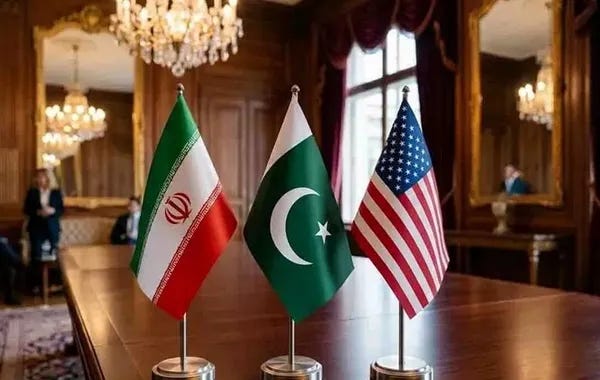
Pakistan’s formal position, declared on February 28 the moment US-Israeli strikes killed Supreme Leader Khamenei, was neutrality. That neutrality has since quietly transformed into something far more ambitious. Army Chief General Asim Munir, who has emerged as the effective center of gravity in Islamabad’s foreign policy, has been conducting back-channel shuttle diplomacy between Tehran and Washington at a pace and directness that has surprised regional observers. His visit to Iran in mid-April was not a courtesy call. It was a signal, to both sides, that Pakistan has the access, the credibility, and the intent to be the room where a deal gets made.
On March 23, Pakistan formally offered Islamabad as a venue for US-Iran talks, a proposal that arrived with meaningful multilateral backing from Egypt, Turkey, and Saudi Arabia. The significance of that coalition should not be understated. These are not natural allies. That they converged around Pakistan’s offer reflects both the absence of other viable mediators and a recognition that Islamabad, uniquely, has functional relationships with Tehran, Riyadh, and Washington simultaneously. On April 6, Pakistan advanced the framework further, floating a two-phased truce plan: an immediate ceasefire first, followed by a Strait of Hormuz reopening within fifteen to twenty days as phase two. The phasing was deliberate. It gave Iran an off-ramp that did not require it to abandon its central leverage on day one.
As of April 17, Donald Trump has praised Pakistan publicly and suggested he may visit Islamabad to sign a deal, contingent on Iran agreeing to curb its nuclear programme. The statement, characteristically imprecise, nonetheless carries weight. A presidential visit to Islamabad for a war-ending agreement would be, by any measure, the single most consequential diplomatic moment in Pakistan’s modern history, eclipsing even its role as a Cold War frontline state.
The architects of this strategy are betting on a specific theory of influence: that Pakistan’s value lies not in its military power or economic weight, both of which are limited, but in its geographic and political position as a state that no major actor in this conflict can afford to alienate. Iran cannot afford a hostile Pakistan on its eastern flank. Saudi Arabia needs Pakistani troops as a strategic backstop under the September 2025 mutual defense pact. Washington needs Islamabad to keep the Afghan border from becoming a third active theatre. And China, Pakistan’s most consequential economic partner, has every interest in seeing a Pakistan-mediated deal succeed, since it would cement Beijing’s preferred alternative to American-led resolution frameworks. Finance Minister Muhammad Aurangzeb’s acknowledgment of Chinese backing for Pakistan’s IMF programme, secured during meetings in Washington this week, is the financial expression of that same logic.
The risks to this strategy are equally structural. Mediation only works as long as both parties believe the mediator is honest. If Tehran concludes that Pakistan’s Munir is too close to Riyadh, or if Washington decides that Pakistan’s neutrality is cover for quiet Iran sympathy, the role collapses. There is also a domestic political dimension. Every day Munir spends in Tehran or Washington is a day he is not managing the Afghanistan front, the Shia protests, or the creeping fiscal deterioration at home. Pakistan’s mediation posture is credible precisely because it is costly. The question is how long Islamabad can absorb those costs.
The Energy Shock
Pakistan’s energy vulnerability was always the war’s most direct and immediate threat, and it materialized almost exactly as analysts feared. The country imports roughly ninety percent of its energy from the Gulf region, a structural dependence that decades of domestic policy failures have never resolved. When Iran retaliated against the US-Israeli strikes, it effectively throttled Strait of Hormuz traffic, a chokepoint through which approximately twenty percent of the world’s oil and gas transits daily. The economic consequences for Pakistan were near-instantaneous.
The blow that cut deepest was the Iranian drone strike on Qatar’s LNG facilities at Laff Industrial City. The attack forced a seventeen percent production cut, with repair timelines estimated at up to five years. Qatar had been Pakistan’s primary LNG supplier under a long-term agreement signed during Islamabad’s last fiscal crisis. Pakistan had, improbably, been running a gas surplus as recently as late February. That surplus evaporated within days of the strikes.
By early March, the government ordered sweeping austerity measures. Petrol hit its highest price in Pakistan’s history at $1.15 per litre, a twenty percent spike within a single week. Industrial energy costs followed. Textile exporters, the backbone of Pakistan’s foreign exchange earnings, began reporting production slowdowns. Fears of fuel rationing, once the language of doomsday scenarios, became routine in cabinet briefings and parliamentary sessions. The Brookings Institution noted in a recent analysis that the energy shocks from the Iran conflict are not yet fully realized globally, a warning that carries particular weight for an economy as import-dependent as Pakistan’s.
The energy crisis also carries a political dimension that the macroeconomic data does not fully capture. Petrol prices in Pakistan are a proxy grievance. Every fuel hike activates a political constituency: transporters, small traders, motorcycle-dependent daily-wage workers who constitute the largest segment of Pakistan’s urban informal economy. The government’s austerity framing, calibrated to satisfy the IMF, runs directly against the political need to cushion these groups. That contradiction is not new to Pakistan, but the speed and severity of this price shock is.
The Economy: Fragile Recovery Under Strain
Pakistan’s economy entered 2026 in what its finance ministry had cautiously labelled a stabilization phase. The IMF had restored the program. Reserves were rebuilding. The current account had improved. None of that has collapsed outright, but the Iran war has placed every indicator under fresh stress.
The IMF’s April 2026 World Economic Outlook revised Pakistan’s FY26 growth forecast to 3.6 percent, below the government’s own 4.2 percent target. Inflation is projected at 7.2 percent for the current fiscal year, rising to 8.4 percent in FY27. The current account deficit is forecast to more than double to 0.9 percent of GDP, approximately five billion dollars, in FY27, driven almost entirely by elevated oil and gas import costs. These numbers, taken individually, are manageable. Taken together, against a backdrop of an active regional war, a domestic protest cycle, and an Afghanistan front that requires defense spending, they describe a country whose fiscal margin for error is essentially zero.
The countervailing data points are real but require context. March 2026 delivered a $1.07 billion current account surplus, the second-highest on record. The KSE-100 hit a record 168,000 on April 16, buoyed by Gulf aid optimism and the possibility of a US-Iran deal brokered in Islamabad. Saudi Arabia announced a $3 billion deposit to the State Bank this week, its most significant financial intervention since the 2023 crisis period. These are not trivial developments. The Saudi deposit alone provides meaningful import cover and signals Gulf confidence in Pakistan’s mediation role, which is itself a financial dividend of the diplomatic strategy.
But the surplus and the stock market record coexist with something the headline numbers obscure: Pakistan’s recovery has been powered disproportionately by remittances and financial flows rather than by productive investment or export volume growth. That is a structurally brittle base. If the Gulf war drags on and Pakistani diaspora workers in the Gulf states face unemployment, remittances will fall. If the Islamabad talks fail and Saudi Arabia recalibrates its Pakistan relationship, the deposit logic reverses. The Chinese IMF support, secured diplomatically this week, reduces one layer of program risk, but it does not resolve the underlying structural fragility.
Domestic Fault Lines
The war’s domestic consequences arrived faster than almost anyone anticipated. On March 1, the day after Khamenei’s death was confirmed, protests erupted in cities across Pakistan. The demonstrators were drawn predominantly from Pakistan’s Shia minority, which constitutes between fifteen and twenty percent of the population and is concentrated in urban centers including Karachi, Lahore, Islamabad, and Gilgit-Baltistan. At least twenty-six people were killed in clashes with police. Protesters attempted to storm US consulates in all three major cities. In Karachi, they breached the consulate perimeter. US Marines reportedly opened fire on the crowd.
The political bind this created for Islamabad is structural, not incidental. Pakistan’s Shia population has historical, religious, and often familial ties to Iran. Its Sunni establishment, particularly the military and the Gulf-linked business class, is financially and strategically bound to Saudi Arabia through the September 2025 Strategic Mutual Defense Agreement. Its military apparatus depends on US security assistance, intelligence cooperation, and IMF goodwill that Washington influences. These three constituencies pull in fundamentally different directions, and any policy that satisfies one risks alienating another.
The government’s response, condemning “attacks by all sides” and emphasizing Pakistan’s Islamic solidarity with civilian victims in Iran while refusing to name the US-Israeli strikes as aggression, is a studied ambiguity. It is not, as critics suggest, simply cowardice. It is a calculated attempt to avoid triggering any single group while preserving the credibility of Pakistan’s mediator role, which requires being seen as honest by all parties. Whether that calculation holds as the war drags on and body counts in Iran accumulate is an open question. The Shia street does not have infinite patience for diplomatic hedging.
The sectarian dimension also intersects with a longer domestic crisis that predates the Iran war. Pakistan’s religious minorities, its Ahmadiyya community, its Hindus, its Christians, have faced escalating state-adjacent persecution for years. The Iran war has temporarily reorganized the fault lines, channelling Shia anger outward toward American targets rather than inward toward the state. That redirection is useful to the government in the short term. It is not stable.
The Afghanistan War: The Forgotten Front
While Pakistan attempts to mediate one war in the Gulf, it is fighting another on its northwestern border with a ferocity that has received a fraction of the international coverage the Iran conflict commands. Pakistani airstrikes in Nangarhar, Paktika, and Khost began in late February, targeting TTP militants operating from Afghan territory with the Afghan Taliban’s tacit tolerance. The strikes triggered what has since been formally designated the 2026 Afghanistan-Pakistan War, a conflict that lacks a ceasefire, a mediator, or a clear end state.
Pakistan has reportedly established a thirty-two square kilometer buffer zone inside Afghan territory. Islamabad has denied this officially and categorically. Security analysts, satellite imagery assessments, and cross-border reporting from humanitarian organizations confirm it. The UNICEF Afghanistan Humanitarian Flash Update from April 2026 documents displacement patterns consistent with a sustained Pakistani military presence inside Afghan territory, without naming it as such.
A temporary Eid ceasefire expired on March 23. As of April 16, Pakistan’s Foreign Minister was publicly vowing to “eradicate terrorism,” language that signals not a winding-down but an entrenchment. The Torkham border crossing, the primary land trade artery between the two countries, has opened and closed repeatedly since February, generating supply chain disruptions that compound Pakistan’s already strained import logistics.
The Afghanistan front matters for reasons beyond the immediate security calculus. Pakistan’s military, which functions as the country’s de facto foreign policy ministry, is now stretched across two simultaneous external conflicts and a domestic protest cycle. That is an institutional strain that does not appear in GDP forecasts. It also creates a command attention problem: the same army chief conducting high-stakes shuttle diplomacy between Tehran and Washington is responsible for an active ground operation in Khost that has produced no defined end state.
There is also an international optics problem. Pakistan presenting itself as a peace broker in the Iran war while conducting military operations inside Afghan territory, however legally and strategically justified from Islamabad’s perspective, is a contradiction that adversaries and skeptics will exploit. Iran, which has its own complicated relationship with the Afghan Taliban, is watching the Afghan front closely. Any suggestion that Pakistan’s buffer zone serves American strategic interests in the region, rather than purely Pakistani counter-terrorism interests, could fracture the trust that Munir’s Tehran visits have constructed.
The Strategic Balancing Act in Full
Taken together, Pakistan’s position in April 2026 is without modern precedent in its own history and arguably without precedent among middle powers in any recent conflict. It is simultaneously: a declared neutral party in a war that directly threatens its energy supply; an active mediator with White House-level access; a signatory to a mutual defence pact with a principal belligerent’s principal backer; a country with a Shia population whose sympathies actively contest the government’s neutrality; an IMF program country whose fiscal space depends on Gulf goodwill; and a belligerent in its own parallel war.
Defense Minister Khawaja Asif has been explicit and consistent on one point: Pakistan will not militarily join any campaign against Iran, even under the terms of the Saudi pact. That line holds for now. It will face pressure as the war continues and as Saudi Arabia potentially calls in political debts. The pact’s defense obligations are sufficiently ambiguous to permit Islamabad’s current posture. Whether they remain so if the conflict expands is a question Pakistani legal and strategic thinkers are actively debating.
The scenario in which Pakistan’s gambit succeeds is not implausible. Trump’s public praise and the hint of an Islamabad visit suggest Washington sees value in the framework. Iran’s willingness to receive Munir suggests Tehran is not closing the door. A deal signed in Islamabad, even a partial one, would deliver Pakistan something it has not had since the 1990s: genuine geopolitical relevance that translates into economic leverage. Gulf investment, American goodwill, Chinese satisfaction, and IMF continuity would all flow from a successful mediation. The KSE-100 record and the Saudi deposit this week suggest markets are beginning to price in that possibility.
The scenario in which it fails is equally plausible. The Iran talks are not the only variable. A single escalation on the Afghan front that draws international condemnation, a Shia protest that crosses into sustained civil unrest, a fuel rationing announcement that triggers political instability, or an IMF review that goes badly in May could each independently unravel the coherence of Islamabad’s current posture. Pakistan has survived worse combinations of crises. It has not survived them while simultaneously holding a mediator’s card at the table of a Middle East war.
What is clear is this: Pakistan is not managing these crises in sequence. It is managing all of them at once, with limited resources, a polarized domestic landscape, and a military that has bet its institutional prestige on being the country that ends the Iran war. That bet may pay. The odds are not comfortable, and the margin for error is thin. But the attempt itself is already one of the more extraordinary performances of diplomatic high-wire walking in the region’s recent memory.
Pakistan has walked tightropes before. It has rarely walked this many at the same time.


