
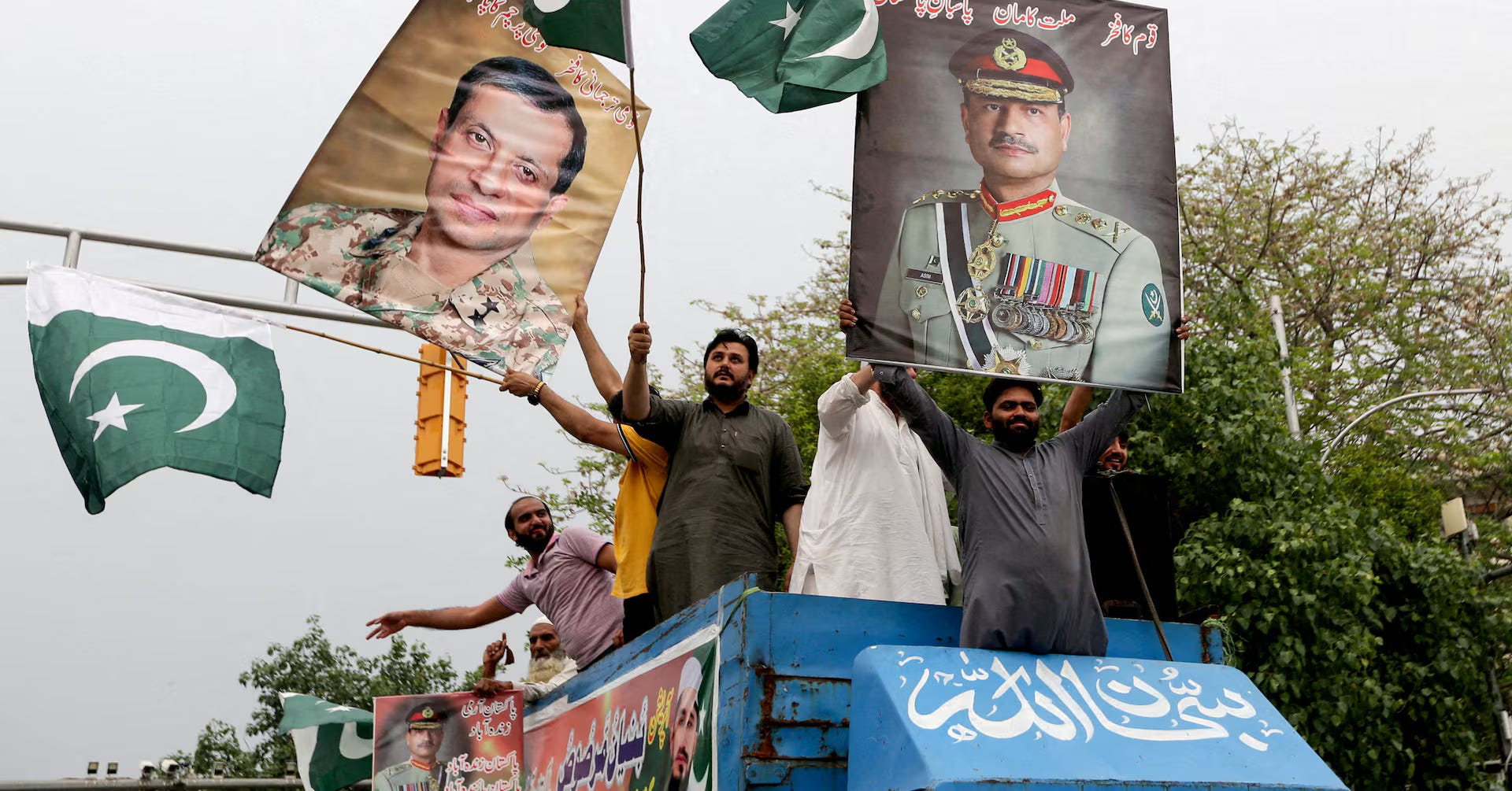
Pakistan Has Never Been Governed for Pakistanis
The British left in 1947, but the machinery they built to control the population survived inside a military state that protects its rulers and abandons the public.
Pakistan wakes each morning to a state that knows exactly where its citizens live when taxes are due, when an electricity bill must be recovered, when a protest must be stopped, when a journalist has crossed an invisible line or when another son from a poor district is needed for a war, and yet the same state becomes confused when a child needs a classroom, a mother needs a clinic, a family needs clean water or a voter asks where the ballot went after it was counted. Every Pakistani knows some part of this transaction because almost every household pays twice for the same country: once through taxes and inflation, then again for the school, generator, water tanker, doctor, transport and security that citizenship was supposed to provide.
The frustration belongs to an entire country. Salaried workers have tax deducted before the wage reaches their accounts while commercial power negotiates exemptions. Parents calculate which fee can be delayed because the public school has no teacher, buy bottled water because the tap is unsafe, find money for a private clinic because the basic health unit is closed, sit through another power cut after paying another inflated bill and still hear that the state has no money. Farmers watch diesel, electricity and fertiliser swallow the value of a crop while policy is written in rooms they will never enter. Families in Balochistan move between police stations, courts and protest camps looking for people the state refuses to acknowledge it took. Young Pakistanis study for years, pass the examinations they were told would determine their future and discover that competence matters less than access, a recommendation, a uniform in the family or the money to leave. The insult is cumulative: work harder, pay more, expect less, remain grateful.
The state has money. The federal budget for 2026-27 totals Rs18.77 trillion. Defence services receive Rs3 trillion, an increase of 18 percent in a budget that cuts development spending, while UNICEF reports that 25.1 million children between five and sixteen are out of school. Pakistan spends about 0.8 percent of gross domestic product on education, its lowest recorded level, and nearly 40 percent of its children are stunted. Three quarters of children who complete primary school cannot read and understand a simple story. These children did not lose a competition for resources. They were never accepted as the purpose of a Pakistan administered, secured, surveyed, disciplined, taxed, censored and periodically allowed to vote without being governed for its people.
The British Raj built institutions to extract revenue, suppress dissent, protect strategic routes and keep a colonised population legible to authority. Independence changed the flag and the senior personnel, but it left the district officer above the village, the cantonment separate from the city, the police organised around order rather than public safety, the secrecy law available against the citizen and the frontier exposed to collective punishment explained as necessity. The armed institution inherited the colonial state’s deepest assumption, which held that the population was a risk to be managed rather than the sovereign to be served, and seventy-nine years later, Pakistanis are still waiting for independence from that assumption.
The public has become the government
Pakistanis have adapted so completely to state failure that self-government now happens inside the household budget. Nobody waits for the water department when the tap runs dry if a tanker can be called. A family that can afford an inverter or solar panels builds its own electricity system. Parents assemble an education from private schools, academies and tuition because the public system cannot be trusted to carry a child from enrollment to literacy. A guard replaces the police, a private laboratory replaces the public clinic and a relative abroad becomes the welfare system when a wage, crop or illness overwhelms the family. The public does the government’s job and pays the government for the privilege.
Each abandoned duty also creates a market around the abandonment. Broken water supply sustains tanker operators. Unreliable electricity sells generators, batteries, inverters and solar installations. Weak schools sustain tuition centres. Unsafe streets sustain private guards. Inadequate hospitals send patients into private laboratories, pharmacies and clinics. Some of these businesses provide necessary work and honest service, and yet their growth records a state failure converted into household expenditure, with the richest Pakistanis able to purchase distance from the collapse while the poorest receive the collapse itself.
The arrangement survives partly because people are resourceful. A parent finds the fee. A neighbourhood pools money for a pump. A family sells jewellery for treatment. A migrant sends remittances. A young worker takes a second job. These acts are celebrated as resilience, but resilience has become a subsidy paid by the public to the rulers because every emergency solved inside a family is one less emergency the state must answer politically. What looks like national endurance from a podium feels different at the kitchen table, where somebody must decide whether this month belongs to the school, the medicine or the electricity company.
Children grow up watching adults administer this private republic. They learn the tanker number before they learn the municipal complaint number, know which hospital requires cash before admission and understand that a government office moves through access, recommendation or payment. By adulthood, the workaround no longer feels temporary. Citizenship has been reduced from a claim upon the state to the ability to buy an exit from it.
This is where military governance enters ordinary life even when no soldier is visible. A state organised around command, security and elite continuity can leave survival to the population because survival has been privatised, and the population remains governable precisely because so much of its energy is consumed securing what functioning government would have supplied. Pakistanis govern themselves through exhaustion while financing a state that governs them.
The colony survived the coloniser
The Police Act of 1861 was enacted after the uprising of 1857. Britain did not design that police force to protect Indians from crime as equal citizens of a constitutional state. It designed a disciplined chain of command capable of watching, controlling and punishing a subject population after the empire had nearly lost it. Pakistan inherited the act, amended it and preserved its governing instinct across police orders, provincial laws and administrative practice in which the officer answers upward while the public waits outside.
The Official Secrets Act arrived in 1923, when the Raj needed broad power over information in a colony where anti-imperial organisation had become a threat, and Pakistan kept it after 1947. A law created to protect British rule from Indians became a law used by a Pakistani state against Pakistanis. The sedition provision in the Penal Code, the architecture of preventive detention and the language of public order travelled the same route, carrying an imperial vocabulary of security, tranquillity, sensitive information, incitement and state integrity that placed the burden on the subject to prove his speech, gathering or knowledge was harmless.
The Frontier Crimes Regulation of 1901 made the design even plainer. It allowed collective punishment, restricted appeal and governed entire communities through political agents because the colonial frontier was considered too dangerous for ordinary law. Pakistan retained the regulation in the former tribal areas until 2018. A country founded through a demand for Muslim political freedom spent seven decades governing millions of Muslims through a British frontier code that denied them the ordinary legal protections available elsewhere.
The law eventually changed, but the frontier idea survived. Balochistan and Khyber Pakhtunkhwa are still discussed first as security maps. A village becomes a suspected route, a political organiser becomes a possible facilitator, a missing student becomes an allegation against the state’s reputation rather than a citizen whose whereabouts the state must establish. The Human Rights Commission of Pakistan reported in 2026 that amendments to federal and Balochistan anti-terrorism laws allow law-enforcement agencies and the armed forces to detain a person for as long as three months without charge or judicial oversight, distributing the empire’s political agent and his discretion among newer offices.
The cantonment supplies the physical record of continuity. British India separated military space from civilian space, with better roads, controlled access, land allocation and its own administrative order. Pakistani cities expanded around the cantonments without absorbing them. Karachi, Lahore, Rawalpindi, Peshawar, Quetta and other cities carry the division in their geography: one public pays municipal taxes into broken infrastructure while another authority controls valuable land, commercial leases and residential development behind a military name.
You can drive through the result as the road improves with the change in authority, the landscaping appears, the boundary wall is maintained, security becomes visible and property values rise. The public city is told that urban failure comes from too many people and too little revenue, and yet the protected city inside it demonstrates that Pakistan can provide functioning services where power decides the residents matter.
Colonialism was never only the presence of a white official. It was a governing relationship in which the ruler extracted from a population, denied that population control over the institutions acting upon it and used law to make resistance look criminal. Pakistan removed the white official and nationalised the relationship.
The coup became a system
The military seized direct power in 1958, again in 1977 and again in 1999. Those dates matter, but they can also mislead because they suggest military rule begins when tanks appear on television and ends when a civilian takes the oath. Pakistan’s military governance operates before the coup, after the coup and between coups. Direct rule is one setting inside a larger system.
For roughly half the country’s history, generals formally controlled the state. During much of the remaining half, GHQ controlled the questions elected governments were not permitted to settle independently: relations with India, Afghanistan and the United States; nuclear policy; the security establishment’s budget; the boundaries of acceptable politics; which armed organisations could be used and which must be fought; which television discussion could continue and which phone call would end it. Civilian governments were left to administer electricity prices, tax collection, IMF conditions and public anger while the institution holding the veto preserved distance from every failure it helped produce.
Pakistanis have watched this arrangement repeat until political memory itself has become a trap. A civilian leader is selected or accommodated because he can serve the moment. The leader begins to mistake delegated space for authority. Conflict follows over an appointment, foreign policy, accountability or the distribution of power. Courts, opposition parties, television channels and investigative agencies discover urgency at the same time. The civilian is removed, imprisoned, exiled or politically disabled. Another civilian coalition then accepts the same arrangement because it expects the institution to use its power against the other side.
Zulfikar Ali Bhutto was executed after a military takeover in a trial the Supreme Court acknowledged decades later did not meet the requirements of a fair trial. Benazir Bhutto returned from exile to a state that could secure nuclear installations but could not keep a former prime minister alive at a public rally. Nawaz Sharif was removed three times and still returned to seek accommodation with the institution that removed him. Imran Khan benefited from the political engineering surrounding the 2018 election, then discovered after losing establishment support that the machinery had never belonged to him. His imprisonment does not erase his earlier bargain, and that earlier bargain does not make his present treatment democratic. Each party believes it can borrow the military’s power without becoming collateral and eventually becomes collateral, which is why the generals need no permanent political party while the civilian class keeps applying for the position.
The February 2024 election showed the arrangement at its most exposed. A major party entered the contest after its leader had been imprisoned, its electoral symbol had been removed and its candidates had been forced to run as independents. Mobile services were suspended on election day and results were delayed. The European Union cited allegations of severe interference, arrests and restrictions on internet access. The Commonwealth observer process examined whether a credible, transparent and inclusive election had been possible. Voters queued because casting a ballot was one of the few remaining ways to insist that Pakistan belonged to them, families stayed awake watching delayed results because even after every betrayal people still wanted to believe the number on the form could carry their decision into government, and yet government formation returned power to a coalition the establishment could manage because the vote was allowed while its consequences were negotiated elsewhere. The public had done its constitutional duty and the system treated that duty as raw material for an arrangement.
Freedom House’s 2026 assessment uses the careful vocabulary of international monitoring: Pakistan holds competitive multiparty elections, but the military exerts enormous influence over elections, government formation and policy, intimidates the media and enjoys impunity for indiscriminate or extralegal force. Pakistanis do not need an index to translate this. They know the name of the institution whose public denial of political involvement is treated as more authoritative than the visible result of that involvement.
The competence alibi has already been tested
The establishment’s oldest argument is also its most flattering: politicians are corrupt, civilians are undisciplined and democracy moves too slowly, while the army can plan beyond an election cycle, make decisions without noise and deliver the development that quarrelling parties cannot. Pakistan has already granted that argument its ideal test. The test lasted a decade, came with concentrated authority and generous foreign support, and ended with the country losing its majority population.
The first military regime took power in October 1958. During the 1960s, Pakistan’s economy grew rapidly, with a World Bank historical assessment putting gross domestic product growth at 6.7 percent a year in the first half of the decade and 6.2 percent in the second. Large-scale industry expanded, the Green Revolution changed agriculture, Mangla Dam was completed, Tarbela was begun and Islamabad rose from a planning grid. These were real achievements, and any serious indictment must admit them, because the case against military governance rests on what that growth produced and whom it was designed to enrich.
In April 1968, Mahbub ul Haq, then chief economist of the Planning Commission, told an audience in Karachi that twenty-two industrial family groups controlled roughly two thirds of industrial assets, four fifths of banking and most insurance assets. Haq spoke as an economist who had helped plan the regime’s development model and could see its ownership ledger from inside. The growth was real, the concentration was real and the state had built both, and yet the regime presented the first as proof of competence while treating the second as an unfortunate side effect rather than the governing choice that made elite accumulation the route to national development.
East Pakistan supplied most of the country’s people and much of its export income, but political power, military commissions and development spending remained concentrated in the western wing. When the Awami League won 160 of 300 general seats in the December 1970 election, it held the democratic mandate to form the federal government. Power was not transferred. The army began its operation in East Pakistan on March 25, 1971, and by December the majority of Pakistan’s citizens had become citizens of Bangladesh. The Hamoodur Rahman Commission examined the military and political failure; the state kept its findings from the public for decades.
Military competence therefore cannot be judged by whether a ruler can build a dam, raise growth for several years or make a cabinet act quickly. Colonial governments also built railways, canals and ports, and their competence was measured by how efficiently those assets served the power above the population. Pakistan’s first long military regime built faster than many civilian governments that followed, concentrated the gains among twenty-two families, refused the electoral decision of the majority and defended the distribution until the country broke around it. The institution could deliver. It delivered to its owners.
Military governance without martial law
The current system no longer needs to suspend the Constitution because Parliament can be made to constitutionalise the result. In November 2024, lawmakers extended the terms of the service chiefs from three years to five through legislation passed amid opposition protest and limited debate. In November 2025, the Twenty-seventh Amendment rewrote Article 243, made the army chief concurrently chief of the defence forces, abolished the office of chairman of the Joint Chiefs of Staff Committee and placed the recommendation for the commander of the National Strategic Command inside the army-led structure.
The same amendment created protections for five-star rank that reporting and legal analysis described as lifetime immunity. It also reorganised the superior judiciary through a Federal Constitutional Court and new appointment arrangements. Parliament voted, the presidency signed and the country heard no martial music as the legal text absorbed a concentration of military authority that an earlier era would have required a coup to impose. This produced military governance in its mature form: the prime minister remains on screen, the cabinet presents budgets, Parliament passes laws, courts hear cases and television channels host panels about democracy, while the current occupant of the army chair has no need to become president because the civilian state has been arranged around powers the institution already holds.
The Special Investment Facilitation Council completes the structure on the economic side. Established in 2023 to accelerate investment, the SIFC brings federal ministers, provincial governments, bureaucrats and military leadership into a single decision-making apparatus. Its own official description says the Pakistan Army stands at the forefront of reviving the economy and provides military “facilitation support.” That sentence should stop the country.
An army exists to defend the state against external aggression under the direction of the federal government. When the same institution becomes investment broker, land facilitator, mining coordinator, agriculture planner, security guarantor and final assurance to foreign capital, civilian incapacity is no longer an unfortunate condition. It becomes the institution’s business case for greater authority. Ministries are weakened, then bypassed because they are weak. Parliament is denied documents because transactions are sensitive. Provinces are told the investment requires speed. Communities are told the land belongs to a national project. The institution that accumulated power because civilian governance failed acquires an interest in ensuring civilian governance never becomes strong enough to replace it.
The foreign investor understands where authority sits. A memorandum may carry a civilian signature, but the photograph includes uniforms because the uniform is the guarantee that the next cabinet, court challenge, provincial objection or local protest will not interrupt the arrangement. Investment and its protection serve Pakistan, but denying the Pakistani public the terms, the risks and the power to decide what protection costs serves its rulers. Pakistan calls the result stability, using the word colonies used when they meant order.
Allies for the rulers, invoices for the public
Pakistan needs China, the United States, Britain and the Gulf Cooperation Council. China is a neighbour, a major trading partner, an infrastructure builder and a source of capital. The United States remains a global financial, diplomatic and technological power with deep links to Pakistan’s security history and diaspora. Britain is a major trade partner, an education destination and home to one of the largest Pakistani communities abroad. Saudi Arabia, the United Arab Emirates, Qatar and the wider GCC supply energy, employment, remittances, deposits and investment. Hostility toward any of these relationships would be strategic stupidity dressed as sovereignty, while the betrayal lies in the terms on which Pakistan’s rulers use those alliances and distribute their costs.
China can finance a power plant, road, port or industrial zone that Pakistan needs. The public question is who owns the asset, who guarantees the return, which tariff repays it, whose land enters the project, how liabilities appear in the budget and whether the electricity reaches households at a price they can pay. Those questions were treated as attacks on the friendship during the first decade of the China-Pakistan Economic Corridor. Contracts were protected by secrecy, parliamentary access remained limited, security costs expanded and repayment obligations accumulated inside an energy system where ordinary consumers were already paying for theft, transmission failures, capacity payments and political refusal to reform.
China did what a powerful creditor and strategic partner does: it negotiated for its interests. Pakistan’s rulers did what a colonial intermediary class does: they called the negotiation a national destiny, concealed the distribution of cost and delivered the invoice to the public. A worker facing another electricity increase did not receive a vote on the project’s guaranteed return. A family displaced by a road or mine did not acquire an ownership stake. A Baloch community living near strategic infrastructure did not become the first beneficiary of the port, mineral or corridor running through its land. The elite received contracts, political imagery and strategic importance, while the public received debt service, security checkpoints and the instruction that questioning any of it helped Pakistan’s enemies.
The GCC relationship follows the same structure. Millions of Pakistani workers have built Gulf cities and sent earnings home, keeping households and foreign-exchange reserves alive. Saudi Arabia and the UAE have repeatedly provided deposits, oil facilities, loan rollovers and promises of investment when Pakistan approached a balance-of-payments crisis. In 2024, Saudi and Pakistani businesses signed twenty-seven memorandums valued at $2 billion across agriculture, energy, mining, health, petroleum, technology and industry. The prime minister and the current army chief attended because Gulf capitals understand that economic assurance in Pakistan now runs through both offices.
Seeking Gulf capital is sensible. The betrayal begins when the state offers land, minerals, ports, agricultural acreage or public enterprises through accelerated structures without publishing the complete terms, establishing parliamentary oversight or guaranteeing a measurable public return. A deposit stabilises the rupee long enough for the governing arrangement to survive, a rollover prevents default without changing the structure that caused the crisis and an investment announcement supplies a headline, and yet the Pakistani consumer pays another tariff, the labourer remains without protection abroad and the citizen is told that disclosure might offend a brotherly state, because brotherhood has become the word the ruling class uses when it does not want to show the contract.
The United States relationship has moved between alliance, sanction, military assistance, counterterrorism cooperation and diplomatic estrangement for seven decades. Washington pursued its own interests during the Cold War, the anti-Soviet war in Afghanistan and the post-2001 war on terror. Pakistan’s military establishment pursued institutional relevance, weapons, money and external recognition. The public absorbed the consequences: armed networks cultivated for one strategic period survived into another, frontier regions became battlefields, disappearances and drone warfare entered national life, and civilian institutions remained secondary because the fastest relationship between Washington and Islamabad ran through security officials.
America did not force Pakistan’s rulers to privilege the military channel every time. The establishment preferred a relationship in which Pakistan’s strategic geography made GHQ indispensable, and Washington repeatedly accepted it because an officer who could make a decision without Parliament was easier to deal with than a democratic system containing argument, provincial interests and public opposition. Both sides received efficiency, and yet Pakistanis received wars whose full terms they never saw.
Britain’s relationship is quieter but carries the same unresolved hierarchy. Bilateral trade in goods and services reached £5.5 billion in the four quarters covered by the United Kingdom’s June 2026 factsheet. British universities educate Pakistani students, development programmes support public institutions and the diaspora connects families, capital and politics across both countries, giving Pakistan assets it should deepen.
Yet Britain also remains comfortable dealing with the governing class produced by the institutions it left behind. Cooperation is announced through reform, stability, migration control, counterterrorism and investment facilitation, while the harder question of who holds power inside Pakistan is treated as a domestic complexity. London can support parliamentary capacity and human rights while maintaining practical relations with the institution that limits both. Pakistan’s rulers receive legitimacy abroad, hold property and family networks within Britain’s legal economy and return home to describe external scrutiny as interference.
None of these countries owes Pakistanis a better Pakistani state. Beijing serves China, Washington serves the United States, London serves Britain and Gulf monarchies serve their ruling interests. Pakistan’s government is the institution constitutionally obliged to serve Pakistanis, and yet it enters each alliance seeking what will preserve the rulers: a deposit before the reserve figures collapse, a weapons relationship that raises the military’s status, an investment announcement before the budget, a diplomatic photograph, a debt rollover, a foreign endorsement of stability.
The public benefit is always promised in the future through CPEC industrialisation, Gulf jobs once memorandums become projects, American security after the next operation and stronger institutions after another British-supported reform programme. The rulers receive the photograph, the deposit, the rollover, the weapons relationship and the foreign recognition at signing, while you receive the future tense: jobs will come, tariffs will fall, exports will rise, stability will return. By the time the bill reaches the meter, the petrol pump or the tax slip, the ceremony is over and nobody who signed it can be found at the counter.
This is the external face of military governance. Pakistan is allied in every direction and sovereign in none that matter to an ordinary citizen because valuable relationships strengthen the state’s rulers without strengthening the public’s claim upon the state, and their capture is the crime.
The enterprise guarding itself
Pakistan’s military is also an economic class. Through the Fauji Foundation, Army Welfare Trust, Defence Housing Authorities, Askari-linked enterprises and associated networks, military welfare has expanded into fertiliser, cement, banking, insurance, food, energy, logistics, real estate and other commercial sectors. The original justification was care for veterans, widows and military families. The result is a vast institutional economy supported by privileged access to state land, administrative influence and a national-security status that resists ordinary scrutiny.
The conflict is structural even when every individual transaction complies with a law Parliament passed. An institution that influences land policy also benefits through housing authorities. An institution that shapes national-security spending also operates commercial entities employing retired personnel. An institution with privileged access to the executive enters markets where civilian competitors must navigate regulators, taxation, credit and land acquisition without the same authority standing behind them. Welfare becomes enterprise, enterprise becomes influence and influence protects welfare from examination.
DHA is the most visible expression because land makes power concrete. Agricultural land, state land and peri-urban territory enter development schemes; files move, boundaries change, roads follow and value multiplies. The officer receives a plot as a service benefit. The civilian buyer pays the market price created by an authority connected to the institution that secures the land and the surrounding order. Meanwhile, informal settlements housing workers who built the city face demolition because their possession lacks the documents power can produce for itself.
The sardonic detail is that Pakistan’s most administratively confident public institution may be the one selling private housing. Ask it to run a ballot without controversy, account publicly for security expenditure, submit intelligence budgets to meaningful parliamentary scrutiny or explain every disappearance and the answer becomes national sensitivity. Ask it to turn land into a gated development and the maps, approvals, utilities, marketing and possession schedule arrive with impressive efficiency. That efficiency proves the public’s case because Pakistan has state capacity allocated according to rank and proximity: it can build, police, document, transfer, subsidise and protect, and it performs each function for the constituencies that govern it.
The budget names the real citizen
The 2026-27 federal budget gives defence services Rs3 trillion. The government called defence its foremost priority. This followed a 20 percent defence increase the previous year, after the May 2025 conflict with India, and the new allocation rose another 18 percent while development spending was cut. Security threats are real. Pakistan faces armed violence, a hostile relationship with India, instability across the Afghan border and attacks that have killed soldiers, police and civilians. A serious state must fund defence and must also understand what it is defending.
UNICEF counts 25.1 million school-age children outside classrooms, including 9.7 million in Punjab, 7.4 million in Sindh, 4.5 million in Khyber Pakhtunkhwa and 3.5 million in Balochistan. Nearly 69 percent of Balochistan’s children aged five to sixteen are out of school. The World Bank reports that nearly 40 percent of Pakistani children are stunted, only half of households had safely managed drinking water in the latest cited national measure and 31 percent lacked safe sanitation. The United Nations reported in June 2026 that 8.6 million Pakistani children between five and seventeen are engaged in child labour.
These figures describe a national-security emergency larger than any one border crisis, with millions of children spending their school years outside a classroom, nearly two fifths carrying the permanent effects of malnutrition, families drinking unsafe water and more than two thirds of Balochistan’s children excluded from education, and yet the state offers flag ceremonies and checkpoints as evidence that the republic has defended and integrated them. If 25.1 million acres had been occupied, if 25.1 million weapons had crossed a border or if 25.1 million official files had disappeared, the state would declare an emergency. Because the number belongs to children outside school, it becomes a statistic released into a news cycle and forgotten by the next budget speech. The ruling structure separates these failures so no institution must answer for the whole: education is assigned to the provinces, water to local government, health to a coordination problem, child labour to poverty, poverty to slow growth and slow growth to political instability, until instability becomes the reason for a stronger security establishment and every abandoned child becomes another argument for the institution under which the abandonment continued.
The public is then asked to admire macroeconomic stabilisation. An IMF programme restores reserves by demanding more revenue, higher energy prices, subsidy discipline and structural reform from a state whose strongest institution remains structurally protected. Salaried Pakistanis are taxed because their income is visible. Electricity consumers pay surcharges because the meter is visible. Shopkeepers face documentation drives because their transactions must become visible. Military-commercial privilege, elite land allocation and the full cost of the security state remain fragmented across categories the public cannot assemble from one budget line. Colonial extraction after independence no longer sends revenue to London, but circulates it through debt service, protected budgets, elite subsidies, loss-making structures, patronage and commercial empires at home, changing the destination while preserving the public relationship.
Silence is part of the administration
The state’s abandonment of public purpose requires control over how that abandonment is described. Pakistan retained the Official Secrets Act, expanded electronic-crime law, used anti-terrorism provisions against political activity and normalised internet shutdowns at moments when citizens most needed to see one another.
HRCP’s State of Human Rights in 2025 documented a severe contraction of civic space, weakened judicial independence, intimidation, enforced disappearances, restrictions on movement and increasing self-censorship. The amended Prevention of Electronic Crimes Act made journalists, activists, lawyers and political workers more exposed to prosecution. Anti-terrorism amendments expanded detention without charge. Human Rights Watch reported that Pakistani authorities used vague and broad laws throughout 2025 to intensify repression of media, opposition and civil society.
On August 6, 2026, the government’s new foreign-media guidelines became the latest administrative layer. Journalists working outside Islamabad, Karachi and Lahore face state-approval requirements under a framework presented as facilitation. The Human Rights Commission of Pakistan said the rules would institutionalise bureaucratic control over news gathering. The Pakistan Federal Union of Journalists called them an attack on freedom of expression. The Ministry of Information said the rules were transparent and were not intended to restrict reporting, which is how control speaks when it has acquired a form to be filled in triplicate.
The geographic logic is unmistakable. Reporting is easiest where the state is strongest and observation most manageable. Travel becomes harder in the territories where enforced disappearances, military operations, separatist violence, displacement and resource extraction most require independent scrutiny. The journalist must request permission from institutions that may be the subject of the reporting. The colonial permit returns as media facilitation.
Baloch families understand the cost better than any press release. Pakistan’s official Commission of Inquiry on Enforced Disappearances had received 10,618 cases between March 2011 and August 2025. Advocacy organisations report higher and sometimes conflicting totals, which is precisely why the state owes the public a credible account of every case. Instead, families maintain photographs, names, dates and protest camps because the institution accused of taking people controls much of the information required to prove they were taken.
The disappearance performs two acts by removing one person and disciplining everyone who knows him. The family keeps the phone charged, carries the same photograph to another hearing and listens for a knock that may bring news or another warning. The journalist learns that a name can become a risk, the neighbour learns that asking is political, parents teach children which subjects cannot be discussed outside the house and the country learns to lower its voice even while insisting it is free. British rule called the method pacification; Pakistan calls it security.
The rulers and the ruled
Pakistan’s civilian elite is not an innocent prisoner of military power. Industrial families, landed politicians, judges, bureaucrats, media owners and party dynasties have repeatedly entered the arrangement because it protects them from public accountability. They condemn interference when excluded and request intervention when threatened. They demand civilian supremacy when their leader is removed and discover national stability when the same institution removes an opponent.
This complicity is why replacing one general or electing one party cannot complete independence. The military sits at the center of the system, but a whole ruling class profits from a state built upward. Tax exemptions, protected markets, land conversion, cabinet access, foreign contracts, sugar policy, energy payments and public appointments distribute reward beyond the cantonment. The system survives because enough civilians receive a share of what the public is denied.
The colonial state governed through intermediaries. It rewarded landlords, titled families, tribal authorities and local administrators who could deliver revenue and order. Pakistan’s postcolonial elite retained the method. Constituencies are treated as vote banks, ministries as allocations, police as personal enforcement and development funds as political currency. The military did not invent every theft, and yet it built the ceiling under which civilian corruption operates: politicians may steal, compete and govern badly so long as they do not challenge the institution’s superior claim over the state.
This is why every crisis ends with the same false choice. Pakistanis are told to choose corrupt civilians or disciplined generals, dynastic parties or technocratic management, disorder or stability. The comparison is rigged because military governance helped weaken the institutions from which a better civilian alternative would have grown. Parties denied internal democracy imitate the command structure above them. Parliament denied authority becomes theatre. Courts repeatedly asked to validate political outcomes lose public trust. Bureaucrats learn that advancement follows obedience. Then the decay is presented as proof that civilians are unfit.
The British made the same argument. Indians were too divided, too emotional, too corrupt, too unprepared for self-government, and the empire therefore had to remain until the people acquired qualities the empire’s rule prevented them from developing. Pakistan’s establishment tells the public that democracy must wait until politicians become responsible while preserving the structure that rewards their irresponsibility.
Independence has not reached the public
August 14 arrives each year with flags on cars, songs on television and speeches about sacrifice, while the same families celebrating beneath those flags calculate the school fee, the electricity bill, the medicine that can wait and the price of leaving the country. The state asks Pakistanis to honour independence as a completed event in 1947, and Pakistanis do honour the struggle that created their country, but patriotism cannot require them to pretend that the freedom won from Britain reached the public offices, cantonments, police stations, courts, classrooms and budget tables governing their lives. The central promise of independence was the right of people to determine the purposes for which they would be governed, not the promotion of a new ruling class into the old offices.
A state governed for Pakistanis would measure security through the child in Balochistan who has a school, the mother in Sindh who survives childbirth, the worker in Karachi who can drink from the tap, the farmer in Punjab who is not priced out of his crop, the family in Khyber Pakhtunkhwa that does not lose another generation to a war designed elsewhere and the citizen in Azad Kashmir whose political rights do not disappear behind the territorial claim made in his name. Defence would protect those lives, economic policy would enlarge them and law would answer to them.
Pakistan’s present structure reverses that relationship by telling the child to wait because defence comes first, the mother to wait because the IMF requires discipline, the worker to wait because the city has no funds, the farmer to wait because the market must adjust, the missing person’s family to wait because the matter is sensitive and the voter to wait because stability requires compromise. Waiting has become the public’s assigned function: wait for electricity after paying the bill, wait for water after paying the tanker, wait for justice after producing the evidence, wait for an election after surviving the last arrangement, wait for the investment announced at the last ceremony to become a job, and wait for the rulers who have already secured their plots, pensions, contracts, protection and exits to discover urgency on behalf of everyone else.
Pakistanis understand that nations inherit poverty, war, displacement and unequal development. Their fury comes from watching scarcity enforced only downward while privilege travels under guard. The state has had seventy-nine years to decide whom it exists to serve, and it has answered through every protected budget, every manipulated election, every gifted plot, every secret file, every missing activist, every shuttered school and every civilian government willing to call subordination pragmatism. People are angry because sacrifice is always national when demanded from them and always private when the rewards are distributed above them.
No foreign governor now occupies Government House, no British officer commands the cantonment and revenue no longer sails to an imperial capital. Pakistan’s rulers are Pakistani, which makes the continuation more intimate and the excuse less defensible. Colonialism survives whenever power treats the land as an asset, the population as a threat, law as an instrument of control and public welfare as an expense to be postponed.
The question is no longer when Britain left Pakistan. It is when Pakistan will leave the empire Britain taught it to build inside itself. Independence is still due.


