
There are cities that exhaust you because they move too fast, and there are cities that break your heart because they move too slowly. Karachi does both at once. It is a city where the road to work can become an armed encounter, where a glass of water can require patronage, cash, or luck, where a short drive across town can feel like an endurance sport, and where the smell of rot can drift in from piles of uncollected garbage or from the sea itself. To live in Karachi now is not simply to inhabit a difficult metropolis. It is to submit, each morning, to a fresh round of trial. Karachi is an entrance exam to dozakh.
That phrase is not rhetorical excess. It is the closest ordinary language comes to the lived arrangement of things. In the Karachi of the Pakistan Peoples Party’s Sindh, pain has become procedural. You do not suffer one large failure of the state. You suffer ten small ones before noon. A snatched phone. A dry tap. A road ripped open for a project that never seems to finish. A generator humming through another power interruption. A hospital that can save a life in one wing and abandon another in the corridor outside. A city can survive poverty. It can survive density. It can survive even corruption, up to a point. What it cannot survive indefinitely is the conversion of every basic need into a contest.
The Pakistan Peoples Party has governed Sindh continuously since 2008, and for the first time in Karachi’s history it also controls the mayor’s office through Barrister Murtaza Wahab. That matters because Karachi’s collapse is often narrated as a blur of inherited dysfunction, as if the city were the victim of some abstract destiny rather than a discernible political order. The truth is plainer and harsher. Karachi’s misery is not the accidental by-product of bad luck. It is the result of a system that extracts wealth from the city, centralizes authority over it, fragments responsibility within it, and then treats its most visible crises as public relations opportunities.
The paradox is obscene. Karachi remains Pakistan’s main commercial engine and was expected to contribute roughly Rs7.78 trillion out of the federal government’s Rs12.97 trillion tax target for FY25, close to 60 percent of the national tax take. It is the country’s primary port city, its industrial center of gravity, the place whose labor, logistics, finance, and informal economies keep the wider republic breathing. Yet the same city ranks near the bottom of the world in liveability. The Economist Intelligence Unit placed Karachi 170th out of 173 cities in its 2025 Global Liveability Index, with a score of 42.7 out of 100. A city that keeps Pakistan solvent is asked to live like it has already been abandoned.
The old language used to describe Karachi has not kept up with the damage. It is still called the city of lights by those who prefer nostalgia to inventory. It is still invoked as the country’s financial capital by men who speak about it as if balance sheets could pave roads or clean drains. Even the word dysfunction is too mild now, because dysfunction suggests a machine that is failing to do its job. Karachi is more sinister than that. Karachi works very well for certain people. It generates revenue, contracts, rents, discretionary power, and political leverage. It produces the exact kind of value that a centralized provincial dispensation can harvest while leaving the burdens of daily life to the people who actually live there.
This is the core of the Karachi story under the PPP. The party does not merely preside over decay. It governs through decay. It manages the city’s crises without resolving them, because unresolved crises preserve the structures of dependency that sustain provincial power. Water scarcity empowers tanker networks and middlemen. Broken municipal authority justifies provincial boards. Garbage emergencies create contract regimes. Insecurity expands the realm of discretionary policing and informal influence. A permanently unfinished city is politically useful, because a finished one might demand accountability instead of favors.
To understand Karachi today, it helps to begin not with ideology but with the street. Karachi’s streets have become one of the clearest expressions of state retreat. The Citizens Police Liaison Committee reported 22,627 crimes in the first quarter of 2024 alone. During that period, 373 cars, 15,968 motorcycles, and 6,102 mobile phones were snatched or stolen, alongside extortion and kidnapping cases that remind residents the city’s older criminal ecologies never truly disappeared. One hundred and fifty four people were killed in various incidents during those three months, including fifty nine who died while resisting robbery. This is not background noise. This is a civic condition.
The Human Rights Commission of Pakistan warned in April 2024 that law and order in Karachi had deteriorated alarmingly, noting that from January 2022 to March 28, 2024, more than 250 people had been shot dead and more than 1,000 injured by street criminals. That kind of tally does something to the social imagination. It instructs the middle class to become furtive, to hide watches and phones, to drive with windows barely cracked, to measure routes not by distance or traffic but by risk. It teaches the working poor to absorb theft as a cost of movement. It invites vigilantism, which HRCP explicitly identified as a dangerous response to state failure rather than a cure for it.
Officialdom offers its usual percentages. Sindh’s inspector general of police said that street crime in Karachi fell from 71,105 incidents in 2024 to 60,592 in 2025. Another report cited more than 64,000 street crime cases in 2025, with over 70 deaths tied to such incidents. Even if every favorable trend line is accepted at face value, the scale remains grotesque. A city with sixty thousand street crimes a year is not recovering. It is normalizing emergency. The point is not whether the line slopes marginally downward. The point is that the floor has sunk so low that incremental improvement is repackaged as relief.
Karachi’s rulers often speak as if insecurity were a purely policing problem, solvable by operations, technology, and sporadic crackdowns. But crime in Karachi is inseparable from the deeper architecture of governance. When local government is weak, when public space is poorly lit and poorly maintained, when transport is chaotic, when economic desperation is widespread, and when prosecution remains uncertain, policing becomes a rotating emergency response rather than a durable public institution. The PPP did not create every one of these conditions. But after nearly two decades in power in Sindh, it has no right to speak of them as if they were meteorological events.[dawn]
The same pattern holds in water, the most intimate and humiliating of Karachi’s ordeals. A city of more than twenty million people requires roughly 1,200 million gallons of water a day, yet piped supply remains far below demand. This gap is not just an engineering deficit. It is a social ranking system. In Karachi, water tells you what class of citizen you are. The wealthy can buy their way out through private tankers, filtration, storage, and backup systems. The poor stand in lines, argue with neighbors, wait for government tankers that may not come, or buy small quantities at inflated prices from informal vendors. Some households plan their sleep around the uncertain hour when pressure may briefly return to the line.
No symbol captures this better than the K-IV project. Conceived in the early 2000s to bring an additional 650 million gallons per day to Karachi, K-IV has become less a project than a genre of political speech. In May 2026, a Senate Standing Committee heard that the scheme had effectively suffered a twenty two year delay and that its cost had ballooned from around Rs25 billion to Rs171 billion. Officials cited litigation, coordination failures, and later inflation as reasons for the drift. Yet in Karachi, delay is never merely delay. Delay is rule. Delay is how a city is kept suspended between promise and shortage.
WAPDA says the project is around 60 percent complete, with most of the pipeline laid and major pumping infrastructure far advanced. That might sound like hope in another place. In Karachi it sounds like the latest version of a sentence residents have heard for years. Parliamentary debate in May 2026 underscored the same distrust. MQM lawmakers accused the Sindh government of failing to perform its share of the work and warned that the project might not be completed even by 2030. PPP leaders in turn point to federal bottlenecks and inherited defects. Between them stands the Karachi resident, still buying tanker water.
The tanker economy flourishes in precisely this zone between official insufficiency and permanent incompletion. Water scarcity has created a market in which access is mediated by money, influence, and connection. In a properly governed city, scarcity is a policy challenge. In Karachi, scarcity has become a political instrument. It disciplines the population into dependence and creates streams of informal profit that no one with real power seems eager to extinguish. The result is not simply thirst. It is degradation. When a city cannot guarantee the most basic element of life, it teaches its people that citizenship itself is conditional.
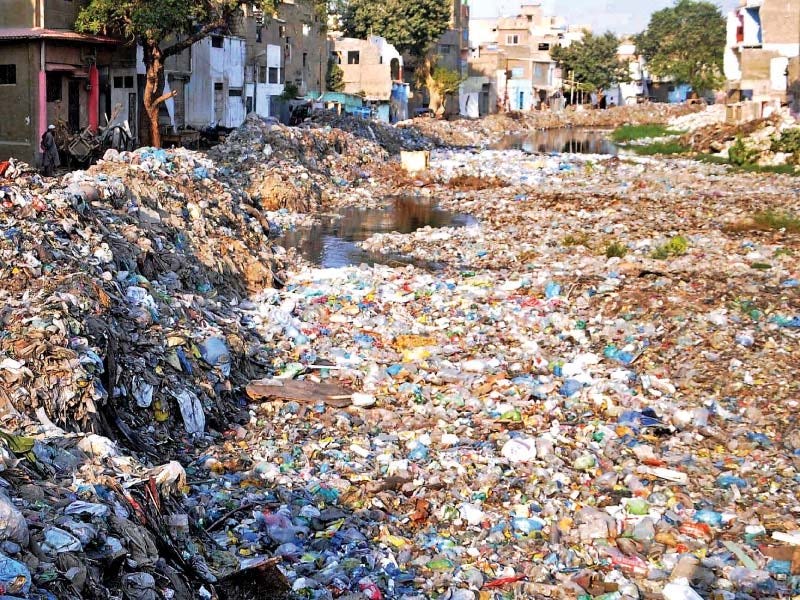
Garbage tells a similar story, though in Karachi it tells it with smell. The Sindh government created the Sindh Solid Waste Management Board in 2014 and progressively pulled sanitation functions away from municipal bodies into a provincialized structure. In theory, centralization was supposed to improve efficiency. In practice, it has provided an object lesson in how power can be consolidated without competence. The mayor has said the city generates roughly 14,000 tonnes of garbage a day and that the board manages around 10,000 tonnes. That claim sits uneasily beside the evidence of ordinary life, where entire stretches of road, neighborhood corners, and public spaces continue to resemble municipal surrender.
Opposition parties have been blistering on the subject. In April 2026, Jamaat-i-Islami called for the abolition of the SSWMB, arguing that after twelve years the board had left Karachi buried under garbage while consuming a budget of roughly Rs43 billion. Whatever one thinks of the party’s motives, the force of the complaint comes from the city itself. Garbage in Karachi is not episodic. It is structural. Even after special operations and seasonal clean-up campaigns, waste remains one of the city’s most visible public facts.
Nothing reveals the hollowness of official claims more quickly than Eid. During Eid-ul-Adha, the city becomes a stress test of administrative capacity. Animal remains, blood, and municipal waste demand fast, coordinated removal. Yet media coverage repeatedly showed offal and garbage still visible on roads and beaches after the ritual had ended. Clifton beach, one of the city’s most symbolically loaded public spaces, has repeatedly been described as a garbage hub. Karachi does not merely fail to clean itself. It performs its failure in the most public way possible.
If garbage is what people can see, sewage is what they cannot avoid. Karachi sends vast volumes of untreated or insufficiently treated wastewater into the Arabian Sea every day. One analysis estimated that around 471 million gallons of municipal wastewater enter the sea daily, while more recent work has documented severe contamination near the Karachi Port Trust coastal area, including excessive levels of biochemical oxygen demand, chemical oxygen demand, nutrients, phenol, cyanide, oil and grease, and hazardous metals. A 2024 review of maritime pollution in Pakistan noted that more than 269 million gallons per day of industrial waste and sewage from Karachi reach coastal waters, much of it through the Lyari River and other outfalls.
There is a moral dimension to this that policy language usually conceals. Untreated sewage entering the sea is not only an environmental statistic. It is a statement about whose lives are considered expendable. It means fishermen work in poisoned waters. It means coastal communities live beside contamination. It means marine life absorbs the consequences of municipal failure. It means fish sold in the city may carry the imprint of industrial indifference. Karachi pollutes its own edge because it has forgotten how to imagine the public realm as something other than a dumping ground.
Transport in Karachi takes this civic cruelty and extends it over distance. The daily commute has become one of the city’s harshest forms of social sorting. Those with money can attempt to buy speed through private cars, though even that promise collapses in gridlock. Those without money ride whatever they can find, often in dangerous, overcrowded, and unreliable conditions. The city has needed a coherent mass transit system for years. Instead, it has been given fragments, announcements, and roadworks.
The Green Line BRT, initiated by the federal government and opened partially in late 2021, was supposed to signal a new transport era. Yet a 2026 academic study found that only a quarter of respondents believed it had effectively reduced congestion on M.A. Jinnah Road, and only 34 percent were satisfied with the service. The study pointed to limited coverage, delayed construction and expansion, weak traffic management, nonfunctional signals, and poor integration with the rest of the transport system. In other words, Karachi received a corridor where it needed a network.
The Red Line BRT has been an even crueler lesson. Feasibility work began in 2016. The project was launched in 2022 with a completion target of 2023 and an initial cost of roughly USD 503 million. By April 2026, only about 23 percent of the work had been completed, according to public criticism from Jamaat-i-Islami after a site visit. University Road, one of the city’s most important arteries, has meanwhile been transformed into an extended punishment. Dust, barricades, diversions, broken surfaces, and bottlenecks have turned what should have been a transit upgrade into a long-running trial of patience and suspension.
This is what PPP’s infrastructure politics often looks like from the ground. Not absence, exactly. Not neglect in the simple sense. Something more maddening than that: a visible presence of state activity that makes life worse before it makes life better, and then continues making life worse because the better never arrives on schedule. Karachi residents do not simply suffer because projects are not initiated. They suffer because projects are initiated theatrically and then mismanaged so thoroughly that construction itself becomes another form of urban disorder.
The education sector offers a quieter but no less devastating register of the same political logic. Opposition figures, using official data, have alleged that Sindh’s education budgets over fifteen years total roughly Rs1,920 billion, including Rs454 billion in 2024-25 alone. Yet the province still has around six million out-of-school children, and tens of thousands of schools lack basic facilities like drinking water, toilets, electricity, boundary walls, playgrounds, and laboratories. The UNFPA’s Sindh fact sheet for 2023 notes a population of about 54 million, a growth rate of 2.41 percent, and severe gender disparities in schooling, with more than half of girls aged five to sixteen out of school in the province.
Karachi, with its large low-income settlements and massive population pressure, does not stand outside this provincial picture. It is one of its sharpest expressions. The city’s elites can send children to private schools or emigrate. Its working poor cannot. For them, educational failure is not abstract. It enters the household as diminished mobility, diminished literacy, diminished safety, and diminished hope. A city that cannot educate its children while siphoning off gigantic public budgets is not merely inefficient. It is practicing a form of social inheritance, ensuring that hardship reproduces itself.
Health is more complicated, because PPP and the Sindh government can point to real achievements there. ChildLife Foundation’s emergency care model, supported by the provincial government, has produced notable results, including a reported mortality rate of 1.2 percent among critically ill children older than one month in emergency departments at Civil Hospital Karachi and Sheikh Zayed Children’s Hospital in Larkana. Over fourteen years, the model is said to have helped deliver life-saving care to more than six million children in emergency rooms across Sindh. Pakistan-wide health indicators have also improved in recent years, with infant mortality declining from 57 to 47 per 1,000 live births and neonatal mortality dropping from 41 to 35 between 2018-19 and 2024-25, according to PBS data reported in 2026.
These are important facts, and honesty requires stating them. But honesty requires more than that. It requires asking why isolated competence in high-visibility hospitals coexists with general civic failure. Sindh still records serious maternal and infant health burdens, with UNFPA estimating around 3,000 maternal deaths annually in the province and high infant mortality in broader provincial data. Karachi’s public hospitals remain overcrowded. Primary care remains uneven. Waterborne disease remains an urban reality because sewage and water failures have not been structurally fixed. What emerges is a pattern not of universal state collapse but of selective performance. Where political prestige, philanthropy, or media visibility are high, outcomes can improve. Where ordinary urban maintenance is required, neglect returns.
That pattern extends into the deeper constitutional and institutional question of who governs Karachi. On paper, PPP can point to rising local government allocations. In the 2024-25 Sindh budget, the Local Government, Housing and Town Planning Department received Rs74.37 billion, up from Rs62.63 billion the previous year. Grants to local councils were also increased, and provincial officials highlighted specific enhancements for KMC and Karachi-related drains and nullahs. These figures form part of a narrative in which Sindh is generously funding urban governance.
But Karachi’s problem is not merely the size of allocations. It is the structure of authority. Over the years, the Sindh government has centralized key functions into boards, authorities, and provincial departments, leaving elected local bodies with limited power and dependent financing. Solid waste is the clearest example, but water, planning, and land governance tell similar stories. The result is a city where responsibility is blurred by design. When the garbage piles up, the province blames the town. When the water fails, the utility blames the project. When the road remains dug up, the executing agency blames the contractor. When crime surges, the police cite broader conditions. No one is fully answerable because the system has been organized to dissolve accountability into layers.
This is why PPP’s defenders so often fall back on the language of inheritance. They say Karachi’s problems were created by decades of misrule by others, especially the MQM at the municipal level. There is truth in that. Karachi did not become ungovernable in 2008. Its history includes military interventions, ethnic violence, uneven federal treatment, demographic shocks, land mafias, and the depredations of many parties and agencies. But inheritance can explain only so much. After nearly eighteen years in power in Sindh, and with the mayoralty now in its hands, PPP can no longer govern as custodian of excuse. It governs as owner of outcome.
And the outcome is visible not only in numbers but in the city’s moral atmosphere. Karachi has become a place where inconvenience metastasizes into humiliation. Residents wake early not to be productive but to preempt failure. They leave home hours ahead of schedule because roads may be blocked, traffic signals may not work, and a short journey may turn into a trap. They store water because the state does not. They hide phones because the police cannot protect them. They plan illness around hospital reputation and social networks. They navigate their own city the way people navigate a hostile bureaucracy, with backup plans for the breakdown of every basic thing.
This is what makes the phrase entrance exam to dozakh so exact. Karachi does not confront you with one definitive catastrophe. It subjects you to a sequence of tests. Can you cross the road? Can you reach work? Can you afford water? Can you avoid being robbed? Can you breathe through the dust raised by an unfinished transit corridor? Can you get your child into a decent school? Can you trust fish from the coast? Can you bear the smell of the drain outside your home in summer? The city asks these questions every day, and the wrong answer to any of them can carry a price in money, dignity, health, or life.
Meanwhile the official vocabulary remains almost comically bloodless. There are schemes, packages, interventions, revised PC-1s, stakeholder meetings, and progress reviews. There are press releases about low-income neighborhoods receiving pipelines and drainage upgrades extending projected utility needs to 2050. There are assurances that work is under way in all districts without discrimination. There is always machinery arriving, contracts being awarded, committees reviewing, or the next phase beginning soon. If one knew Karachi only through its briefings, one might imagine a city on the verge of breakthrough. To know Karachi through the body is to understand that the breakthrough keeps receding.
That distance between language and life is part of what people mean when they speak of AI voice or bureaucratic voice or development-speak. It is a prose of deodorization. It converts the violence of misgovernance into nouns. It turns people into beneficiaries, delays into slippages, corruption into irregularities, and suffering into service gaps. But cities are not spreadsheets. Karachi’s crisis is not that some indicators remain weak. Its crisis is that an entire political arrangement has made permanent stress the medium of citizenship.
The cruelty becomes even clearer when placed against Karachi’s standing in the world. The EIU’s 2025 ranking placed Karachi among the very least liveable cities globally. That is not merely an insult from abroad. It is a compressed judgment on the city’s stability, infrastructure, healthcare, education, and environment. Karachi is not being compared to fantasy. It is being compared to other cities, many of them also crowded, unequal, and historically burdened. The ranking says, in effect, that Karachi has been failed in a way that is empirically legible even from the outside.
Yet the most revealing comparison is not international but domestic. Lahore has had an integrated emergency service since 2006 and multiple mass transit schemes, including Metrobus in 2013 and the Orange Line in 2020. Karachi, a larger and more economically indispensable city, has had to wait for partial BRT fragments and endlessly delayed corridors. This contrast is not the whole story of Pakistan’s urban inequality, but it makes the point sharply. Karachi is expected to produce national value without receiving a proportionate share of national seriousness.
There are, of course, structural causes beyond PPP. Karachi has absorbed decades of migration, informal expansion, weak census politics, underinvestment, and federal-provincial conflict. Climate pressures and heat amplify the burden. The city is too large and too socially stratified for any single reform to rescue it. But structural causes do not absolve political actors. They test them. The PPP has responded to that test by consolidating power without producing metropolitan coherence. It has centralized institutions without creating accountability. It has publicized projects without building trust. It has governed Karachi as a resource to be managed, not as a city to be repaired.
This matters because the alternative is not mysterious. Karachi does not need miracles. It needs devolution that is real rather than ceremonial. It needs a metropolitan government with authority over transport, waste, planning, and water rather than a maze of overlapping bodies designed to confuse blame. It needs transparent, performance-based contracts for sanitation and infrastructure rather than opaque boards with elastic responsibility. It needs the completion of water and sewerage infrastructure as a civic emergency, not as a perpetually renewable announcement. It needs policing that is professional, accountable, and tied to a justice system capable of following through. It needs rulers who understand that a functioning city is not a favor distributed to supporters. It is the minimum condition of modern politics.
For now, Karachi remains stuck inside a provincial logic that is both extractive and sentimental. Extractive, because the city is milked for revenue, contracts, and power. Sentimental, because every criticism of that arrangement is met with speeches about love for the city, historical injuries, or schemes yet to mature. This combination has proved durable. A city can be kept in suspended animation for a long time if its crises are intense enough to keep people anxious and fragmented but not concentrated enough to force a final reckoning.
Still, reality has a way of embarrassing rhetoric. A city where more than sixty thousand street crimes can occur in a year is not secure. A city waiting two decades for a major water project is not being planned. A city dumping sewage into the sea by the hundreds of millions of gallons is not being governed. A city ranked among the least liveable on earth is not merely misunderstood. These are not partisan slogans. They are facts, and facts eventually become atmosphere.
Karachi’s atmosphere now is one of strained nerves and reduced expectations. Parents do not ask for beauty. They ask for safety and schools that function. Workers do not ask for efficiency. They ask to get home with phone and wallet intact. Residents do not ask for urban elegance. They ask that the drain not overflow, that the water arrive, that the road remain passable, that the garbage be lifted before it ferments in the sun. This is what prolonged misrule does. It shrinks civic desire until survival itself looks like moderation.
And that, finally, is the real indictment of the PPP’s Karachi. Not simply that the party has failed to make the city flourish, but that it has presided over the lowering of the imaginable. It has governed long enough for indignity to become routine. It has turned emergency into administration and scarcity into politics. It has allowed Karachi to become a place where millions of people, in one of the most economically vital cities in South Asia, must begin each day by proving themselves worthy of basics that should have been guaranteed long ago.
Karachi is not hell. Hell implies finality. Karachi is worse in a more modern way. It is the waiting room, the corridor, the queue, the detour, the form you submit again because the first one vanished, the road that stays broken, the tap that stays dry, the phone you keep hidden, the sea you can smell but not trust. It is a city that has not been destroyed so much as deliberately left unfinished. Under the Pakistan Peoples Party’s Sindh, that unfinishedness has become a method of rule. And for the people who live inside it, every day begins the same way: with another paper, another turn, another test, another attempt to pass through the gates.


Karachi deserves to be a great city. It’s sad that it has been destroyed