
Inherited Assembly
How Family Networks Shape the Sind Legislature
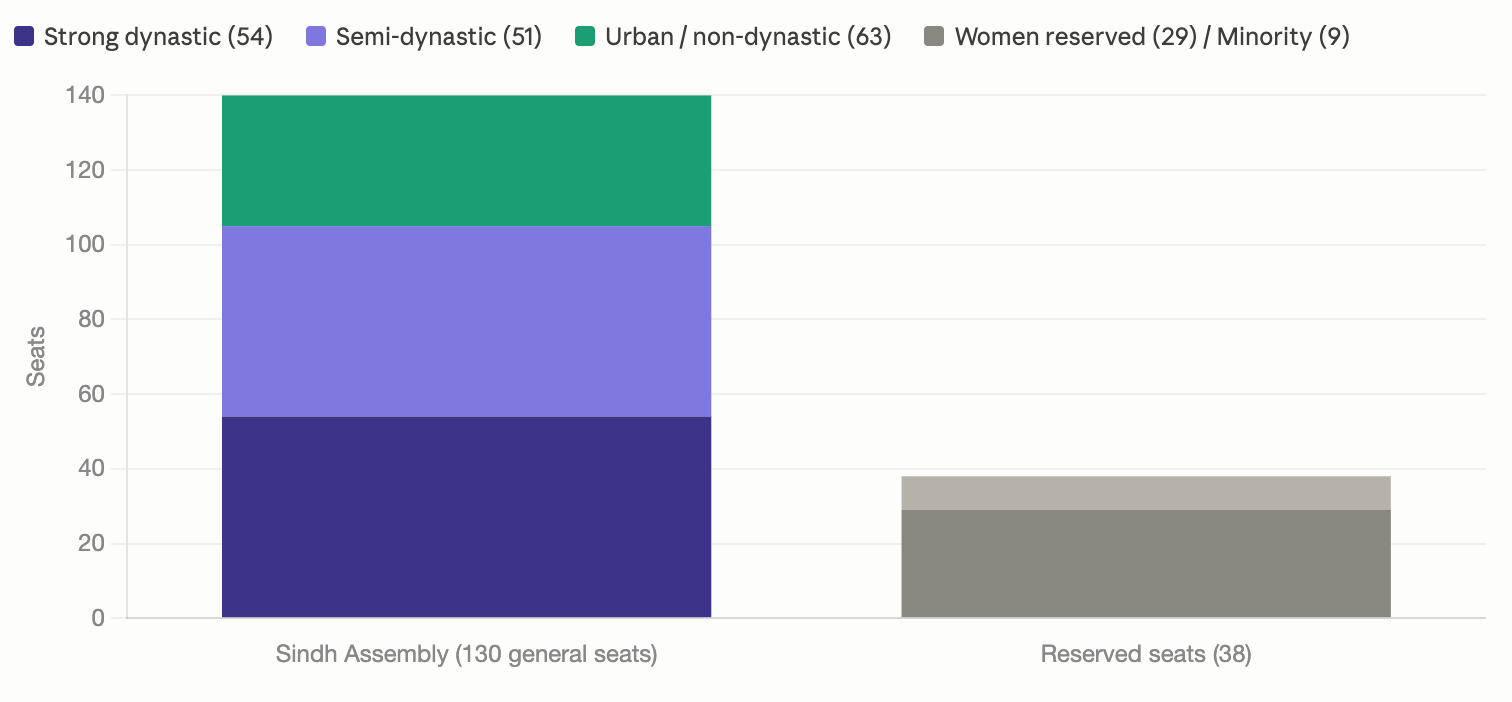
Of the 130 directly elected seats in the Sind Assembly, fifty-four are held by families whose electoral presence predates the province’s own constitutional architecture. Another fifty-one are contested by candidates whose political identity is mediated through family surname, family land, or family access to party tickets distributed along lineage. The remaining sixty-three seats, concentrated almost entirely in Karachi and Hyderabad, are won through competitive party politics where a surname carries less weight than a polling station machine. That is the provincial legislature of Pakistan’s second most populous province, mapped not by ideology or platform but by blood.
The numbers above come from a seat-by-seat analysis of the Sind Assembly’s 168-member composition following the February 2024 general elections, cross-referenced against the Election Commission of Pakistan’s 2024 candidate data, the historical record of constituency winners since 2008, and party ticket distributions documented by The News International ahead of the polls. The categories are not self-evident; the methodology matters. A “strongly dynastic” seat is one where the same family surname has won across at least two electoral cycles and where the winning candidate’s relationship to a previous winner is either direct (parent, child, sibling) or mediated through the same landed estate. A “semi-dynastic” seat is one where family networks dominate candidate selection even if the specific name on the ballot shifts. The distinction is fine but consequential. Together, the two categories account for 105 of the assembly’s 130 general seats, or 62.5 percent of the directly elected legislature.
The reserved seats, thirty-eight in total (twenty-nine for women and nine for minorities), are allocated not through geographic voting but through party lists controlled by party leaderships. Since the party leaderships in Sind are themselves drawn from the same dynastic families documented below, reserved seats do not dilute the concentration; they amplify it. A party that wins the interior through feudal electoral machinery also controls the reserved seat allocation. The legislature that results is structurally insulated from electoral accountability.
Larkana Division: Where the Barometer Is Set
Dawn described Larkana division as “the barometer of politics” in its pre-election coverage on February 8, 2024, noting that the Pakistan Peoples Party had fielded “tried and tested old guard and feudal electables” across the division’s five districts, rendering results a “foregone conclusion.” The description is accurate, and the division repays closer examination precisely because its political geography is so legible.
The division comprises Larkana, Kambar-Shahdadkot, Shikarpur, Jacobabad, and Kashmore-Kandhkot, covering seventeen provincial assembly constituencies. Larkana district itself has given Pakistan Zulfikar Ali Bhutto and Benazir Bhutto; its four PA seats are distributed between the Bhutto-Zardari network and the Jatoi family of Naushahro Feroze, whose patriarch Ghulam Mustafa Jatoi led the IJI alliance against the PPP in 1990. The electoral competition in Larkana, such as it is, tends to occur between factions of the same landed class rather than between that class and any representative of the landless majority.
Kambar-Shahdadkot presents the clearest case of family partition. The district’s four PA seats are distributed between two families: the Magsis and the Chandios. In the 2024 cycle, The News International documented that Amir Magsi held the National Assembly ticket while his brother Nadir Magsi contested the provincial seat, while Sardar Khan Chandio and his brother Burhan Khan Chandio held PPP tickets for the remaining two provincial seats. A district with four legislators and two families. The arithmetic is its own argument.
In Shikarpur, the Mahar family (in this district, the Shehryar Khan branch, distinct from the Ghotki Mahars) holds the National Assembly seat while the provincial ticket goes to Arif Khan Mehar, Shehryar’s brother. The Pirzada family, which has contested Shikarpur constituencies since the Ayub era, provides the semi-dynastic fill for the remaining seats. Jacobabad and Kashmore-Kandhkot follow the same arrangement: the Jatoi and Dharejo families dominate candidate selection for both national and provincial seats, with party affiliation adjusting to accommodate whoever holds power at the center rather than reflecting any programmatic difference.
Sukkur and Khairpur: The Reach of the Talpur and Shah Families
The Talpur family of Sind is one of the province’s most geographically distributed dynastic formations, and understanding its reach requires separating the family’s three distinct branches by region. The Hyderabad branch, the original ruling house, governed Sind under the Chauyari system until the British annexation in 1843 under General Sir Charles Napier. The Khairpur branch, founded by Mir Sohrab Khan Talpur in 1784, governed the princely state of Khairpur until the One Unit policy of 1955 absorbed it into West Pakistan. The Mirpurkhas branch is associated with the Nawab Yousuf Talpur line. All three remain electorally active in their ancestral territories.
In Khairpur district, which has six provincial assembly seats, the Talpur (Sohrab branch) and the Shah family associated with Qaim Ali Shah hold the dominant positions. Qaim Ali Shah served as Chief Minister of Sind from 2008 to 2018 across three consecutive terms and ran for a provincial seat again in 2024 alongside family members holding National Assembly tickets. Dawn’s 2018 election results documented that Syed Ali Mardan Shah had won PS-52 (Umerkot, historically adjacent to Khairpur’s political sphere) for the fourth consecutive time, receiving 52,139 votes against his nearest rival’s 20,160. A margin of that magnitude, in a constituency that has returned the same family across four elections, does not result from competitive campaign strategy.
In Sukkur, the Shah family associated with Khursheed Shah, a PPP senior figure who has served as federal minister and National Assembly speaker, extended its hold to provincial seats through documented family ticket distribution. The News International reported before the 2024 polls that his son Syed Faruukh Shah and son-in-law Owais Shah held PPP tickets for provincial assembly constituencies in Sukkur. PS-23 and PS-24 returned PPP candidates from within this network in the February results, with Syed Awais Qadir Shah winning PS-23 with 69,266 votes.
Ghotki district, where the Mahar family (Ali Gohar branch, distinct from Shikarpur) has been a dominant force since the early post-independence period, illustrates the robustness of these networks against competitive pressure. A study published in the Al-Aasar Journal of Political Science in 2024, authored from Shah Abdul Latif University in Khairpur, documented that “in the district of Ghotki, political authority has largely remained in the hands of the descendants of these traditional elite families since the creation of Pakistan.” PS-20 returned Sardar Muhammad Bakhsh Mahar of PPP in 2024 with 87,431 votes. PS-18, however, produced what Dawn categorized as “PPP’s first upset” in the division, where an independent candidate, whose affiliation to Leghari family networks was noted in election coverage, defeated the party candidate. The upset was contained to one seat. The broader structure did not move.
The Pir Layer: Spiritual Authority as Electoral Infrastructure
Alongside the wadera landlord families, Sind carries a second and distinct layer of hereditary power: the pir families and their sajjada nashin (hereditary custodian) networks. The Express Tribune documented the depth of this system in a profile of the pir-political relationship: “The influence of Pir and Syed families runs deep in Sind. Not only do these families... indirectly back particular political parties, but they also directly contest the elections as well.”
The Makhdoom family of Hala, which runs the Sarwari Jamaat from one of Sind’s most significant dargahs, has held Matiari district’s PA seats across generations. The 2018 Sind Assembly final list shows Makhdoom Mehboob Zaman at PS-58 (Matiari-I). The News International’s 2024 ticket analysis documented that in Matiari, Makhdoom Jameel-uz-Zaman held the National Assembly seat while his son Makhdoom Mahboob-ul-Zaman and nephew Makhdoom Fakhr Zaman held provincial tickets. Three seats, one family, two generations on the same ballot.
The Pir Pagaro line, associated with the Hur Jamaat, has historically contested Khairpur and adjacent constituencies under PML-F while the Pir of Ranipur’s network aligns with PPP; the competition between these two pir networks has structured Khairpur’s electoral landscape for decades in a way that leaves little room for a candidate without either a landed family name or a shrine affiliation.
The Colonial Foundation
This structure did not assemble itself. It was built, incrementally, through a series of institutional decisions that the British colonial administration made in Sind after the 1843 annexation, and that successive Pakistani governments chose not to unravel.
General Napier’s annexation transferred political authority in Sind to a colonial administration that needed local intermediaries to govern a vast, irrigation-dependent agricultural system. The British revenue settlement policies formalised land ownership in ways that confirmed and extended the power of the families who already controlled the canal network and the agricultural labour attached to it. As documented in a historical study of landownership published in academic literature: “the post-1947 developments increased the power, and enlarged the number of landed aristocracy. Bureaucrats, army officers, politicians, and industrialists served and strengthened the landlords.”
Sind was separated from Bombay Presidency in 1935. The political structures that accompanied that separation, and that were then inherited by Pakistan in 1947, were built on a landholding framework that the new state chose to maintain rather than redistribute. Land reform legislation passed in 1972 under Zulfikar Ali Bhutto exempted significant categories of land and was incompletely implemented in Sind. The families that held power in 1947 were, with few exceptions, the same families holding power in 1977, in 2008, and in 2024. What the British settlement created, Pakistani democratic arrangements inherited and sustained.
The Jaffrelot study, cited in the academic literature on Sind’s wadera system, characterises this dynamic as the PPP’s “entrenched patronage networks, which distribute resources and favours to maintain loyalty among rural electorates, alongside dynastic leadership tied to the Bhutto and Zardari families, whose historical roots in Sind amplify symbolic appeal.” The patronage network is not a corruption of the democratic system; it is the mechanism through which landed families converted pre-partition social power into post-partition electoral power and have reproduced that conversion across seven decades.
Karachi: The Counterargument
The urban exception is real and matters. Karachi’s twenty-one directly elected provincial assembly seats do not follow the interior model. The Express Tribune noted that “urban constituencies are far more competitive and less dynasty-driven,” with seats won through party organisation, demographic turnout, and campaign strength rather than land control. MQM-P, whose origins in the Mohajir urban middle class are explicitly counter-feudal, holds the dominant position in Karachi’s assembly representation. The party’s 2024 performance was the weakest in its history, with PTI-affiliated independents and PPP candidates taking seats that MQM-P once held without contest, but the competition remained organisational rather than hereditary.
This urban/rural split is not incidental. It reflects a structural difference in how power is reproduced. In interior Sind, a seat is passed from father to son because the father’s control over tenancy arrangements, canal water access, and employment in the local informal economy makes defection by voters economically catastrophic for those who depend on the land. In Karachi, no single family controls the apartment block or the wholesale market. The city’s working class is dispersed across employers, supply chains, and informal sector arrangements that no single political family can monopolise. The city is ungovernable by feudal methods.
The implication is architectural. Karachi’s competitive politics are not evidence that Sind as a whole has transcended feudal electoral arrangements. They are evidence of what those arrangements require to function: land concentration, tenancy dependency, and the absence of the economic alternatives that urbanisation provides.
What the Structure Produces
The Sind government’s own data, presented to a provincial meeting on education governance documented by the Asian Human Rights Commission, recorded 5,229 ghost schools across the province as of 2015, with over 40,000 ghost teachers drawing salaries while absent from classrooms. A 2022 Sind Education Department survey cited in subsequent reporting found nearly 11,000 schools either abandoned or non-functional, accounting for nearly fifty percent of all schools in some districts. The survey specifically named Ghotki and Khairpur, two of the districts most thoroughly controlled by dynastic political families, among those with the highest concentrations of non-functional schools.
Sukkur district’s education minister at the provincial assembly disclosed in January 2022 that more than 5,000 ghost schools in Sukkur alone would be “closed down” because they had been “functioning only on paper for over a decade.” The minister further acknowledged that the school buildings had been used as “autaak” (guest houses) and cattle pens by waderas. Sukkur district, as documented above, is among the constituencies most thoroughly controlled by the Shah family network.
According to data cited in the UNICEF-supported Sind Learning Programme document from 2024, 37 percent of the rural population of Sind lives below the poverty line. The province accounts for 23 percent of Pakistan’s total population. No district in Sind placed in the top fifty of Alif Ailaan’s national education rankings across multiple assessment cycles between 2013 and 2017. The province receives an annual education budget of hundreds of billions of rupees. The money moves. The schools do not fill.
A Sind Education Department report cited in Dawn’s analysis of ghost schools documented that 12,794 schools in the province are shelterless, 34,386 lack electricity, 26,669 have no boundary wall, 23,349 have no lavatory block, and 25,237 have no access to drinking water. These figures describe the educational infrastructure of constituencies represented, in many cases, by the same families for three or four consecutive terms. Dawn’s commentary on wadera-style governance put the mechanism plainly: “student drop-out rates at the primary and secondary levels are on the rise, largely due to absconding, or ‘ghost’, teachers with powerful political connections.”
The Sind government allocated PKR 454 billion for education in the 2024/25 fiscal year budget, up from PKR 334 billion the previous cycle. The increase was described as a milestone. Meanwhile, 37 percent of rural Sind lives below the poverty line.
The Reserved Seats Amplifier
The party-list mechanism that allocates reserved seats deserves its own scrutiny because it is rarely subjected to any. Thirty-eight of the assembly’s 168 seats are allocated to women (twenty-nine) and minorities (nine) not through geographic voting but through ranked party lists. A party that wins seats in the general election receives proportional reserved seat allocations.
In practice, this means that the PPP, which controls interior Sind through the family networks documented above, also controls the reserved seat allocations. Those allocations go to candidates selected by party leadership, which is itself drawn from the same dynastic core. The reserved seat mechanism was designed to increase legislative representation for women and minorities. In Sind’s specific institutional context, it functions as an additional instrument through which family networks extend their hold over the legislature without requiring their nominees to face any geographic constituency. A family that wins a district through wadera networks also gains reserved seat leverage from that win.
An Open Question
If 62.5 percent of the directly elected legislature is structurally insulated from competitive electoral accountability through family network dominance, the relevant question is not whether Sind has elections. It does, on schedule, with millions of voters casting ballots, and the Election Commission of Pakistan administering the process with whatever competence and independence it can bring to bear. The question is whether the mechanism of inheritance that determines who contests, who wins, and who receives party tickets can be disaggregated from the formal electoral apparatus without a structural change in land ownership, tenancy law, and the economic dependency that the wadera system requires to reproduce itself.
Pakistan’s land reform history does not suggest optimism. But the urban competitive exception in Karachi, and the handful of interior constituencies where independent candidates broke through in 2024, suggests the mechanism is not inviolable. Whether those cracks will widen, or whether the family networks will absorb the pressure and close them, is the question the next assembly cycle will answer.
A Note on Sources and Methodology
The seat classification system used in this report (strong dynastic, semi-dynastic, and urban/non-dynastic) is derived from cross-referencing four data sets: the Election Commission of Pakistan’s official 2024 general election results for all 130 Sind Assembly constituencies; the ECP’s historical constituency-level results for the 2013 and 2018 elections; candidate ticket distribution data published by The News International ahead of the February 8, 2024 polls, which documented family relationships between National Assembly and Provincial Assembly nominees within the same districts; and the official member lists of the Sind Provincial Assembly published by the PAS (Provincial Assembly of Sind) for the ninth and tenth assemblies.
A seat is classified as “strong dynastic” where the same family surname has won the constituency across at least two consecutive electoral cycles and where the relationship between the current winner and a previous winner is direct (parent to child, sibling to sibling) or mediated through shared landed estate and party ticket access. A seat is classified as “semi-dynastic” where candidate selection is demonstrably controlled by family networks even where the specific name on the ballot changes between cycles, typically because the family rotates members across National Assembly and Provincial Assembly seats within the same district. The “urban/non-dynastic” classification applies to constituencies where results are determined by party organisation, demographic turnout, and campaign competition without documented family seat inheritance, a category concentrated in Karachi’s twenty-one PA constituencies.
Election Commission of Pakistan. The primary source for all vote tallies, constituency boundaries, and official results. Constituency-level results are publicly available through the ECP’s elections portal. The 2024 results referenced in this report, including PS-20 Ghotki (87,431 votes, Sardar Muhammad Bakhsh Mahar, PPP), PS-23 Sukkur (69,266 votes, Syed Awais Qadir Shah, PPP), and PS-52 Umerkot historical data, are drawn from ECP declarations cross-referenced against ARY News and Dawn live result coverage from February 8 to 11, 2024.
Dawn. Pre-election constituency analysis published February 8, 2024, under the headline “With ‘tried and tested’ contestants, poll outcome for PPP a foregone conclusion in Larkana division,” provided the divisional breakdown of candidates, voter registration figures (Larkana division total: 3,592,271 registered voters), and the characterisation of candidates as “feudal electables.” Dawn’s election night live results coverage provided the PS-18 Ghotki upset documentation. Dawn’s editorial on “Wadera governance,” published June 24, 2016, provided the structural analysis of ghost teacher connections to political networks.
The News International. Pre-election ticket analysis published ahead of the February 2024 polls documented family ticket distribution across Sind constituencies. This is the primary source for the intra-family seat arrangements in Kambar-Shahdadkot (Magsi and Chandio families), Ghotki (Mahar family, NA-199 and provincial seats), Sukkur (Shah family, NA-201 and provincial seats), Matiari (Makhdoom family, NA seat and two provincial seats), Khairpur (Shah family, NA seats and PA seat), and Mirpurkhas/Umerkot (Talpur family, NA-220 and PS-53 arrangements). The report also sourced the Shikarpur Mahar family arrangement (Shehryar Khan Mahar, NA-193, and Arif Khan Mehar, PA seat).
Asian Human Rights Commission. The figure of 5,229 ghost schools and over 40,000 ghost teachers in Sind is drawn from an AHRC report published January 22, 2015, citing a Supreme Court commission investigation into the province’s education infrastructure. The commission’s finding that 4,540 school buildings exist on ground but are non-functional was published in that report.
Weekly Cutting Edge / Sind Education Department (cited). The January 2022 provincial assembly disclosure by Sind Education Minister Sardar Ali Shah, that more than 5,000 ghost schools in Sukkur district alone would be closed because they had been used as “autaak” and cattle pens, was reported by Weekly Cutting Edge and cross-referenced against the Sind Education Department’s own public statements on ghost school closures in that period.
UNICEF / Global Partnership for Education. The Sind Learning Programme document published December 2024 through the Global Partnership for Education provided the current provincial poverty and education statistics: 37 percent rural poverty rate, 55.6 million provincial population (23 percent of Pakistan’s total), and the PKR 454 billion education allocation for FY 2024/25. The document cites UNICEF’s 2019 to 2022 Multi-Indicator Cluster Survey (MICS) and the National Achievement Test (NAT) 2023 Sind findings as its data sources.
Al-Aasar Journal of Political Science (Shah Abdul Latif University, Khairpur). The 2024 peer-reviewed article on the historical development of family-based politics in Ghotki district, authored from the Department of Political Science at Shah Abdul Latif University, provided the academic documentation of British administrative reform as the structural origin of family political authority in northern Sind. The article established the 1843 annexation as the inflection point and documented the continuity of the same landed families from the princely-state period through contemporary electoral politics.
Express Tribune. The profile of pir and syed family electoral influence in Sind, which documented the Sarwari Jamaat (Makhdoom family, Hala), the Hur Jamaat (Pir Pagaro), the Ghousia Jamaat (Shah Mehmood Qureshi), the Pir of Ranipur (Khairpur Mirs), and the Bharchundi Sharif network (Ghotki), provided the structural account of the spiritual-authority layer of Sind’s hereditary political system. Senior journalist Niaz Bhanbhro’s quoted observation about the Pir Pagaro and Pir of Ranipur opposing each other across electoral cycles since the 1970s established the temporal depth of this layer.
The Nation / Brecorder. Pre-election analysis from 2007 and 2013 documenting the PPP and other parties’ practice of fielding landlords as candidates across Sind constituencies provided historical baseline data. The 2007 analysis documented that PPP fielded 52 landlord candidates in 112 constituencies and PML-Q fielded 52, establishing that feudal candidate selection is not a PPP-specific arrangement but a cross-party structural feature of Sind’s electoral economy.
Researchgate / Academic literature. The Jaffrelot study cited in the academic literature, “The Wadera system and regional politics in Pakistan: The case of Sind,” Journal of Asian and African Studies, 50(1), 2015, provided the peer-reviewed framing of PPP patronage networks and dynastic leadership as causal mechanisms behind electoral dominance in rural Sind. The study on historical landownership and landed aristocracy in Pakistan provided the post-1947 consolidation analysis.
Alif Ailaan District Education Rankings (2013 to 2017). The finding that no district in Sind placed in the top fifty of national education rankings across multiple cycles, cited in Dawn’s education coverage and confirmed in Alif Ailaan’s published ranking reports (archived through ASER Pakistan and the Sustainable Development Policy Institute), established the education performance baseline against which budget allocations are measured.
Provincial Assembly of Sind official records. The PAS member lists for the ninth and tenth assemblies, available through the PAS website, provided constituency-level data on sitting members and their declared addresses, used to cross-reference family seat arrangements against geographic constituencies.


