


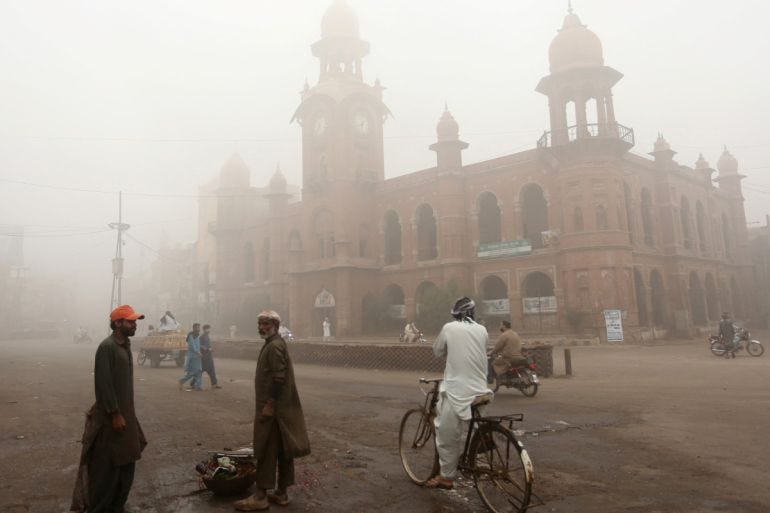
At midday, Rashid Ali’s two boys needed lunch. Their father had been driving a rented Lahore rickshaw since six in the morning and expected to keep driving well into the night. The vehicle cost him 600 rupees each day before the first passenger climbed in. He had been stopping for LPG four or five times, paying 300 to 400 rupees at each stop, while passengers bargained his fares down. After thirteen years behind the wheel, he was still trying to get his family through the month on what he described as 700 or 800 rupees a day. They had already cut their meals to two. The rent on their home was 11,000 rupees. Lunch, in that household, was a matter of how many more hours he could drive.
The provincial government has a medical instruction for men like Ali when Lahore’s air turns hazardous: remain indoors and avoid unnecessary travel. I would like to see the official who wrote that instruction sit beside him at noon and identify the unnecessary journey. Is it the one that pays for the vehicle, or the trip that buys the boys their evening food? Ali’s expenses arrive in cash; the government’s concern arrives as an advisory. A salaried resident can move a meeting online, travel in a closed car and filter a bedroom. The people who drive that car, deliver its food and clean its building are asked to remain outside, and yet the warning addresses both households as though they have the same freedom to obey it. The government is asking the poor to finance their own protection with wages they cannot spare.
Lahore registered among the world’s most polluted major cities on November 9, with one live city index at 590 and a separate hourly reading reaching 647. An index changes by station and by hour, but both readings signaled air dangerous enough to make the government’s advice urgent. On the same day, men stood beside a road waiting for daily work. They had to leave home before knowing whether a contractor would hire them, which meant that even the ones who earned nothing had taken their morning dose of polluted air. The broadcast tells them to go inside. The labor market requires them to be visible from the road.
By the time a minister announces that an afternoon index has fallen, a driver facing Ali’s expenses has already paid for the vehicle and fuel. A later reading cannot refund a missed fare or return the air breathed during the hazardous morning.
Mohammad Arif had bought himself a pair of glasses for a hundred rupees. At the construction site where he worked during an earlier smog season, the air also held dust from the bricks being loaded around him and exhaust from an excavator. Men waited along the roadside for work. Arif worried about who would pay for his medicine if he became ill; Muzaffar Ahmed described a sore throat and irritated eyes. The workers had no masks or gloves. Their employer could calculate the cost of a sack of cement down to the rupee, yet the air the men breathed while carrying it was left off the invoice.
Amjad found out what a site closure could cost when smog restrictions stopped construction and his contractor sent the crew home without pay. The building still had to be finished; when work resumed, the missing time could be recovered through earlier starts and later finishes that workers said were rarely paid as extra hours. The province had saved its closure order from the expense of a wage guarantee, and the contractor had saved his deadline from the inconvenience of paying workers for the hours he could later demand back. Amjad had neither the wage nor control over the schedule.
At a private golf club, Irfan made a living as a caddy. Members could look at the sky and decide whether to play; his pay depended on their decision, and he worried that staying away because the air made him sick could cost him his place. When the club closed during a previous smog emergency, he did not know whether staff would receive wages. A member could cancel the round and lose an afternoon’s amusement, while the man who carried the clubs might lose the pay on which his household depended. Amjad’s site can close with an order, but his landlord will still collect the rent. The province has used its power to stop work and left each worker to bargain alone over what happens to his wage. Why is the owner’s deadline protected with such care while the worker’s dinner is left to chance?
Mohammad Amir bought fruit at the wholesale market early in the morning and brought it out to sell despite falling ill more than once during smog season. A fruit seller cannot tell his stock to keep until the air clears. Nor can a rickshaw driver collect tomorrow’s fares for a ride he refused today. When Khalid Mehmood described illness cutting into his income, he was describing the part of the smog story absent from the official air-quality dashboard: money spent getting sick, money lost while sick, then more hours outside to recover it. These people have no quarrel with clean air or with the advice to protect their lungs. They have been denied the means to follow it.
A cleaner named Asiya and her husband went to work while their children stayed with their grandmother during a school closure. Their low-cost private school had no online classes. Across the city, children in homes with reliable internet and a device could continue their lessons inside; Asiya’s children were out of class while both parents went into the hazardous air to earn a wage. The school gate had closed, but the household had not been moved into a filtered room. No one paid Asiya to stay with her children, and no government order could make her employer’s workplace appear in her kitchen. Asiya’s children had somewhere to go only because their grandmother was available. Remove that relative from the arrangement and the government has another problem it has not planned for; leave her in place and the province can go on describing the school closure as if it supplied the care itself. A minister may congratulate the cabinet for acting quickly, while the actual work of making the order bearable falls on a woman who had no part in writing it. The grandmother’s labor will never appear in the announcement.
Lahore’s monthly average fine-particle readings stayed above 35 micrograms per cubic metre throughout the period from October 2025 to October 2026. April through September ran from 40 to 59; June, the least polluted of those months, averaged 40. October reached 100. The more recent count, covering the forty valid days from October 1 through November 9, averaged 126, and every one of those days exceeded Pakistan’s daily standard. Winter makes the crisis more visible and often more severe. It cannot be held responsible for the pollution residents breathed through June. The word season has been extremely useful to the people in charge. It gives every November a beginning and a promised end, inviting Lahore to endure a few dreadful weeks and then forget what its lungs were doing in July. Traffic exhaust, industrial emissions, waste burning and dust do not keep a festival calendar. Cooler weather lowers the height of the air layer into which pollution can disperse; what the city releases then collects closer to the ground. The precise depth of that layer is disputed between researchers and provincial officials, but nobody disputing it has made the exhaust pipe disappear. A shower or a strong wind can improve the readings for an afternoon. Neither can inspect a factory or change the fuel in a truck.
Punjab has expanded its regulatory-grade monitoring network from thirty stations to fifty-nine. More monitors are useful; a resident should be able to know what is in the air near home and work. Their readings also make the official optimism harder to bear. A government that can measure forty consecutive days above its own daily standard cannot plausibly treat the last bad day as an ambush. Every screen showing a hazardous reading is a public record of the distance between what the province knows and what it has made safe.
A fall in the local air-quality index from 489 in the morning to 232 by midafternoon on November 9 was presented as progress. The wind improved while emergency measures were underway, and the two readings cannot assign a precise share of credit to either cause. At 232, the air was hardly fit for a victory speech. The day laborer had already waited by the road; the rickshaw driver had already paid to put his vehicle into service. Officials can revise an afternoon figure. They cannot return the morning to the people who spent it outside.
Punjab’s senior minister, Marriyum Aurangzeb, pointed to Diwali fireworks and smoke traveling from Indian Punjab. Some air did cross the border: trajectories tracked before it reached parts of Pakistani Punjab passed over India. A responsible government would have given the public that fact alongside the other one sitting in the satellite record. Between October 1 and November 9, instruments detected 16,714 likely crop-residue fire signals in Pakistani Punjab. The signals are heat detections rather than individually confirmed field fires; a satellite cannot tell us how much of any one plume reached Arif’s worksite. The scale of burning on this side of the border still demands an answer from the people who govern it. Nearer Lahore, an analysis of the period from October 15 to November 1 found 781 crop-associated detections within forty kilometres of the city centre. Sheikhupura accounted for 322. Across the border, Tarn Taran accounted for 149 and Amritsar for 106. Nankana Sahib, Kasur and Lahore itself also appeared in the count. The provincial cabinet was free to study cross-border smoke while its own districts burned; instead, the story told to residents made the foreign wind the star. A Pakistani farmer whose field is on fire cannot be reached by a press briefing about Diwali.
Nor did the available measurements isolate firework smoke from crop smoke and all the other material suspended in Lahore’s air. The city experienced an increase after Diwali compared with the same hours in the preceding week, while Faisalabad and Multan, farther inland, recorded larger increases in the period examined. Chemical tests would be needed to identify how much came from fireworks. Aurangzeb had supplied the culprit before anyone had supplied the proof.
I do not need the government to pretend that air stops at Wagah. Cross-border pollution is a real problem that requires cooperation. I need the people who hold office in Punjab to account for the emissions within their reach and for the workers exposed while they are busy describing a plume’s passport. Lahore’s buses and trucks run on Pakistani roads, waste is burned in Pakistani neighbourhoods, and the satellite detections appear in Pakistani fields. The border explanation is politically convenient because a minister can condemn a firecracker in another country without asking a local transport operator, a factory owner or an agricultural interest to change anything at home.
After the fireworks briefing came the familiar November equipment: water cannons, altered school hours and statements about improving conditions. Those measures can help in a limited place or time. The cannons cannot remove the emissions that keep monthly particulate readings high through the warm months, and a school closure does not take care of Asiya’s children. The briefings nevertheless have a convenient audience. The officials who give them can retire indoors afterward; the people they address have to find their next fare or shift.
A $300 million concessional World Bank loan supports Punjab’s clean-air plan. It calls for six hundred electric buses, five thousand super seeders to cut crop-residue burning, stronger monitoring and two fuel-testing laboratories, with a target of reducing PM2.5 exposure in Lahore Division by 35 percent over a decade. The plan names sources of pollution the province has the power to confront. Its timetable also contains a cruelly familiar division: the government has ten years to meet its target; a driver paying rent on his vehicle has until tonight to earn the money back. A bus promised in a project document cannot carry him home, and a laboratory whose work has not changed the fuel on sale cannot clean what he inhales tomorrow.
Where Arif loaded bricks, an inspector could check the dust and the equipment supplied to workers. The provincial government could put wage protection in its own construction contracts and require payment when smog orders suspend private sites. Fuel can be tested, industrial units inspected while they burn and waste collected before anyone lights it in the street. Each step requires an employer, a fuel supplier or the province itself to carry part of the cost. The advisory leaves that cost with the worker. Ali can be told to maintain a vehicle, but if a failed emissions test becomes a fine without an affordable route to repair or replacement, the state has made him poorer without making transport clean. The cabinet is paid to solve the problem it can regulate, not to transfer it to someone else’s dinner table.
An air purifier can run throughout a school closure in a comfortable home. Asiya still has to reach her cleaning job after arranging care for her children, and the owner of a closed car does not breathe the roadside exhaust that surrounds the person paid to drive it. Every exhortation to shelter that arrives without wages, transport or childcare charges the cost of Punjab’s emergency to the people doing its least protected work.
Punjab counts inspections and sanctions. It should show residents which large fleets and industrial premises were checked, whether penalties were collected and whether the air near their homes and workplaces improved. The same public record should say where purchased buses operate and where seeders have reached farms. A photograph of officials beside equipment will circulate more readily than an inspection report, but only the second can help a resident judge whether the province has touched the sources of pollution. The driver waiting for next week’s fares cannot live inside a ten-year target.
When Amjad’s construction site closed, the contractor sent him home without pay and kept the deadline for the building. That decision meant the government’s restriction reached the worker’s household as a loss of income, then reached him again as a demand for longer hours. Lahore’s government knows the air is dangerous, possesses the readings and has begun to fund a response, and yet it still leaves the people who can least afford a lost shift to pay for its immediate orders. If Punjab sends workers home for their health, it must pay them for the day.