
How PMLN Punjab Turned a Children’s HIV Epidemic Into a Press Release
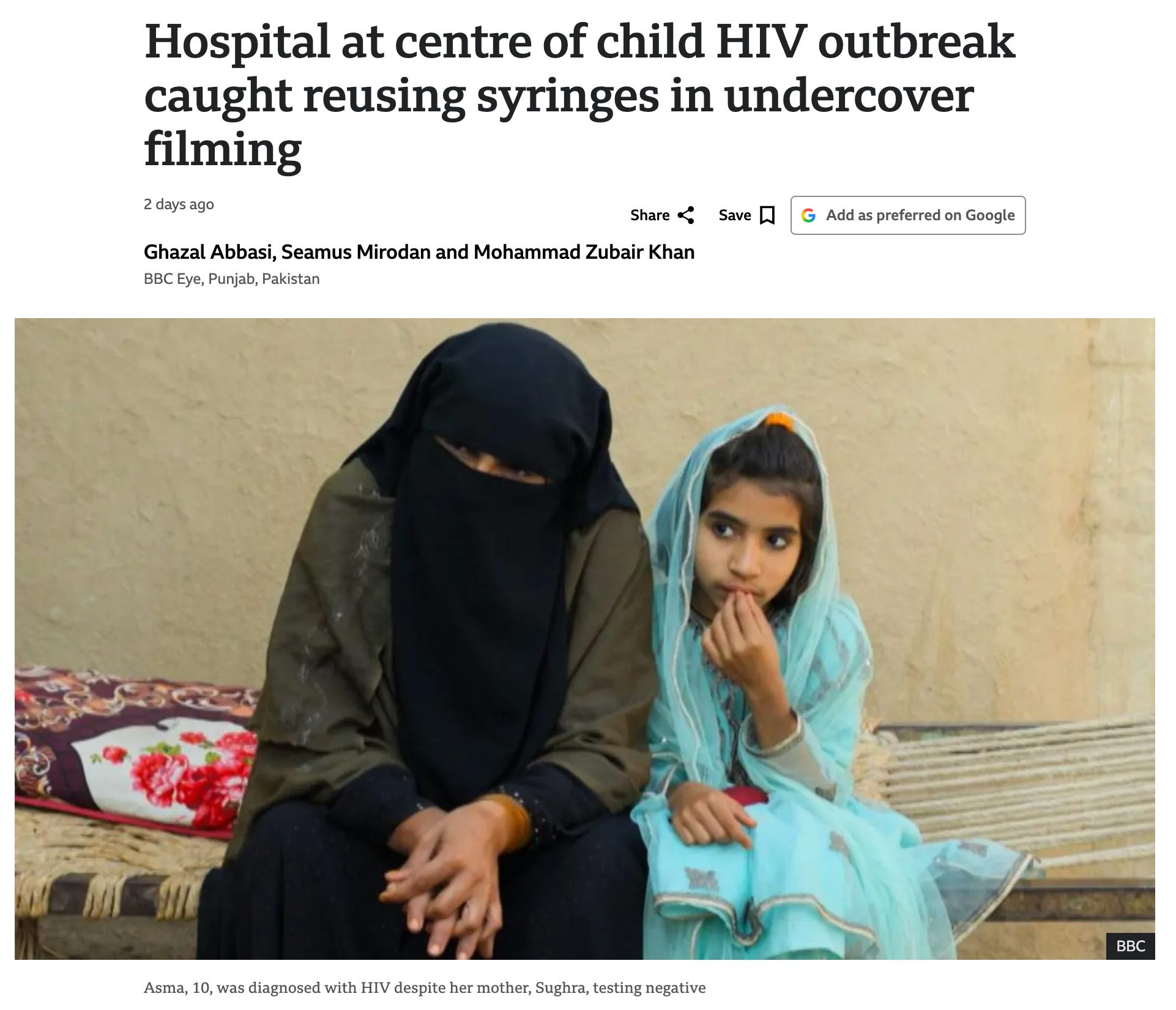
Asma is ten years old. Her family brought her to THQ hospital in Taunsa for a routine injection, and she came home with HIV. She is one of 331 children in this district of southern Punjab who have tested positive, her case among those documented by BBC Eye, and the Punjab government that runs the hospital where she was injected has issued a formal position on what happened to her: there is, in its official assessment, no validated epidemiological evidence conclusively linking THQ hospital to the outbreak.
Her family has no counter-position prepared. They are raising a child who is HIV positive, in a district where the government hospital at the center of the outbreak is still operating, still seeing patients, still funded by the same provincial budget that paid for the press conference in which Maryam Nawaz announced she was taking this seriously.
THQ Taunsa is a government facility. It operates under the Punjab Department of Health, which operates under the Punjab government, which is led by Chief Minister Maryam Nawaz Sharif of the Pakistan Muslim League-Nawaz. The accountability runs in a single unbroken line from Asma’s injection to the Chief Minister’s office, which is precisely why the government has spent the better part of a year arguing that the line does not exist.
The syringe reuse at THQ Taunsa was a practice, not a rupture. BBC Eye’s investigation drew on provincial screening data, leaked police records, and the testimony of the private doctor who first identified the cluster in Taunsa. That doctor flagged it. The BBC confirmed it. When the Punjab government was asked to confirm it, it produced instead a detailed inventory of its own response: meetings chaired, missions ordered, officials suspended, international partners mobilized. The response was meticulous in its public architecture. It produced, in practice, zero criminal prosecutions, no structural reform of the hospital’s injection protocols, and a ward that BBC Eye filmed reusing syringes on children months after the crackdown was announced.
The current medical superintendent, Dr. Qasim Buzdar, told BBC Eye the footage was either staged or recorded before his tenure began. The footage has timestamps. The children have medical records. What Dr. Buzdar has is a talking point that does not hold up to either.
When the outbreak went public in March 2025, with 106 reported cases confirmed at the time, the Punjab government’s first act of visible accountability was the suspension of the hospital’s medical superintendent, Dr. Tayyab Farooq Chandio. The suspension came with the full official production: a CM-chaired meeting, a formal directive, Chandio’s name attached to the government’s claim that it was taking action. His suspension was cited in reporting. It was cited by the government itself.
He was subsequently reinstated as a senior medical officer at a rural health center on the outskirts of Taunsa. No criminal case was filed. No public explanation was offered for why the official whose removal had been announced with such urgency was now back on government payroll at a quieter posting. The Pakistan Medical Association formally demanded criminal prosecutions over Taunsa. As of the date of this piece, none have been initiated, and Chandio’s reinstatement has attracted less reporting than his original suspension by a considerable distance, which is, of course, the point.
To understand Taunsa, you have to go back three months before Taunsa, to Nishtar Hospital in Multan, because Maryam Nawaz’s government had already run this play once by the time BBC Eye arrived in Taunsa with hidden cameras.
In November 2024, approximately 30 dialysis patients at Nishtar Hospital contracted HIV through reused dialysis kits. Mandatory HIV screenings had not been conducted. Worse, positive results had been actively concealed by hospital staff. Patients were living with HIV and did not know it, not because the health system had missed it, but because someone inside it had decided not to tell them. Maryam Nawaz suspended seven officials and visited the hospital in a media-covered trip. A Punjab government inquiry subsequently found senior officials guilty and recommended the removal of the university Vice Chancellor overseeing the hospital. Criminal cases were recommended by the inquiry. Criminal cases were not filed.
The same provincial government. The same sequence. The same silence at the end where prosecution should have been.
When Taunsa broke publicly four months later and Maryam Nawaz chaired another emergency meeting and suspended another medical superintendent and ordered another international mission, she was not failing to learn from Nishtar. She was repeating Nishtar. There is a difference between the two, and it matters.
The Punjab government’s formal counter-narrative on Taunsa attributes the outbreak to unregulated private practices and unscreened blood transfusions, a carefully chosen formulation that moves the source of infection away from a government-run facility and onto a private sector the government cannot be held institutionally accountable for. The BBC’s data came from provincial screening programs, leaked police records, and a clinician who identified the cluster before any government agency acknowledged it. The government’s counter-narrative came from the government’s assessment of the government’s own hospital.
The public was asked to accept that 331 children in a single district of southern Punjab had contracted HIV through informal private channels, and that the government hospital where those same children received injections was a coincidence. Dr. Buzdar’s claim that the undercover footage was filmed before his tenure does not deny that syringe reuse was happening. It does not deny that 331 children tested positive. It locates the problem in a previous superintendent of the same facility, under the same department, under the same Chief Minister, which is still a catastrophic indictment of the Punjab health system even on the government’s most charitable reading of its own conduct. The BBC’s timestamps make even that reading unavailable.
Punjab has been PMLN territory for the better part of thirty years, with intervals brief enough that the party’s institutional roots in the province’s administrative machinery are close to total. District-level government appointments, including medical superintendents at public hospitals, run through political networks that the party has had three decades to cultivate and protect. The reinstatement of Dr. Tayyab Farooq Chandio is legible against that background not as a bureaucratic lapse but as a network performing its basic function: protecting its people from consequences.
PTI’s Imran Ismail named this publicly, pointing to the reinstatement as evidence of political protection rather than administrative drift. The Pakistan Medical Association named it differently, in the formal language of a demand for criminal prosecution, which the provincial government, sitting on the authority to initiate those cases, has declined to exercise. Not in Taunsa. Not in Multan. Not across two major institutional HIV outbreaks in twelve months in the same province under the same administration.
On the day of Maryam Nawaz’s emergency meeting in March 2025, the session produced a UNICEF/WHO joint mission, a commitment to free treatment, and the suspension of the medical superintendent. BBC Eye produced something else: footage of the same children’s ward at Taunsa THQ, filmed months after the crackdown, with syringes still being reused.
The press conference delivered everything a press conference can deliver. The ward delivered the same thing it had been delivering since before the outbreak was reported. What sits between them is not confusion, not systemic inertia, not the ordinary gap between policy and implementation that any large bureaucracy produces. It is a decision, made at some level of an administration that had already run this sequence once in Multan and knew exactly where the sequence ended. The press conference is the product. The ward is the condition under which it continues to operate.
There is one question the documented record cannot yet answer: at what level was the decision made not to prosecute? The facts on the surface are clear enough. The PMA demanded criminal cases. The provincial government has the authority to initiate them. It did not, in Taunsa, and it did not in Multan, and the interval between the two is short enough that the second non-prosecution cannot be attributed to oversight.
What the record does not yet show is whether this is the bureaucratic preference of a health department that has learned over decades that suspensions satisfy scrutiny and prosecutions create enemies, or whether it is a decision carried by someone with enough political weight to ensure that Dr. Chandio’s reinstatement was quiet, that the PMA’s demand went unanswered, and that 331 children in Taunsa remain the evidence of a practice the state has chosen not to formally attribute to anyone.
That is the question Maryam Nawaz’s government has not answered and has shown no indication of being asked to answer by anyone with the institutional standing to compel a response.


