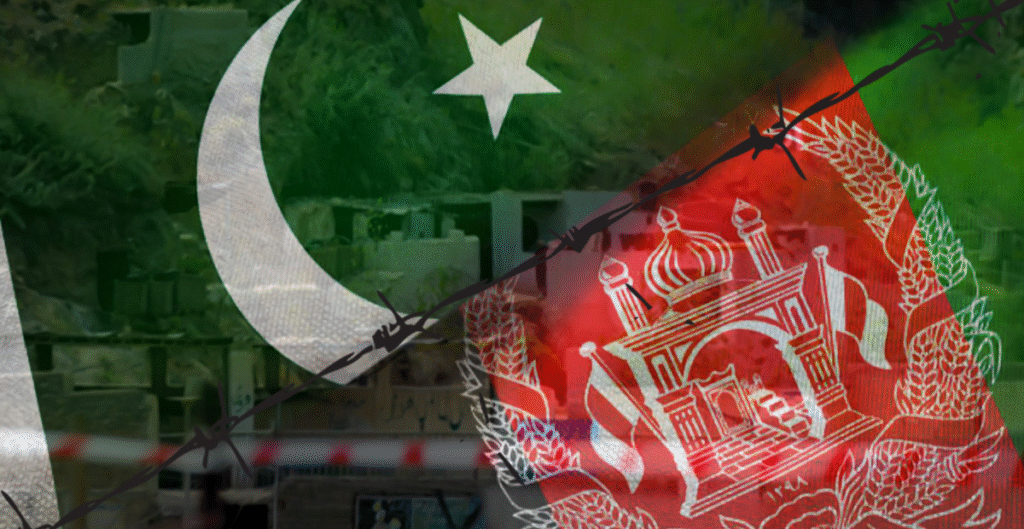
From Islamabad to Nangarhar, the Dead Keep Multiplying
The TTP kills Pakistani civilians. Pakistani airstrikes kill Afghan civilians. Two governments have turned this cycle into a permanent condition and called it counterterrorism.
The smell of a mosque after a bombing is something specific. Dust from collapsed plaster, electrical burning from shorted wiring, the particular sweetness of blood pooled on a floor where men had just been kneeling in prayer.
At the Khadija Tul Kubra mosque in Islamabad’s Tarlai Kalan neighbourhood, on the afternoon of 6 February, worshippers had gathered for Friday prayers. A man fought past the security guards at the entrance, opened fire, and detonated. The Pakistan Institute of Medical Sciences received the injured in waves through the afternoon. At least thirty-two people were killed and 170 wounded, confirmed by the UN Security Council in formal session, though some Pakistani media sources reported the toll rising toward forty in subsequent days as the critically injured died. It was the deadliest attack in Pakistan’s capital since a truck bomb took apart the Marriott Hotel in 2008.
Sixteen days later, at midnight on 22 February, Pakistani warplanes found Girdi Kas village in Nangarhar’s Bihsud district. A farmer named Nezakat, thirty-five years old, was in his room with his wife when the bombs landed. He came out and carried his aunt from the debris. Then his son called to him from under the rubble, injured. Thirteen members of Nezakat’s family were found dead. Five more were missing when he spoke to Radio Free Europe’s Radio Azadi. The youngest person killed in the strike was one year old. The oldest was eighty. Eighteen members of a single family were buried together in a mass grave in the village while neighbours who had run toward the sound stood in the early morning and dug.
These are not two separate stories requiring balance. They are the same story. The worshippers in Tarlai Kalan and the family in Girdi Kas are casualties of the same war, conducted by different actors, justified by different press releases, but sustained by the same institutional failure on both sides of a boundary that has been producing corpses for over a century.
The bombing of Khadija Tul Kubra was the second major attack in Islamabad in three months. In November 2025, a suicide bomber had struck outside the city’s District Judicial Complex, killing twelve people. That attack targeted a state institution. The February bombing targeted a Shia congregation at Friday prayers. The Islamic State Khorasan Province claimed the mosque attack on Telegram, releasing what it said was a photograph of the attacker. Pakistan’s Interior Minister Mohsin Naqvi announced four arrests in Peshawar and Nowshera and named one suspect as an “Afghan Daesh mastermind.” The UN Security Council condemned the attack in formal session. The dead were buried over the following days by families who had arrived expecting them home from prayers.
Pakistan’s Defence Minister Khawaja Asif declared the country was in “a state of war.” He blamed India and Afghanistan, without producing evidence for the India connection. The Afghan Taliban condemned the bombing and denied any knowledge of the attack. Pakistan’s security establishment, which had attributed the November 2025 judicial complex bombing to Afghan-linked factions as well, had exhausted its patience with denials from Kabul it considered operationally dishonest.
The numbers in Pakistan are not invented. The Pakistan Institute of Peace Studies recorded 699 terrorist attacks across the country in 2025, a 34 percent increase from the year before, killing 1,034 people. The Armed Conflict Location and Event Data Project documented more than 4,000 deaths in Pakistan’s frontier provinces from militant violence in 2025 alone. The Pakistan Institute for Conflict and Security Studies called 2025 Pakistan’s deadliest year for terrorism in a decade. Brown University’s Watson Institute for International and Public Affairs placed total Pakistani civilian and security deaths in the war on terrorism since 2001 at more than 30,000. The direct and indirect economic cost reached $126 billion by 2018 according to Pakistani government figures reported by Dawn, and has continued upward through years of compounding attrition in Khyber Pakhtunkhwa and Balochistan.
Hours before the 22 February airstrikes, a suicide bomber struck a security convoy in Bannu during the opening days of Ramadan, killing two soldiers, one of them a lieutenant colonel. The week before, a vehicle-borne device rammed a security post in Bajaur and killed eleven soldiers and a child. Pakistani authorities identified the Bajaur attacker as an Afghan national. The Pakistan military issued a statement after Bannu that it would not “exercise any restraint.” This was not a threat without a record behind it. It was a statement of policy.
Pakistan’s Foreign Office spokesperson Tahir Andrabi had told reporters three days before the strikes, as reported by Dawn: “Pakistan very legitimately demands that Afghan territory should not be used for terrorism inside Pakistan.” Information Minister Attaullah Tarar said Islamabad held “conclusive evidence” that the recent attacks were carried out at the direction of “Afghanistan-based leadership and handlers.” President Asif Ali Zardari, in a statement published by The Express Tribune, called the subsequent airstrikes “rooted in Pakistan’s inherent right to defend its people against terrorism” and said Kabul had created conditions “similar to or worse than pre-9/11.”
None of this was invented by a press office. Pakistan has buried thousands of its own in this war, in mosque courtyards, in military cemeteries along the frontier, in the hospitals of cities that were supposed to be safe. The Islamabad of February 2026, attacked in its own capital nearly two weeks before Ramadan began, carrying a decade of compounding insurgency on its frontier, has a genuine security crisis that no serious analysis can dismiss.
In the early hours of 22 February, Pakistani jets struck seven locations across Nangarhar and Paktika provinces. The Ministry of Information and Broadcasting said the strikes were “intelligence-based, selective operations” against camps belonging to the TTP, its affiliates, and ISKP. Deputy Interior Minister Talal Chaudhry told Geo News that at least seventy militants were killed. He offered no evidence. Pakistan’s state media revised the figure to eighty. No names. No unit designations. No independent confirmation.
What AFP, Al Jazeera, the Associated Press, and TOLOnews documented on the ground that morning: in Bihsud district alone, eighteen people killed in the Girdi Kas residential strike. An Afghan security source told AFP that twelve of the seventeen confirmed dead in that single location were children and teenagers. An AFP journalist watched villagers use a bulldozer to search for bodies under the debris of what had been a family home. Nangarhar police told AFP that the bombardment started around midnight and hit three separate districts. Strikes also hit Khogyani and Ghani Khel districts in Nangarhar, and Bermal and Urgun districts in Paktika. The religious seminary struck in Bermal was reported empty at the time of impact.
Habib Ullah, a tribal elder from the area, told the Associated Press: “They were poor people who suffered greatly. Those killed were neither Taliban, nor military personnel, nor members of the former government. They lived simple village lives.”
Raz Wali, an eyewitness who joined the rescue, told Radio Azadi: “We came and pulled out four people from the rubble who were unfortunately dead. Later, we called a squatter to pull out the other bodies.”
Pakistan’s claim of eighty militants killed in seven precision strikes, produced within hours, with no names, no photographic evidence, no unit identifications, and no independent access granted to the strike sites, sits against the testimony of AFP journalists present in the aftermath, the statements of Afghan security sources, the account of a tribal elder speaking to the Associated Press, and the image of a mass grave containing a one-year-old and an eighty-year-old alike. The gap between what Islamabad announced and what the ground shows is the story. It has appeared in this form before. It will appear in this form again.
Afghanistan’s Foreign Ministry summoned Pakistan’s ambassador in Kabul and handed him a formal note of protest. Taliban spokesperson Zabihullah Mujahid condemned the strikes as a “blatant violation of Afghanistan’s territorial integrity” and said Pakistani generals were “compensating for security weaknesses in their own country through such crimes.” The Afghan Defence Ministry vowed an “appropriate and calculated response at the appropriate time.” That phrasing is not diplomatic language. It is a reference to October.
The February escalation follows the shape of a war that has already been fought. On 9 October 2025, Pakistan struck Kabul targeting Noor Wali Mehsud, the TTP’s commander, following a TTP attack on Pakistani soldiers the previous day. Afghan forces retaliated across multiple border sectors simultaneously. In a single week, UNAMA documented thirty-seven civilians killed and 425 injured from cross-border violence. The provinces of Paktia, Paktika, Khost, Kunar, Kandahar, and Helmand saw the highest civilian concentrations. In Spin Boldak alone, the death toll on the Afghan side reached forty according to local health officials, with 171 more injured. Pakistan reported twenty-three soldiers killed and twenty-nine wounded. Six Pakistani civilians were injured by mortar rounds fired from the Afghan side that struck residential homes.
Both sides announced each other’s defeat daily. Both sides raised flags over border posts the other claimed not to have lost. Pakistan’s ISPR said it had destroyed an Afghan Humvee and raised the Pakistani flag over a post in Angoor Adda. Afghan Taliban fighters claimed they captured posts in Helmand. Pakistan conducted airstrikes it initially declined to confirm on Kandahar and Helmand, killing nineteen Taliban fighters including Commander Haji Nusrat according to local sources, figures Kabul did not confirm. The Pakistan Army claimed two hundred Afghan and TTP fighters killed total. Neither government permitted independent verification of anything.
A ceasefire brokered through Qatar and Turkey was formalised in Doha on 19 October, signed by the defence ministers of both countries. Saudi Arabia subsequently secured the release of three Pakistani soldiers captured during the fighting. Qatar and Turkey then conducted multiple rounds of talks in Istanbul through late October and into November. The talks produced no formal agreement. On 25 November, the Taliban accused Pakistan of striking Khost, Kunar, and Paktika, claiming nine children and one woman killed in Khost. Pakistan denied it. ACLED recorded more than eighty border clashes between the two countries across all of 2025, more than double the 2024 figure, with Pakistan conducting over sixty aerial strikes inside Afghanistan in that period. The UN mission in Afghanistan documented seventy Pakistani-caused civilian deaths between October and December.
Sixty aerial strikes in a year produced no documented reduction in TTP capacity. The organisation’s attack rate in Pakistan increased.
The structural logic running through this conflict is not difficult to trace and has been traced before by the people living inside it.
Pakistan’s military, whose institutional supremacy over civilian governance was formalised in November 2025 through the 27th constitutional amendment, has chosen the instrument of air power over political engagement with the Pashtun and Baloch communities whose alienation feeds the insurgency’s recruitment base. The amendment, passed in four days and signed by President Asif Ali Zardari on 13 November, created a new post of Chief of Defence Forces to be held by the sitting army chief, granted Field Marshal Asim Munir lifetime immunity from prosecution, and removed the Supreme Court’s original jurisdiction over constitutional matters. Two Supreme Court justices resigned in protest the same night. The International Commission of Jurists called it “a full-frontal assault on the rule of law.” ACLED’s analysis identified the broader pattern directly: for Pakistan’s security crisis to genuinely abate, military pressure must be combined with political engagement with affected communities and cooperation from Afghanistan. The army controls the first of those three conditions and has consistently refused the second. The civilian government, constitutionally subordinated and electorally delegitimised after the jailing of Imran Khan and the contested 2024 elections, has no independent capacity to pursue the third.
The Afghan Taliban, for its part, signed the 2020 Doha Agreement committing Afghan soil would not be used to threaten the security of other states, then presided over a 34 percent annual increase in TTP attacks on Pakistan launched from that soil. A UN Security Council report confirmed that the Taliban provides support to the TTP. The Taliban continues to deny TTP presence on its territory as a matter of official position while making no documented effort to constrain TTP operations. Kabul’s warming relationship with India, including Taliban Foreign Minister Amir Khan Muttaqi’s weeklong visit to New Delhi in October 2025 and the full reopening of India’s Kabul embassy announced during that visit, intensified Pakistani suspicions that it is being squeezed from both sides by coordinated adversarial policy.
Into this structure, Washington has thrown an accelerant. The United States bolstered its ties with Pakistan and with Chief of Army Staff Asim Munir following American mediation in the India-Pakistan conflict of May 2025, during which Munir was promoted to five-star rank. President Trump simultaneously called for the United States to regain control of Bagram Air Base, signalling renewed American strategic interest in Afghanistan. Washington has emboldened an already emboldened Pakistani military without creating any leverage over how that military chooses to fight, which is from altitude, at midnight, against villages that produce civilian death tolls its press office dismisses before sunrise.
Security analyst Abdullah Khan told NPR from Islamabad after the February strikes: “These strikes are likely to further escalate the situation.” In Islamabad, that reads as analysis. In Bihsud, it reads as prophecy already fulfilled.
The Shia worshippers killed at Khadija Tul Kubra were not combatants. They were members of a community that constitutes more than twenty percent of Pakistan’s 250 million people and has endured organised sectarian violence for decades, sometimes by the same organisations the Pakistani state has at various points enabled, funded, and then attempted to suppress. The people in the Tarlai Kalan neighbourhood who spoke to Al Jazeera’s correspondent after the bombing said they believed the authorities knew of an imminent threat and failed to act. The security establishment that failed them on 6 February was the same one ordering airstrikes by 22 February.
The family in Girdi Kas were farmers in one of the poorest provinces of one of the poorest countries on earth. Nangarhar’s Bihsud district is not a military installation. It is a borderland populated by people who have survived Soviet bombardment, American bombardment, civil war, and Taliban governance, and who now find themselves absorbing Pakistani airstrikes in a war whose terms they did not set and whose outcome they will not determine. The International Human Rights Foundation described the Girdi Kas strike as “the complete annihilation of a family lineage.” Two children survived.
These are the people the institutional machinery on both sides produces when it functions as designed. Pakistan’s ISPR issues a press release. Kabul issues a condemnation. Mediators in Doha and Istanbul collect their diplomatic credit. Washington monitors its assets. The dead are buried by whoever is left to bury them.
The Pakistan Institute of Peace Studies recorded 699 attacks killing 1,034 Pakistani civilians and security personnel in 2025. UNAMA documented seventy Afghan civilian deaths caused by Pakistani military action between October and December of that same year. Both figures are almost certainly undercounts. Neither figure has been used by any government on either side as the basis for a genuine change of approach.
Afghanistan’s Defence Ministry has promised a response. The language it used, “appropriate and calculated,” is the same register it used before the October fighting that produced thirty-seven civilian deaths in a week and required three separate mediators and a ceasefire that took ten days of active warfare to achieve. There is no diplomatic infrastructure in place that would produce a faster result now. The Istanbul talks collapsed. The Qatari channel produced the October ceasefire and nothing more permanent. Saudi Arabia extracted a prisoner release but no agreement. The 27th amendment has institutionally removed from Pakistan’s civilian government any capacity to pursue a different political strategy independently of the military, even if it wanted to, which the current government has given no sign of wanting.
The border between Pakistan and Afghanistan follows a line drawn in 1893 by a British colonial official named Mortimer Durand, cutting through Pashtun tribal territory without the consent of the people living on it. Pakistan recognises it as an international boundary. Afghanistan has never formally accepted it and considers the demarcation a colonial imposition, a position that remains a source of deep friction between the two states to this day. The fact that this contested line must be mentioned here as context, not as a political endorsement of either position, is itself an indication of how thoroughly the unresolved colonial geography of this region continues to determine who gets bombed and who does the bombing. The people on both sides of it share language, family ties, and customs that predate every government currently claiming authority over them. They are now being killed by those governments in a dispute about who is responsible for the organisations that are killing both of them.
Nezakat, the farmer in Bihsud, has thirteen members of his family in the ground and five more unaccounted for. The families in Tarlai Kalan buried their dead in the same week that Pakistan was delivering final warnings to Kabul. The child killed alongside eleven soldiers in Bajaur died before Pakistan’s military had decided what it was going to do next.
None of them are mentioned in the Doha Agreement. None of them appear in the ISPR press releases. None of them were in the room when Pakistan’s military-civilian leadership decided that sixty aerial strikes a year producing no measurable reduction in TTP capacity was a policy worth continuing.
They were in the mosque. They were in the village. They were in the convoy on the road from Bannu.
Both governments know where they are. Neither one is stopping.
Sources: Al Jazeera, Agence France-Presse, Associated Press, NPR, RFE/RL Radio Azadi, Bloomberg, CNN, The Express Tribune, Dawn, Geo News, TOLOnews, France 24, UNAMA, ACLED, Pakistan Institute of Peace Studies, Pakistan Institute for Conflict and Security Studies, Brown University Watson Institute for International and Public Affairs, United Nations Security Council, Chatham House, JURIST.