
From Green Vision to Desert Reality
The Unraveling of Pakistan’s Cholistan Agricultural Experiment
When the Green Pakistan Initiative launched its ambitious Cholistan Project on February 15, 2025, the ceremony radiated optimism. Punjab Chief Minister Maryam Nawaz Sharif and Army Chief General Asim Munir stood before cameras, extolling a vision that would transform between 1.6 and 4.8 million acres of barren desert into productive agricultural land. The initiative promised to address Pakistan’s mounting food security crisis, generate export revenues, and demonstrate how modern corporate farming could unlock the potential of seemingly worthless terrain. International investors from Saudi Arabia, local conglomerates, and military-affiliated enterprises committed substantial capital. Advanced irrigation systems, hybrid seeds, precision agriculture technology, and management expertise would, proponents assured, turn sand into sustenance.
Eleven months later, as 2026 unfolds, the reality confronting these corporate ventures bears little resemblance to the inaugural promises. The Green Corporate Initiative, the Army-backed entity managing land allocations and investor relations, now oversees what many observers characterize as a failing experiment. Investors have withdrawn or dramatically scaled back operations. Crops have withered under brutal environmental conditions. Promised infrastructure remains unrealized. Meanwhile, a parallel crisis has erupted as the government moves to repurpose irrigated state lands for corporate use, displacing tenant farmers whose families have worked these acres for generations. The Cholistan saga, anticipated by early analyses that questioned the project’s fundamental premises, has become a case study in how ambitious development schemes can founder when divorced from hydrological realities, environmental constraints, and social equity.
Understanding this trajectory requires examining both the conceptual framework that birthed the initiative and the material conditions that doomed it. Pakistan’s agricultural sector, contributing approximately 24 percent of gross domestic product and employing 42 percent of the workforce, faces genuine pressures. Population growth exceeds 230 million, with food demand rising roughly four percent annually. Climate change intensifies droughts and floods. Import dependency for wheat and other staples drains foreign reserves. Against this backdrop, the notion of activating dormant desert lands through corporate capital and technological sophistication held superficial appeal. The Green Pakistan Initiative offered a narrative of modernization, efficiency, and self-sufficiency that resonated with both economic planners and military strategists viewing agriculture through security lenses.
The structural design centered on 30-year leases granted to corporations willing to invest in parcels of at least 1,000 acres. Entities like Saudi Arabia’s Al-Khorayef Group and SALIC, alongside Pakistani companies including Fatima Group and Unity Foods, signed agreements anticipating substantial returns on wheat, cotton, vegetables, and other crops. Central pivot irrigation systems, each covering hundreds of acres in perfect circles visible from satellites, represented the technological centerpiece. These systems, fed by tube wells drilling into aquifers beneath the desert, would deliver precise water quantities to monoculture plantations managed by agronomists using satellite data and drone surveillance. The model reflected Gulf agricultural ventures in places like Saudi Arabia’s Al-Kharj or UAE’s Al Ain, where desalination and capital-intensive methods produce food in hostile climates.
Critical flaws emerged immediately, though many went unacknowledged in official discourse. First and foremost stood the water question. Cholistan’s aquifers, unlike the relatively clean groundwater beneath some Middle Eastern deserts, contain severely brackish water. Total dissolved solids measurements range from 3,500 parts per million at the more favorable locations to an agricultural death sentence of 25,000 ppm elsewhere. Most crops struggle above 1,500 ppm; wheat tolerates perhaps 3,000 ppm before yields crater. The original scheme anticipated six major canals diverting water from the Indus River system and possibly the Sutlej, replicating irrigation networks that sustain Punjab’s existing agricultural heartland. These canals, however, existed only as lines on maps and political promises. Sindh province, downstream on the Indus, immediately recognized the existential threat. The 1991 Water Apportionment Accord, which governs distribution among provinces, already generates friction as upstream diversions reduce flows to Sindh’s agricultural districts and the ecologically critical Indus Delta. New megaprojects in Cholistan would further diminish water reaching areas like Badin, Thatta, and Mirpurkhas, where millions depend on irrigation agriculture and delta fisheries.
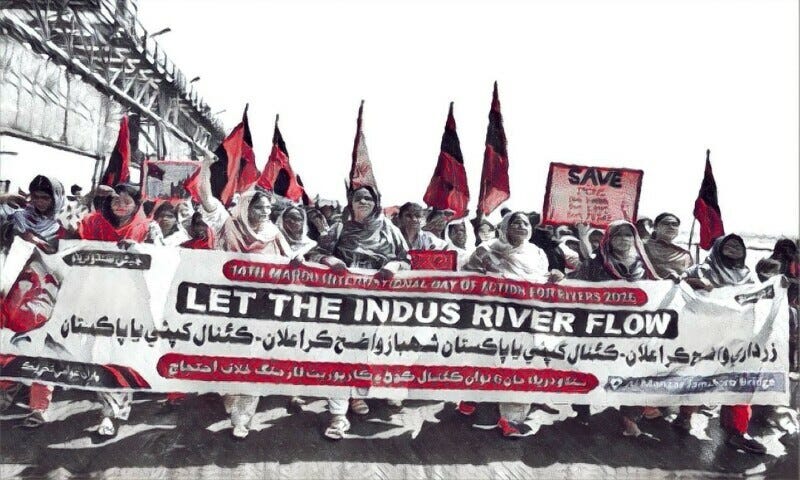
Sindh’s Provincial Assembly passed a resolution on March 13, 2025, categorically rejecting any Indus diversions for Cholistan, warning that such actions would violate constitutional water rights and threaten livelihoods. Protests erupted across Sindh, with farmers blocking highways and nationalist parties framing the issue as Punjab’s perpetual exploitation of Sindh’s resources. The controversy revived memories of the Kalabagh Dam dispute, which similarly pitted Punjab’s development aspirations against Sindh’s water security concerns. Federal authorities, caught between provincial tensions, made vague assurances while advancing the project. The Indus River System Authority, responsible for water allocation adjudication, warned of 30 to 35 percent shortages across wheat-growing regions but offered no resolution to competing demands. Punjab moved forward regardless, banking on tube wells as interim solutions until canals materialized through political negotiations.
The environmental consequences of relying on brackish groundwater became apparent within months. Early entrants like Kasaltan Farms attempted wheat cultivation, anticipating yields comparable to irrigated Punjab districts where 29 maunds per acre represents the average. Instead, wheat struggled to seven maunds per acre, economically catastrophic figures even accounting for lower land costs. Soil salinization accelerated as irrigation deposited dissolved salts that concentrated in root zones. Central pivot systems, designed for uniform water distribution across level terrain, proved ill-suited to Cholistan’s undulating dunes and fierce winds. Sandstorms, a regular feature of desert ecology, buried young plants and damaged irrigation infrastructure. Cotton trials fared worse, with entire fields smothered under shifting sands. Vegetables and other high-value crops demanded water quality and soil conditions simply unavailable.
Faced with these realities, surviving operations pivoted to the only crop proving marginally viable: Rhodes grass and similar forage varieties destined for silage production. This coarse grass, used as livestock feed, tolerates higher salinity and requires less intensive management than food crops. Markets exist, particularly among Gulf states importing feed for dairy herds and camels, creating export opportunities. The irony escaped few observers. A project marketed as enhancing Pakistan’s food security, reducing import dependency, and feeding a growing population had devolved into producing livestock feed for export to already wealthy nations. The 44 percent of Pakistanis living below the poverty line, many suffering food insecurity, would see no benefit from Cholistan’s green circles.
Corporate investors, confronting these facts, adjusted expectations downward or withdrew entirely. Unity Foods, initially enthusiastic, scaled back commitments. Fatima Fertilizer, which had anticipated synergies with crop production, reassessed involvement. International partners, discovering that Pakistani desert farming differed substantially from their Gulf experiences with desalination and stable political environments, grew cautious. The Green Corporate Initiative, managing these relationships, could offer little beyond promises that canal construction would eventually solve water problems. Those promises rang hollow as provincial disputes stalemated and cost projections for major hydraulic works soared into tens of billions of rupees that Pakistan’s strained treasury could ill afford.
While corporate farms struggled with environmental constraints, a second front opened around land tenure. The Green Pakistan Initiative’s scope extended beyond truly barren desert to encompass approximately 96,000 acres of state-owned agricultural land currently under cultivation. These parcels, located in areas like Rakh Ghulaman (10,237 acres), Ehsanpur, and Muhammad Nagar, have irrigation access from existing canals and support tenant farmer communities. Some families trace their cultivation of these lands back to Partition in 1947, working under informal arrangements with provincial authorities. The lands remained technically state property, but generations of continuous cultivation had created de facto tenure that local communities considered legitimate.
Government plans to transfer these irrigated acres to corporate entities under GPI leases sparked immediate resistance. Unlike the barren expanses where environmental factors determine viability, these were productive agricultural lands generating crops and sustaining livelihoods. The rationale for corporate takeover rested on efficiency arguments: large-scale operations with pivot irrigation, mechanization, and professional management would yield higher outputs than fragmented tenant farming. To facilitate pivot systems requiring circular layouts and centralized water delivery, authorities began marking ancient trees for removal, including specimens hundreds of years old that provided shade, fruit, and cultural significance to local communities.
The Anjuman Mazareen Punjab, a tenant farmers’ organization, mobilized protests bringing thousands into the streets. Their slogan, “malki ya maut” (ownership or death), encapsulated the stakes as they saw them. These were not landless laborers seeking employment on corporate farms but cultivators with generational attachments to specific parcels, who viewed displacement as erasure. Court challenges ensued, with civil society lawyers arguing that evictions without proper compensation and rehabilitation violated constitutional protections. Several high courts issued stay orders temporarily halting takeovers in places like Muhammad Nagar, where judicial scrutiny revealed inadequate due process and consultation.
The tree-cutting controversy crystallized opposition. Environmental activists joined farmers, noting that removing established vegetation in arid regions for monoculture irrigated circles represented ecological vandalism. Trees provided windbreaks, moderated temperatures, supported wildlife, and sequestered carbon. Their removal for pivot systems that might fail, as barren land experiences suggested, seemed particularly shortsighted. Media coverage amplified these concerns, with images of chainsaws biting into centuries-old trunks providing visceral evidence of the project’s costs.
This agrarian resistance revealed class and political dimensions that official narratives had obscured. The Green Pakistan Initiative, despite “green” branding and development rhetoric, functioned substantially as a land allocation mechanism benefiting military-linked entities and large corporations. The Fauji Foundation, the Army’s vast commercial conglomerate, managed model farms through its subsidiary FonGrow. Gulf investors gained access to Pakistani land and water resources to grow exports. Local tenants, small farmers, and landless laborers featured minimally in planning except as potential displaced populations or cheap labor. The model replicated patterns critics have identified in Pakistan’s political economy: elite capture of resources, military commercial expansion, and marginalization of vulnerable populations.
Agricultural experts observing these developments offered pointed critiques. Dr. Rana Fartab Shaukat, among others, argued that Cholistan’s greening required phased approaches beginning with afforestation to stabilize soils, moderate climate, and improve water retention before attempting intensive agriculture. Trees suited to arid conditions, native plant communities, and careful watershed management over decades could gradually transform the desert. Rushing to install irrigation circles on unprepared land invited the salinization and degradation now evident. International experiences in desert agriculture, from Australia’s Murray-Darling Basin to Israel’s Negev, demonstrated that sustainable desert farming demands meticulous attention to water quality, soil chemistry, drainage systems, and crop selection. The corporate urgency to generate returns within lease periods conflicted with timeframes required for ecological adaptation.
Environmental consequences extend beyond individual farm boundaries. The Hakra River, a vestigial channel running through Cholistan related to the ancient Sarasvati system, occasionally carries water during exceptional rains. Agricultural runoff now introduces fertilizer chemicals, pesticides, and concentrated salts into this drainage, impacting downstream areas. The Indus Delta, already stressed by reduced river flows, faces additional pressures as diversions contemplated for Cholistan would further diminish the freshwater reaching the Arabian Sea. Reduced flows exacerbate saltwater intrusion, destroying mangrove forests that protect coastlines and nursery fisheries. Communities dependent on fishing and coastal agriculture in Sindh bear the costs of upstream decisions.
Climate projections compound these stresses. South Asia faces increasing temperature extremes, altered monsoon patterns, and greater hydrological variability. Himalayan glaciers feeding the Indus system are retreating, threatening long-term water availability. Major reservoirs like Tarbela and Mangla show declining storage as siltation reduces capacity and drought years limit inflows. Karachi, Pakistan’s largest city, already experiences water deficits approaching 650 million gallons daily, stressing the Keenjhar Lake and Hub Dam supplies. Within this context of tightening water budgets, launching megaprojects based on assumed abundance seems disconnected from physical reality.
Economically, the Cholistan experiment’s returns remain dubious even for successful forage operations. Rhodes grass silage generates modest revenues, insufficient to justify the infrastructure investments and political capital expended. Pakistan’s agricultural priorities should center on staple crop security, smallholder productivity improvements, and irrigation efficiency gains in existing agricultural zones. Water-saving technologies like drip irrigation, canal lining to prevent seepage losses, better seed varieties, and improved extension services offer higher returns than speculative desert ventures. Research into climate-resilient crops such as millet, drought-tolerant wheat varieties, and soil conservation practices would address actual challenges facing the majority of farmers.
The Special Investment Facilitation Council, created to attract Gulf capital for development projects, promoted Cholistan as a flagship demonstrating Pakistan’s openness to foreign agricultural investment. Yet the troubled implementation may achieve the opposite, signaling inadequate planning, unresolved provincial disputes, and social conflicts that deter rather than attract serious investors. International partners seeking stable environments with clear regulations, reliable infrastructure, and social acceptance may look elsewhere after observing Cholistan’s difficulties.
Politically, the Cholistan controversy has deepened provincial alienation. Sindh views it as another instance of federal policies favoring Punjab at Sindh’s expense, following historical grievances around water apportionment, revenue distribution, and political representation. The Pakistan Tehreek-e-Insaf party tabled a National Assembly resolution echoing Sindh’s objections, indicating cross-party concern. Civil society organizations, bar associations, and provincial assemblies have united in opposition, a rare consensus in Pakistan’s fractious politics. This broad-based resistance suggests the project lacks the democratic legitimacy required for sustainable implementation.
Looking forward from January 2026, several scenarios appear possible. The federal government could persist with current approaches, completing corporate leases while managing protests through administrative measures and selective concessions. This path risks continued unrest, legal challenges, and ultimate project failure as environmental constraints and water disputes remain unresolved. Alternatively, authorities could pause for comprehensive reassessment, convening stakeholder dialogues including Sindh representatives, tenant organizations, environmental experts, and investors to redesign the initiative around more realistic parameters. Such reassessment might redirect resources toward improving existing agricultural lands, investing in water conservation, and supporting smallholder productivity rather than speculative desert expansion.
A third possibility involves fragmentation, where some corporate farms continue producing forage for niche export markets while most operations are abandoned, leaving behind degraded lands and embittered communities. The irrigated state lands dispute might be resolved through compromise granting tenant ownership or long-term secure tenure while reserving portions for demonstration farms under strict environmental safeguards.
International observers watching Pakistan’s agricultural policies should note the Cholistan experience as illustrative of broader challenges facing developing countries. Population pressures, food security imperatives, and climate change create urgent demands for agricultural expansion. Yet shortcuts bypassing hydrological constraints, environmental sustainability, and social equity generate new crises while failing to solve original problems. Genuine food security requires investing in people, not just land and machinery. Secure tenure, accessible credit, technical knowledge, market access, and stable water supplies enable smallholders to increase productivity sustainably. Corporate models have roles, but not as replacements for broad-based rural development.
As this analysis goes to press in late January 2026, the Cholistan Project stands at a crossroads. Early warnings about water scarcity, environmental risks, and social conflicts have materialized precisely as anticipated. Corporate enthusiasm has cooled. Tenant resistance has solidified. Provincial tensions fester. The sands of Cholistan, indifferent to human schemes, continue their ancient patterns. Whether Pakistan’s policymakers learn from this unfolding cautionary tale or persist in prioritizing ambition over assessment will determine not only Cholistan’s fate but the broader trajectory of agricultural development in a country where 230 million people depend on increasingly scarce water resources. The desert, as always, instructs those willing to listen: nature’s limits cannot be decreed away, no matter how powerful the decree.


