
From Gilgit to Gwadar, the Lights Come On in Lahore First
How Punjab Used CPEC for a Rs300 Billion Metro While the Corridor’s Ends Stayed in the Dark
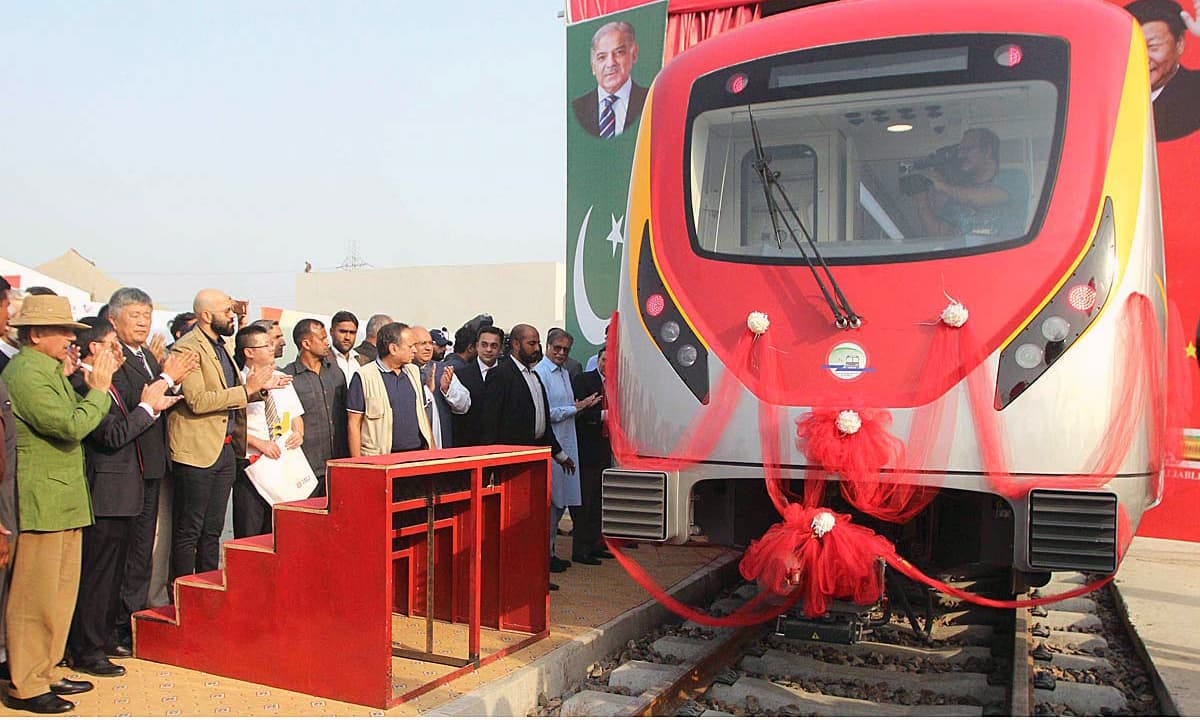
The train glides past Lahore’s crumbling flyovers in air-conditioned silence, a white and orange capsule floating above a city that still drives with its hand on the horn. Below, rickshaws jostle with motorcycles and Qingqi carts. Above, the Orange Line Metro Train, Pakistan’s first urban rail system, moves on electricity paid for with Chinese loans and Punjab subsidies. The project cost in excess of two hundred billion rupees once loans, local spending and delays are counted, much of it routed through the China Pakistan Economic Corridor, the great promise that was supposed to connect China’s west to the Arabian Sea.
From Gilgit to Gwadar, that corridor still cannot guarantee two things: power that stays on and water that comes from a tap. The gateway is in the dark. The port city rations desalinated water and imported electricity. Lahore, in the middle, has a metro. And the man who lobbied that metro into existence is now serving his second term as prime minister.
The imbalance was not produced by geography or weak institutions. It was made by specific people in specific rooms who used CPEC’s diplomatic prestige and Chinese financing as raw material for provincial politics, then left the corridor’s actual endpoints, the regions that carry its strategic weight and absorb its security risks, to negotiate with tanker drivers and protest in the snow.
The early harvest: how Shahbaz Sharif put a Lahore train in China’s flagship
When Beijing and Islamabad announced CPEC, the emphasis was on hard infrastructure: highways, ports, energy. On paper, the corridor linked Kashgar in Xinjiang to Gwadar on Pakistan’s Makran coast. In practice, one of its earliest and most photogenic fruits was not a power plant or a transmission line but a 27-kilometre elevated metro in Lahore.
Official CPEC documentation lists the Lahore Orange Line Metro Train as an “early harvest” urban transport project under the corridor. The engineering, procurement and construction contract was signed in April 2015 between the Punjab Mass Transit Authority and a Chinese joint venture of China Railway Corporation and China North Industries Corporation. The total EPC contract value was approximately 1.62 billion dollars, financed by China Exim Bank. The main line runs 25.58 kilometres with 26 stations and 27 train sets designed to serve 250,000 daily passengers.
The political architecture behind that contract is inseparable from Shahbaz Sharif, who served as Chief Minister of Punjab from 2008 to 2018. Sharif cultivated Beijing with a focus and consistency that other politicians envied. He traveled to China repeatedly during CPEC negotiations, met railway and construction officials, and lobbied within federal planning forums to have the Orange Line elevated to “early harvest” status alongside energy and road projects. His government signed agreements with Chinese construction conglomerates for multiple infrastructure projects simultaneously. Punjab’s Mass Transit Authority, operating directly under his chief ministerial office, drove the Orange Line from conception to contract. When critics inside the Planning Commission questioned why an urban metro in Punjab was sharing a basket with port infrastructure and transmission lines, they found themselves on the wrong side of a provincial government with both political muscle and a direct line to Chinese partners already committed to the project. The Commission did not have the authority to override a chief minister who had already secured financing commitments through bilateral channels Islamabad could not ignore.
Construction began in September 2015 but courts issued injunctions over damage to heritage sites, Lahore Fort, the Shalimar Gardens, historic mosques along the route. Work was halted in some sections while engineers continued in others. A 2019 project report calculated that delays had added around eleven billion rupees in premium costs, money paid by Punjab even when the concrete sat idle. None of this reduced the foreign loan exposure attached to the EPC contract, China Exim Bank was owed regardless of whether Pakistani courts thought the project should pause. Each injunction was a legal event. Each resumption was a political decision. The project reached commercial operation in October 2020 as CPEC’s first television-friendly symbol inside Punjab: sleek carriages gliding above a provincial capital, framed in the language of friendship and early harvest, while corridor communities further up and down the line wrestled with load shedding and tanker mafias.
A train that will not pay for itself
The Orange Line was never structured to pay for itself. It was sold as a social good, reduced journey times, lower emissions, safer mobility, and as transport philosophy, that logic has merit. Inside a crisis state, the numbers still demand scrutiny.
In the first months of operation, the gap between projected and actual ridership bit immediately into Punjab’s budget. Early estimates touted 250,000 daily riders; Chinese operators reported averages around 120,000, while Punjab officials claimed around 200,000 in mid-2023, still below design capacity. The province set a flat fare of 40 rupees, then introduced a distance-based structure capped at 40 rupees, a ceiling that limited revenue growth while making the political optics of affordable public transport easy to maintain at election time.
By 2025, the train had carried more than 270 million passengers in its first five years, according to Punjab government figures. Yet the financial ledger remained heavy. Punjab was paying about 21 billion rupees a year across its mass transit systems, the Orange Line, the Lahore and Rawalpindi-Islamabad Metro Bus services, and the Multan Metro, with fare revenue covering barely a quarter of operating and maintenance costs. The Orange Line’s annual subsidy alone ran to around seven billion rupees.
Those figures exist alongside a national power crisis in which Pakistan is paying Chinese independent power producers tens of billions of rupees in capacity charges, contractual payments for generation capacity that sits idle because Pakistan lacks the transmission infrastructure to absorb it. The power sector’s capacity payment bill crossed four trillion rupees in the 2024-25 fiscal year. A significant portion flows to Chinese-owned plants under take-or-pay agreements signed by the Nawaz Sharif government between 2015 and 2018, agreements whose full terms were not disclosed to parliament, and which contain arbitration clauses that give Chinese companies recourse to Chinese courts rather than neutral international forums. Pakistan is simultaneously paying Chinese companies not to produce electricity and paying subsidies to run a Chinese-built metro that was never designed to recover its costs. The beneficiaries in both cases belong to the same class of state-backed contractors and policy lenders. The bill falls on Pakistani consumers and taxpayers in provinces that have no metro to show for it.
The map: a corridor built for Punjab
The Orange Line’s CPEC status would be less contentious if the corridor’s spine were strong. It is not.
On the northern end, CPEC enters Pakistan through the Karakoram Highway, descending from the Khunjerab Pass into Gilgit-Baltistan, a region that has never been granted full provincial status. It has no Senate seats. Its legislators cannot threaten a government’s parliamentary arithmetic, cannot trade votes for budget allocations, and cannot sit at the table where federal resource decisions are made with the institutional weight of an elected senator behind them. Gilgit-Baltistan’s constitutional position has been kept deliberately unresolved for decades: Islamabad will not fully integrate the territory because doing so could complicate Pakistan’s Kashmir position before the United Nations, and Beijing objects to any move that could be read as Pakistan asserting uncontested sovereignty over territory through which CPEC’s northern route passes. The people who live there have been made hostages to a legal ambiguity they did not choose and from which the state extracts strategic convenience without offering administrative obligation in return.
On the southern end lies Gwadar, in Balochistan, a province that does have Senate representation but whose senators have spent decades warning that federal projects in Balochistan serve federal interests and Punjabi contractors before Baloch communities. Those warnings have been managed as insurgent politics rather than addressed as administrative feedback. The corridor runs between these two ends through Khyber Pakhtunkhwa, down through Punjab’s motorways and ring roads and into Sindh and then west to the Makran coast. The single item that attracted the most symbolic capital, foreign financing, and provincial subsidy sits in Lahore, in the province that already had the roads, the institutions, and the politicians with the direct line to Beijing.
A corridor marketed as a lifeline for the federation delivered its first major rail system to the provincial capital that was never in darkness. At the edges, people block highways in minus-fifteen-degree weather to demand the right to switch on a fan.
Gilgit-Baltistan: CPEC’s gateway without a grid
On a January morning in 2025, residents of Hunza blocked the Karakoram Highway at Aliabad. Temperatures had dropped to minus fifteen degrees. Protesters lit bonfires on the asphalt; trucks carrying Chinese and Pakistani goods sat idle. Tourism and trade through the CPEC route were suspended. The cause was electricity outages lasting more than twenty hours a day.
Gilgit-Baltistan is not connected to the national grid. Its electricity comes from dozens of small hydel plants scattered across ten districts. In winter, when water flows in rivers and channels drop, generation collapses. Thermal backup is limited and expensive. The regional government does not have funds to run diesel generators at scale. Federal emergency meetings were convened, promises of fuel money were made, the highway reopened, and the next winter arrived with the same outages.
By mid-2025 the crisis had moved from the highway to the Assembly. Lawmakers described eight to twelve-hour daily outages even in summer as incomprehensible in a region whose rivers ran full. Protesters again blocked the Karakoram Highway across Jutal, Rahimabad, Hunza, Ghizer, Astore, Nagar, and Diamer. Installed capacity near Gilgit city runs to roughly 70 megawatts; actual generation in winter hovers around 33 megawatts, well below demand. Businesses could not run machinery. Students could not study after dark. Heating collapsed.
The consequences for CPEC itself were direct and measurable. Hundreds of trucks sat immobilised at the dry port. Pakistan-China trade halted for nearly a week. Snow-clearing machinery was trapped on the highway by the very protesters whose roads it should have been clearing.
The technical answer for why the national grid has not been extended to GB involves transmission distance and terrain. The political answer is that GB has no Senate seats from which to threaten a government’s parliamentary arithmetic, and its constitutional limbo strips its politicians of the formal status needed to compete at the planning tables where CPEC projects were sorted into early harvest and later review. Planning Commission records from the CPEC project selection period show that GB’s grid integration was categorised as Phase II, deferred, while an urban metro in the country’s most politically powerful province was fast-tracked as Phase I early harvest. No federal official has been held to account for that classification. No timeline for GB’s grid integration has ever been legally binding on the federal government. Islamabad has found GB’s ambiguous status useful for managing its China relationship and its Kashmir claim. The people who live there have found it useful only as a reason to stand on a frozen highway until Islamabad picks up the phone.
Gwadar: the port city that ran out of water
Gwadar’s crisis is the mirror image of Gilgit-Baltistan’s. Where GB drowns in hydroelectric potential while its grid starves, Gwadar sits beside an ocean it cannot drink.
Long before CPEC, the city’s drinking water depended on a small constellation of dams and seasonal rain. As climate patterns shifted and dams silted, the city fell back on tankers and emergency rationing. CPEC amplified the promises. Gwadar became a flagship: a deep-sea port with a free zone, the projected terminus of a corridor that would move Chinese goods to the Arabian Sea. Federal and provincial officials announced a 300-megawatt coal-fired power plant under CPEC and multiple grid integration schemes. Protest after protest over water and electricity was met with the same talking points: the plant is under construction; the grid connection is coming; Iranian imports are temporary.
The China Overseas Port Holding Company holds a 40-year operating lease over Gwadar’s port and the adjacent free zone, negotiated under terms that were not disclosed to Pakistan’s parliament until leaks and legal challenges forced partial transparency. Inside the free zone, Chinese companies operate under a tax exemption regime lasting up to 40 years, a privilege unavailable to Pakistani businesses operating a kilometre down the road. The port’s revenue-sharing structure gives the operator the majority of earnings for decades before meaningful receipts reach the Pakistani state. This is the architecture of a company town built inside a port city, and the people of Gwadar, the fishing families who have been pushed off traditional grounds to make way for port expansion, the households paying tanker rates for water in a city that sits beside the Arabian Sea, did not negotiate any of it.
A 1.2 million gallon per day seawater desalination plant in the Gwadar Free Zone, funded by a Chinese grant of 12.7 million dollars, was designed to supply potable water to the old city and the port. It was completed. Then the bureaucracy stalled. By 2021, officials were still discussing plans to address the water shortage while residents complained the plant was not fully operational. A detailed report from March 2025 found that more than ten years after CPEC’s launch, Gwadar still lacked a stable national grid connection and relied on imported electricity from Iran. Chinese authorities had by then provided 10,000 solar panels in May 2024, another 5,000 in September, 150 water filtration units, and ten solarised tube wells, emergency humanitarian provision dressed as development delivery, in the city Pakistan’s government has described for ten years as a strategic jewel. Much of the equipment had not been properly installed or integrated. At an October 2025 review meeting, Pakistan again sought Chinese technical assistance to bring the desalination plant to full capacity while the 300 MW coal project remained delayed and the grid connection remained pending.
The anger has not stayed in queue lines. The Gwadar Ko Haq Do movement organised mass protests in 2021 and 2023, drawing hundreds of thousands at their peak, demanding fishing rights, an end to trawler incursions on traditional grounds, and the removal of military checkpoints that protesters said had turned daily life into a surveillance exercise. Several demands were conceded on paper and quietly shelved. Meanwhile, the Balochistan Liberation Army and allied groups have attacked Chinese workers, engineers, and convoys along CPEC routes with lethal frequency, attacks treated by Islamabad as a security problem to be solved with deployments and operations rather than as feedback from a population watching a corridor named after their region deliver its most visible prizes everywhere else. No federal government has drawn a public line between Gwadar’s unaddressed grievances and the security crisis in Balochistan that now threatens the corridor’s viability. Making that connection would require acknowledging that the policy produced the problem.
Punjab’s choices: who decided what
Governments everywhere invest unevenly. The question is not whether Lahore should have mass transit. The question is what it reveals about the federation that CPEC’s capital, political and technical bandwidth delivered a fully operational metro in Punjab before it delivered reliable electricity in the corridor’s gateway or sustainable water in its terminus, and that the official record makes clear this did not happen by accident.
Punjab’s leaders have a ready defence. The Orange Line moves hundreds of thousands of commuters daily, cuts journey times, reduces emissions, and created more than 90,000 local employment opportunities by Chinese estimates. The financial structure, fare revenue covering a fraction of costs, loan repayments in foreign currency stretching beyond 2030, is presented as the price of inclusive public transport.
The defence collapses against the procurement record. The EPC contract with China Railway Corporation and NORINCO was awarded without competitive international bidding, fast-tracked under CPEC’s government-to-government framework in a way that would have faced challenge under standard public finance rules. The loan terms with China Exim Bank were not published before being signed, and the repayment schedule was not submitted to the Punjab Assembly for scrutiny. When the rupee depreciated, as it has done catastrophically in recent years, the real cost of repayment in local currency increased accordingly, with no renegotiation mechanism. The eleven billion rupees added by court-ordered construction delays went to contractors who continued billing on a project that was legally stopped. Nobody was prosecuted. Nobody was fined.
Gilgit-Baltistan cannot pull a grid project into an early harvest basket. It has protests. It has bonfires on a frozen highway. It has representatives in a semi-autonomous assembly who cannot threaten a confidence vote in the Senate because they have no senators. Its connectivity is strategic when officials brief Beijing; it is peripheral when corridor priorities are divided in Islamabad. Gwadar carries the rhetorical weight of regional integration, Central Asian trade, and naval strategy while its residents argue with tanker drivers in the same city where China holds a 40-year port lease. The gap between Gwadar’s geopolitical valuation and its residents’ lived experience is not a planning failure. It is a policy outcome, a decision made repeatedly by federal and provincial officials to extract strategic value from the place without delivering the administrative obligation that would come with it.
The loan architecture nobody published
The financial structure of CPEC is the part Pakistan’s government has worked hardest to keep out of public view. The framework agreements were classified for years. Dawn’s investigative reporting revealed that key CPEC contracts gave Chinese contractors and lenders terms that Pakistan’s own auditors later flagged, including dispute resolution provisions steering disagreements toward Chinese arbitration venues rather than neutral international courts, and sovereign guarantee provisions that made the federal government the backstop for provincial project risks, meaning that when a Punjab metro runs a deficit, or when a Gwadar power plant stalls, the Chinese lender’s exposure is covered by Pakistan’s treasury.
The China Exim Bank financing for the Orange Line carries an interest rate and repayment structure that Punjab’s government has never disclosed in full to its own Assembly. The loan runs in foreign currency; the train earns in rupees at a capped fare. The rupee has lost more than half its value against major currencies since the loan was contracted. Every devaluation widens the gap between what the train earns and what the province owes, and that gap is covered by a provincial subsidy that is ultimately financed by the same federal transfers that other provinces could be receiving for grid projects and water infrastructure.
Across the CPEC energy sector, the structure is more damaging still. Capacity payment contracts for Chinese independent power producers, signed in bulk between 2015 and 2018, many without full parliamentary disclosure, guarantee Chinese plants payment for capacity whether or not Pakistan draws the electricity. Pakistan has consistently failed to build the transmission infrastructure to use the power it is contractually obligated to pay for. The result is that Pakistan is paying billions in capacity charges for electricity it cannot move to the people who need it. Gilgit-Baltistan, running at half its installed generation capacity in winter while residents block roads over blackouts, sits inside a country that is writing cheques to Chinese power plants for electricity that cannot reach the north. No official who signed those contracts has been prosecuted for the terms. No government has successfully renegotiated them, because the arbitration clauses make unilateral renegotiation an invitation to international legal action Pakistan cannot afford.
What the federation reveals
Follow the CPEC route from Khunjerab to Gwadar and you will see what the Pakistani state considers urgent in each place.
In Lahore, urgency meant a metro gliding over traffic, funded by undisclosed loans, built without competitive bidding, and subsidised by budgets that will keep cutting elsewhere, serving a city that already had functioning roads, political representation, and a chief minister with a direct line to Beijing. In Gilgit-Baltistan, urgency meant emergency meetings called only after people lit bonfires on an international highway in minus-fifteen-degree temperatures, followed by promises that dissolved before the next winter. In Gwadar, urgency meant a decade of inter-ministerial meetings, progress reports on infrastructure that was “completed” but not operational, and a desalination plant whose commissioning had to be re-tendered while residents continued to queue for tanker water alongside the empty boulevards of a port city China calls a strategic gateway.
The officials who signed undisclosed loan agreements are not in jail. The chief minister who lobbied a metro into CPEC’s early harvest basket is serving his second term as prime minister. The contracts that locked Pakistan into capacity payments for Chinese power plants the grid cannot absorb have not been renegotiated, because doing so would require picking a legal fight with state-backed Chinese companies in arbitration venues designed to favour them. The Planning Commission officials who approved GB’s grid integration as Phase II and a Lahore urban metro as Phase I have retired on their pensions. The people of Gilgit-Baltistan will block the Karakoram Highway again this winter. The people of Gwadar will queue for tankers again this summer.
The Orange Line hums above Lahore on a seven billion rupee annual subsidy. It is a monument to what becomes possible inside Pakistan’s federation when one province’s political machinery is powerful enough to convert a national infrastructure project into a provincial showcase, hide the loan terms, skip the bidding process, and leave the bill to be paid by a treasury that will not build a grid in the north or keep a desalination plant running in the south. The corridor was supposed to lift all of Pakistan. It lifted Lahore first, longest, and most expensively, and the people who made that happen have faced no consequences for it.


