
Forty-One Percent More Poor: Punjab's Poverty Crisis Under Maryam Nawaz
Why Punjab's Government Governs for Optics While Thirty Million Go Poor
The government’s own Household Integrated Economic Survey, released February 21, 2026, records a 41 percent jump in Punjab’s poverty rate over seven years. One in four Pakistani families cannot meet basic nutritional needs. The province’s Chief Minister, in the same week, took delivery of a PKR 11.7 billion Gulfstream jet for personal use.
KEY FIGURES AT A GLANCE
Punjab poverty rate: 16.5% to 23.3% (+41%)
Pakistanis below poverty line: 40.5 million to 70 million
Food insecurity: 15.9% to 24.4% of all households
Real household income: down 12% in real terms
Bottom quintile income: collapsed 45%
Unemployment: 7.1%, a 21-year high
The document that arrived on Friday, February 21 carried the dry title of preliminary poverty estimates, but what the Planning Ministry released was, in any fair accounting, an indictment. Pakistan’s Household Integrated Economic Survey 2024-25, conducted under a 17-member government committee led by Dr. G.M. Arif of the Pakistan Institute of Development Economics, showed that 28.9 percent of Pakistan’s population now lives below a monthly poverty line of Rs 8,484. That is the highest rate since 2014. It covers 70 million people. And it represents a 32 percent increase in the poverty headcount since the last survey in 2018-19.
In Punjab, the numbers carry a more specific weight. Under Maryam Nawaz Sharif, who took office as the province’s first female Chief Minister on February 26, 2024, Punjab’s poverty rate has climbed from 16.5 percent to 23.3 percent, an increase of 41 percent over the survey period. Income inequality in the province widened from a Gini coefficient of 28.4 to 32.0. The real income of the average Punjab household fell. The bottom quintile of earners absorbed 45 percent of the income collapse while the top experienced a 6 percent decline.
On the same day the government released this data, Maryam Nawaz issued a statement calling for collective efforts to uphold social justice. One day before the data dropped, her government confirmed the acquisition of a Gulfstream GVII-G500 aircraft, manufactured in 2019, for PKR 11.7 billion, approximately USD 42 million in public money, for VIP transport.
TABLE 1 Punjab Key Poverty Indicators: HIES 2024-25 vs. 2018-19
Source: HIES 2024-25, Planning Ministry of Pakistan. Released by Planning Minister Ahsan Iqbal, February 21, 2026. Methodology: Cost of Basic Needs (CBN), CPI-adjusted. Committee Chair: Dr. G.M. Arif, PIDE.
WHAT THE SURVEY MEASURES AND WHAT IT DOESN’T
Pakistan’s poverty methodology uses the Cost of Basic Needs approach, adjusted by the Consumer Price Index. The poverty line of Rs 8,484 per month represents the minimum expenditure required to meet basic human needs. The HIES is the primary official instrument for tracking this; the 2024-25 survey is the first conducted since 2018-19, a six-year gap that itself reflects institutional failures of a different order.
The survey covers the full period from 2018-19 to 2024-25. It encompasses the Imran Khan government, the Covid-19 contraction, the 2022 super-floods, commodity super-cycles, and the Shahbaz Sharif federal government’s three IMF stabilization programmes, each of which required subsidy cuts, energy tariff increases, currency devaluation, and fiscal compression. The data does not isolate Maryam Nawaz’s tenure specifically, and the structural drivers of poverty in Punjab are national in origin, federal in execution, and decades deep.
But the accountability question is specific. Maryam Nawaz governs Pakistan’s largest province. Punjab holds 60 percent of the country’s population. It generates the majority of Pakistan’s agricultural output. The argument that Punjab’s Chief Minister is a passive recipient of federal macroeconomic decisions, with no capacity to direct spending toward the population being stripped of income, does not survive scrutiny of the spending choices that have been made.
TABLE 2 Provincial Poverty Comparison: HIES 2024-25
Source: HIES 2024-25, Planning Ministry. As reported by The Express Tribune, February 21, 2026. Gini coefficient measures income inequality; higher values indicate wider disparity. Pakistan's national Gini of 32.7 is the highest since 1998.
WHY POVERTY IS RISING: THE STRUCTURAL CASE
The poverty increase documented in the HIES 2024-25 did not happen randomly. It has a specific mechanism, and that mechanism operated with the full knowledge and active participation of the governments now claiming to be surprised by the data.
Start with energy. Between 2022 and 2025, electricity tariffs in Pakistan increased by over 150 percent. Gas prices rose by comparable margins. These increases were not market corrections. They were conditions attached to successive IMF programmes - the Extended Fund Facility of 2019, the bailout of 2023, and the current programme - that the federal government of Shehbaz Sharif and, before him, the caretaker administration agreed to and implemented. The rationale was fiscal consolidation: reducing the circular debt that had accumulated in the power sector through years of subsidised pricing. The method was to transfer the full cost of that debt onto household electricity bills.
For a family in the bottom two income quintiles, electricity is not discretionary. You cannot decide to use less of it the way you can decide to eat less meat. It powers the single bulb in a one-room house, the handloom a woman runs from her courtyard, the water pump in a village where there is no alternative supply. When the tariff doubles and then doubles again, the money comes from somewhere, and it comes from food. The HIES data makes this visible: food insecurity rose from 15.9 percent to 24.4 percent over the exact same period as the tariff increases. This is not correlation. This is the transmission mechanism of IMF conditionality operating on the bodies of the poor.
Then there is wheat. In 2023, the federal government abandoned the wheat support price, the floor price at which the state procured wheat from farmers, as part of the same programme of subsidy withdrawal. This was presented as a market liberalization measure. What it did in practice was destroy the income floor for millions of small farmers in Punjab’s agricultural belt. The wheat support price had functioned for decades as a de facto income guarantee for smallholders. Without it, farmers became price-takers in a market dominated by large traders and flour mills. Their incomes fell. Rural poverty in Punjab, already higher than urban poverty, accelerated.
Then there is currency. The rupee was allowed to depreciate from approximately Rs 180 to the dollar in 2022 to over Rs 280 by 2024. This was another IMF condition: removing the managed exchange rate to reduce pressure on foreign reserves. For a household importing nothing directly, this seems abstract. It is not. Pakistan imports edible oil, pulses, machinery, fertilizer, and fuel. Every rupee of depreciation raised the price of the cooking oil on a family’s table, the fertilizer a farmer used to grow his crop, the medicine at the pharmacy. The 12 percent decline in real household income documented in the HIES is, in significant part, a measure of what currency devaluation does to people who earn in rupees and live in an economy where the prices of essential goods are set in dollars.
These three mechanisms, energy tariff increases, wheat support withdrawal, and currency depreciation, were not accidents of the market. They were policy decisions, taken by the federal government, negotiated with the IMF, and implemented with full knowledge of their distributional consequences. The IMF’s own programme documents, available publicly, include projections of the poverty impact of its conditionalities. The government read those documents and signed anyway.
TABLE 3 Income and Expenditure Collapse: HIES 2024-25
Source: HIES 2024-25, Planning Ministry. Food insecurity cross-referenced with IPC Acute Food Insecurity Analysis, Pakistan, November 2024 to July 2025.
THE OPTICS MACHINE: HOW PML-N GOVERNS
To understand what Maryam Nawaz is doing in Punjab, you have to understand what PML-N has always done in Punjab. This is not a new government making new mistakes. This is a political family executing a governance model they have refined across four decades in power.
The model works as follows. Identify a visible, photographable, individually experienced intervention. Distribute it at scale before an election or during a political crisis. Generate maximum media coverage of the distribution ceremony. Repeat with variations. The substance of the intervention, whether it actually addresses the structural condition it claims to address, is irrelevant to the political calculation. What matters is the image of a government giving things to people.
Nawaz Sharif built motorways. Not because Pakistan’s development bottleneck was highway infrastructure between cities that already had roads, but because motorways are visible, they can be inaugurated, they produce photographs of ribbon-cutting, and they feed contracts to a construction industry whose owners sit in PML-N’s donor networks. Shahbaz Sharif, as Chief Minister of Punjab in his previous tenures, launched the Dastaan programme, the Apna Rozgar scheme, the Punjab Skills Development Fund. Each was announced with fanfare, each produced a ceremony, each faded without structural impact on employment or poverty in the province he governed for over a decade.
Maryam Nawaz has taken this model and accelerated it into the social media era. Her government has launched more than 30 schemes in under two years. Solar panels. Laptops. E-bikes. Ration cards. Marriage grants. Free plots. Interest-free loans. The common characteristic of every scheme is that it produces a distribution event, a moment where a person receives a physical object or a cash transfer directly from the government, with the Chief Minister’s name and image attached to it. The Nigahban Ramzan Package arrived with a letter from Maryam Nawaz. The laptops carry her branding. The solar panels come with a CM Punjab sticker.
This is not welfare policy. It is political communication delivered in the form of goods. The distinction matters because the resources used for this communication could instead be directed toward the structural interventions that would actually alter the poverty trajectory: teacher salaries and school construction, primary healthcare infrastructure outside Lahore, agricultural extension services for small farmers, and industrial policy that generates employment rather than contracts for the connected. Instead, they produce photographs.
The HIES data quantifies the gap between the communication and the reality. Education spending fell from 4 percent to 2.5 percent of GDP over the survey period. This is not a peripheral data point. Pakistan’s Human Capital Index is among the lowest in South Asia. The only proven mechanism for intergenerational poverty reduction is educational investment that reaches children before they enter a labour market with no skills and no options. A government that launches a laptop scheme for university students while allowing the foundational education budget to collapse has made a clear choice: the university students produce better photographs and are more likely to vote. The children in rural Punjab primary schools do not.
WHY THIS IS CORRUPTION
The word corruption in Pakistani political discourse usually refers to money stolen: kickbacks on contracts, diverted development funds, properties acquired through influence. These forms of corruption exist and are documented against the Sharif family through years of legal proceedings, the Panama Papers, the Avenfield reference, and assets whose declared value bears no relationship to known income. But the corruption this governance model represents is of a different and in some ways more damaging kind.
Call it structural corruption: the deliberate and systematic misdirection of the state’s capacity away from outcomes that would benefit the population and toward outcomes that benefit the political survival of the governing class. It is corruption not of the treasury but of the purpose of government itself.
Here is what structural corruption looks like in practice. Punjab’s energy sector circular debt, the liability that justified doubling household electricity bills, was accumulated in significant part through years of PML-N governance in which power purchase agreements were signed at rates that guaranteed profits to independent power producers connected to party networks, while the state absorbed the cost. The IMF conditions that are now impoverishing households are the price of cleaning up a balance sheet that was deliberately distorted through political patronage. The population paying higher electricity bills is paying, in effect, for the profits extracted by the people who govern them.
The wheat support price withdrawal, presented as a liberalization measure, freed up procurement markets dominated by a small number of large trading families, many of them with direct political relationships with both PML-N and the establishment interests that bring PML-N to power. The farmers who lost their income floor were not politically organized. The trading families who gained market share were.
The 30-plus welfare schemes launched under Maryam Nawaz serve a dual function. They are political communication, as described above. But they are also a mechanism for appearing to address a crisis that the same government’s policies are producing. The Nigahban Ramzan Package gives Rs 10,000 to families whose electricity bills rose by more than that over the same year. The ration card programme subsidizes food for families whose food costs rose because the wheat support price was removed and the rupee was devalued. The government creates the wound and sells the bandage as compassion.
The Gulfstream aircraft is not a corruption scandal in isolation. It is a symptom made visible. It reveals the operative assumption: that the resources of a province of 130 million people, 30 million of whom now live in documented poverty, exist to service the comfort and movement of its governing elite. The jet costs PKR 11.7 billion. Punjab’s entire annual allocation for primary education in the last disclosed budget was a fraction of what is needed to reverse the collapse in education spending the HIES documents. These are choices made from the same pool of provincial resources, within weeks of each other.
Jamaat-e-Islami’s Hafiz Naeemur Rehman called it what it is: a government that purchases luxury aircraft for its chief minister while children in its own province go malnourished is not a government experiencing a resource constraint. It is a government that has decided whose needs are worth meeting.
THE JET
PKR 11.7 BILLION. THE COST OF THE GULFSTREAM GVII-G500 ACQUIRED BY THE PUNJAB GOVERNMENT FOR VIP TRANSPORT. CONFIRMED FEBRUARY 20, 2026. ONE DAY BEFORE THE POVERTY DATA.
The Punjab Government confirmed the acquisition of a Gulfstream GVII-G500, a 19-seat long-range executive aircraft manufactured in 2019, at an approximate cost of PKR 11.7 billion. Punjab Information Minister Azma Bokhari described it as part of the proposed Air Punjab fleet.
Jamaat-e-Islami chief Hafiz Naeemur Rehman addressed the purchase directly: the province was experiencing a frightening surge in child malnutrition, poverty, and social distress, he said, and asked how those conditions could coexist with a luxury aircraft bill measured in the tens of billions. Former federal finance minister Miftah Ismail wrote: “While Pakistanis are supposed to tighten belts and sacrifice, Punjab’s entitled VIPs are fastening their seatbelts for taking off in luxury private jets.”
PKR 11.7 billion divided across the approximately 30.3 million people now living in poverty in Punjab would provide each of them approximately Rs 386. That is not a solution to structural poverty. But it is a statement about priorities, made in public money, at a moment when the government’s own data was about to document the scale of what those priorities have produced.
TABLE 4 Punjab Government Spending vs. Poverty Outcomes
Source: HIES 2024-25; Punjab Government press releases; The Express Tribune, February 20 to 22, 2026.
THE GOVERNMENT’S DEFENCE AND WHY IT FAILS
Planning Minister Ahsan Iqbal, responding to questions about PML-N policy responsibility for the poverty figures, said it takes at least three years to reverse the adverse implications of PTI policies. He placed the structural blame on Imran Khan’s tenure, the Covid shock, flood losses estimated at USD 30.7 billion in 2022 and USD 2.9 billion in 2025, and the IMF programmes that successive governments, including his own, signed and executed.
This attribution is not factually wrong in its individual components. It is politically dishonest in its framing.
The IMF programmes whose conditionalities drove energy tariff increases and wheat support withdrawal were negotiated and signed by PML-N governments. The Extended Fund Facility of 2023, which carried the most severe conditionalities, was a PML-N programme. The caretaker government that administered it between August 2023 and February 2024 was installed with PML-N’s political acquiescence. The current programme, which the IMF review mission will assess on February 25, is a Shehbaz Sharif government programme. Ahsan Iqbal sits in that cabinet.
The argument that it takes three years to reverse PTI’s damage would be more credible if PML-N’s own prior tenures had produced a Punjab economy less vulnerable to the shocks Iqbal lists. They did not. Punjab’s agricultural infrastructure, its industrial base, its human capital stock, and its fiscal capacity were all shaped over decades by the same political family now claiming that someone else’s two-year tenure is responsible for the crisis their survey just documented.
The floods of 2022 caused USD 30.7 billion in damage. The government’s flood relief and reconstruction response was widely documented as inadequate, captured by local political elites in the disbursement of funds, and structurally disconnected from the agricultural rehabilitation that would have restored rural incomes. The floods were a natural disaster. The government’s response to them was a political choice.
What the government cannot say, because saying it would require acknowledging what the IMF programme documentation already makes explicit, is this: the poverty increase was predictable, predicted, and accepted as a cost of the stabilization programme. The IMF’s own documentation projected welfare losses to lower-income households from the conditionalities it attached to the 2023 programme. The government signed. The population paid. The government is now describing the payment as an act of God.
The IMF itself bears direct institutional responsibility for the specific mechanisms that hit lower-income households hardest: energy tariff increases, withdrawal of subsidies, exchange rate depreciation, and fiscal consolidation that compressed public investment. The IMF review mission is scheduled to arrive in Pakistan on February 25, three days after this data’s release.
Maryam Nawaz spoke on World Day of Social Justice, February 20, the day before the survey results were published. She said poverty alleviation and improving the living standards of our people remain at the top of our priorities. The survey she was one day away from having to account for measured those priorities in documented outcomes.
WHAT 70 MILLION LOOKS LIKE
The poverty line of Rs 8,484 per month is not a comfortable baseline. It is the Cost of Basic Needs floor. A family of five living on this threshold has Rs 1,697 per person per month, Rs 56 per person per day, approximately USD 0.20. That is below the World Bank’s international extreme poverty line of USD 2.15 per person per day under purchasing power parity.
Seventy million people live below that floor. Pakistan’s total population is approximately 242 million. The 70 million below the poverty line is a larger population than France, than the United Kingdom, than any single country in Europe. They are concentrated in rural areas, where poverty reached 36.2 percent. They are, in Punjab, disproportionately agricultural workers, daily wage labourers, and small-scale farmers whose incomes collapsed under wheat support price withdrawal and energy cost increases they had no means to absorb.
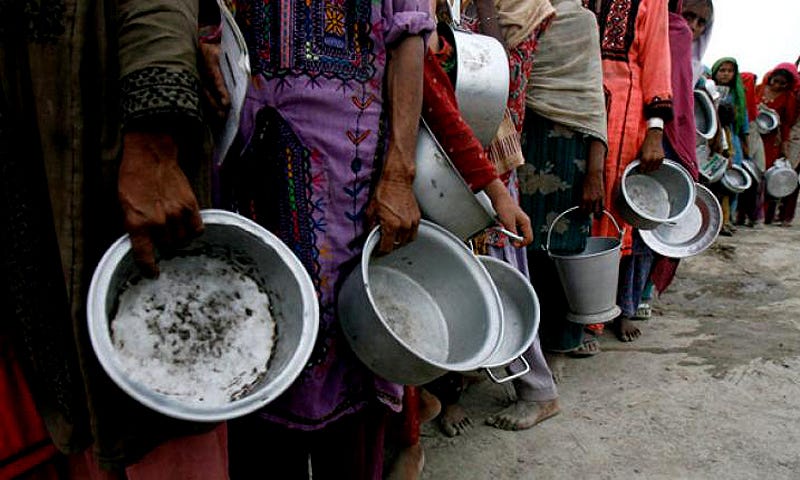
Food insecurity, running at 24.4 percent nationally, is the most direct physiological measure of what this means at the household level. One in four families cannot reliably meet basic nutritional needs. In cities, where poverty is often rendered invisible by density and mobility, the food insecurity rate has more than doubled to 20.6 percent.
TABLE 5 — Reference Timeline
Source: Planning Ministry of Pakistan; Punjab Government statements; The Express Tribune; Geo TV; The News.
GOVERNANCE AS THEATRE AND ITS COST
The pattern documented here is not unique to Maryam Nawaz. It is the operating logic of the Pakistani state as it has been organized under PML-N across four decades: centralize political communication, distribute visible goods to individuals, avoid structural investment that produces outcomes without ceremonies, protect the interests of the donor class that funds political operations, and when the numbers come in, point to external forces.
What changes under Maryam Nawaz is the sophistication of the communication technology and the audacity of the contrast. TikTok videos of laptop distribution events, run alongside HIES data showing a 41 percent poverty increase in the same province, are not a coincidence. They are the same governance model made visible by the collision of its outputs with its official measurement.
This piece has attributed the poverty data to the full survey period, not exclusively to Maryam Nawaz’s tenure, because that is what the data covers and honest attribution requires acknowledging it. But the accountability question does not rest on whether she personally caused every percentage point of the increase. It rests on this: she took office knowing the structural conditions. Her party’s governments signed every conditionality that contributed to the household income collapse. She chose to govern through distribution spectacles rather than structural intervention. She purchased a PKR 11.7 billion aircraft from a provincial budget serving a province with 30 million people below the poverty line. And she issued a statement about social justice the day before the government’s own data documented the consequences.
The HIES 2024-25 is the most comprehensive official measurement of Pakistani living standards in seven years. Its findings should drive every budget, every development plan, every IMF negotiation, and every political accountability reckoning from this point forward. What it has produced instead, in the first forty-eight hours, is a government statement on social justice, an opposition press conference, and a scheduled IMF mission whose agenda was set before the survey was released.
The theatre continues. Seventy million people are paying for the tickets.
All data from official Pakistan government sources. Primary source: Household Integrated Economic Survey (HIES) 2024-25, Ministry of Planning, Development and Special Initiatives, released by Planning Minister Ahsan Iqbal, February 21, 2026. Poverty methodology: Cost of Basic Needs (CBN) approach, CPI-adjusted. Committee Chair: Dr. G.M. Arif, former Joint Director, PIDE. As reported by The Express Tribune, The News, Geo TV. Gulfstream acquisition confirmed by Punjab Government press release, February 20, 2026.


