
Five Points Against Five Points
China and Pakistan issued their peace framework today. Read it next to Iran’s own conditions and something becomes clear: this document does not answer Tehran’s demands. It refuses them.
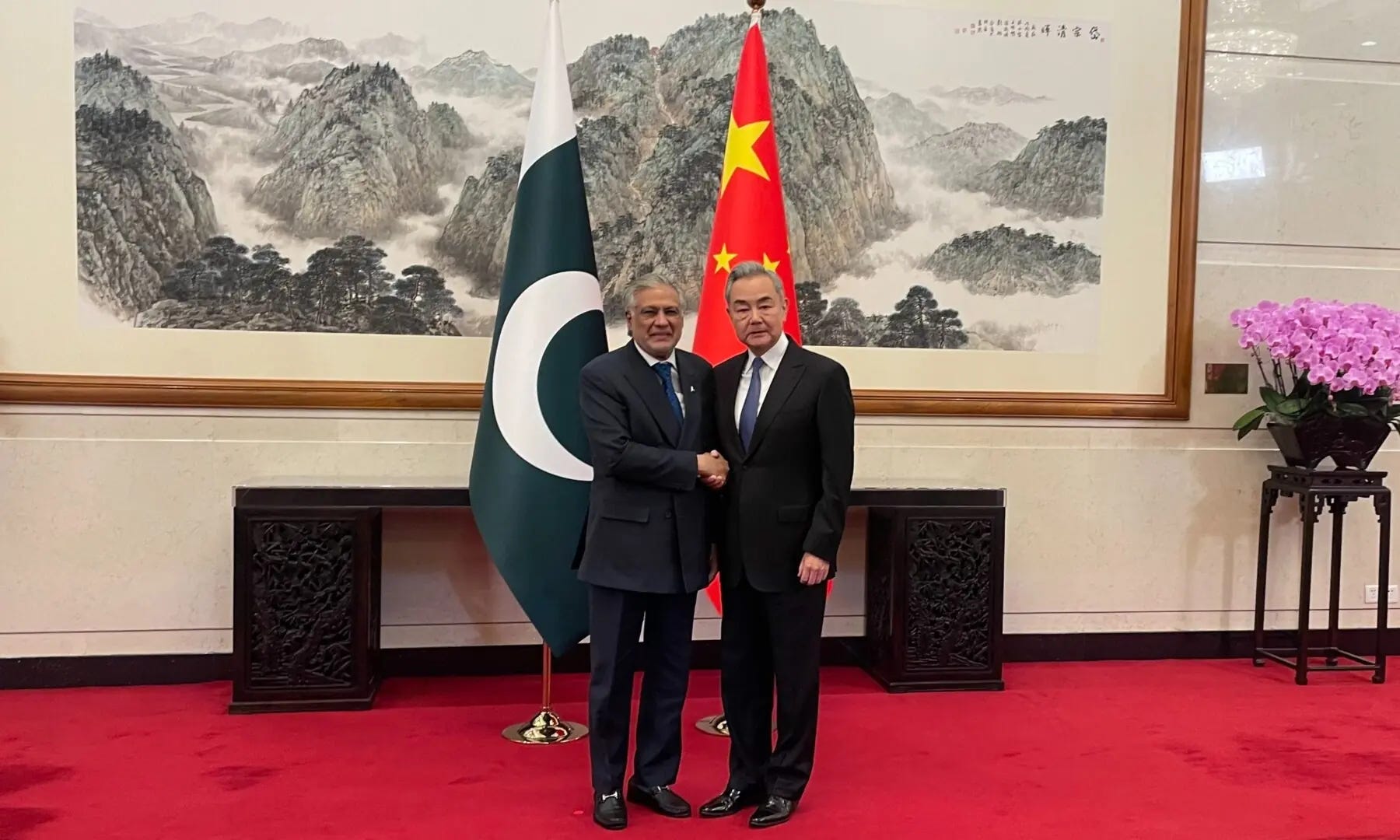
Wang Yi and Ishaq Dar met in Beijing today, March 31, 2026. Dar had come directly from Islamabad, where two days earlier he had hosted the foreign ministers of Turkey, Egypt, and Saudi Arabia to coordinate positions on the war. From those consultations he flew to Beijing and co-authored a document with China’s foreign minister. The Pakistan Foreign Office released it as Press Release No. 85/2026. Five points. Issued in the name of both states. Presented to the world as a joint peace initiative.
Iran published its own five points through Press TV ten days earlier, also numbered, also formal. Two documents. Same structure. Read them side by side and the diplomatic situation becomes legible in a way that the press conferences, the expressions of goodwill, and the coordination language have been designed to obscure.
The comparison does not show convergence. It shows a refusal dressed as an offer.
The Documents, Point by Point
Iran’s first condition: a halt to aggression and the assassination of Iranian officials. The China-Pakistan document’s first point: an “immediate cessation of hostilities.” The language sounds similar. It is not. “Cessation of hostilities” is symmetric, applying equally to Iran’s missile and drone campaign against Israel and the Gulf states. Iran’s demand is not symmetric. It is directed at a specific party conducting a specific campaign. The China-Pakistan formulation neutralises the asymmetry between a state defending itself and states that launched a war against it, treating both as equally responsible for the violence. Tehran has refused exactly this framing since February 28.
Iran’s second condition: binding mechanisms guaranteeing the war will not restart. The China-Pakistan document’s second point: peace talks in which “all parties commit to peaceful resolution of disputes and refrain from the use or threat of force during peace talks.” The gap there is measurable. Iran wants a guarantee. China and Pakistan are offering a commitment to behave during the talks themselves. One is a structural safeguard. The other is a procedural norm. Iran already sat at a table in February 2026 while Oman mediated. The US launched Operation Epic Fury during those negotiations. Iran’s demand for binding mechanisms exists precisely because good conduct during talks is not, on the available evidence, a meaningful protection.
Iran’s third condition: reparations, payment of war damages and compensation. The China-Pakistan document: not mentioned. Not in any of the five points. Not implied. Absent.
Iran’s fourth condition: a comprehensive end to hostilities across all fronts, explicitly including against Hezbollah in Lebanon and pro-Iranian militias in Iraq. The China-Pakistan document’s third point calls on parties to “immediately stop attacks on civilians and nonmilitary targets” and adhere to International Humanitarian Law. It does not address Iran’s regional alliance network or the ongoing Israeli campaign in Lebanon. The IHL formulation covers Israeli strikes on Iranian civilian infrastructure, which is notable. It also covers Iran’s missile strikes on Gulf states’ civilian areas, which is not what Iran’s condition addresses. Again: symmetric language applied to an asymmetric situation.
Iran’s fifth condition: international recognition of Iranian sovereignty over the Strait of Hormuz. The China-Pakistan document’s fourth point: the Strait, “together with its adjacent waters, is an important global shipping route for goods and energy” and all parties should restore “normal passage through the Strait as soon as possible.”
Read that slowly. Iran claims the Strait as sovereign territory. China and Pakistan describe it as an international waterway. These are not compatible positions. They are opposite positions on the central legal and strategic question underpinning the entire conflict’s maritime dimension. China’s foreign ministry spokesperson Mao Ning confirmed today that three Chinese COSCO vessels have already transited the Strait, with coordination from “relevant parties.” Those ships passed through a waterway China is describing today as a global commons, not Iranian sovereign territory. China has a direct economic interest in that legal framing.
The fifth point of the China-Pakistan document invokes the UN Charter and calls for true multilateralism. Iran has argued, consistently, that the UN framework cannot protect it because the United States uses its Security Council veto to block any binding resolution against Israeli military action. Calling for UN primacy without addressing the veto architecture is calling for the existing order to govern the outcome. That order has shielded Israeli military conduct from binding censure for four decades, and no state in the current framework has proposed any mechanism for changing that. Point five is, in this sense, the most complete of the five refusals: it invokes the institution Iran cannot use to defend itself and asks Tehran to put its faith in that institution’s primacy.
The Name That Does Not Appear
Scan the entire China-Pakistan five-point document. Israel does not appear. Not in the preamble, not in any of the five points, not in the framing language around sovereignty and territorial integrity. The document refers throughout to “parties to the conflict” and “relevant parties.”
This is a diplomatic choice with consequences. Israel is conducting the most operationally aggressive campaign of the war: accelerating strikes on Iranian arms factories as ceasefire discussions proceed, announcing the killing of the IRGC Navy commander while the Islamabad consultations were underway, launching over 120 munitions on Tehran in a single day during the same week regional foreign ministers gathered to discuss de-escalation. NPR reported on March 26, citing Islamabad officials, that in Pakistan’s facilitation of talks between Washington and Tehran, “neither country has mentioned the other warring power, Israel, in the process.”
China and Pakistan have now formalised that omission. A document calling for the protection of “peaceful nuclear infrastructure, such as nuclear power plants” stops precisely at the threshold of naming who has been destroying those sites. The Chinese foreign ministry itself confirmed today that US and Israeli strikes have hit the Arak heavy water production plant, the Khondab heavy water reactor, the Ardakan yellowcake production plant, and the Bushehr nuclear power plant, which China helped construct. Beijing named the sites. It named the strikes. It could not bring itself to name Israel as the party conducting them, because naming Israel would require the document to take a position, and taking a position is precisely what the document is engineered to avoid. Protection of sites and accountability for who destroyed them are, in this framework, entirely separate questions, and only one of them made it onto the page.
Why China Signed This
China is not a disinterested party in this conflict. It is an interested party whose interests have been carefully calibrated into the document it co-authored today.
Three COSCO vessels transited the Strait of Hormuz with Iranian cooperation. The fourth point calling for normal passage through the Strait serves Chinese shipping immediately and directly. China’s opposition to the framing of the Strait as Iranian sovereign territory is a commercial interest, not a principled legal position.
The Bushehr nuclear power plant, built with Chinese technical assistance, was struck by US and Israeli forces. Point III of the document, protecting “peaceful nuclear infrastructure,” is China protecting its own infrastructure legacy in Iran, not making a principled distinction on Iran’s behalf.
The China-Pakistan Economic Corridor, running from western China to Gwadar in Balochistan near the Iranian border, makes Pakistan China’s single most important land route to the Arabian Sea. The entire CPEC investment, assessed at over $65 billion, depends on Pakistani stability and on Chinese access to the maritime routes the war is currently disrupting. China’s interest in a ceasefire is real, urgent, and entirely explicable from its own economic geography. It has nothing to do with Iran’s security conditions.
China has not provided Iran with military assistance. Beijing has called for calm and restraint throughout the conflict. Its principal public contribution to Iran during five weeks of war has been statements, not material. A state that is Iran’s “all-weather strategic partner,” in the formulation its foreign ministry uses for Pakistan, and Iran’s “comprehensive strategic partner,” in the formulation it uses for itself, has watched Iran absorb over 8,000 strikes across 26 of its 31 provinces without committing a single weapons shipment to Tehran’s defence.
That is not neutrality. It is a choice about where China’s actual interests lie. The five-point document signed today reflects those interests with precision.
The Choreography
The sequence of the past seventy-two hours is worth mapping. Sunday, March 29: Islamabad hosts Turkey, Egypt, and Saudi Arabia. Positions coordinated. Pakistan described as the facilitator of indirect US-Iran talks. Monday, March 30: consultations continue. Tuesday, March 31: Dar flies to Beijing. Wang Yi and Dar co-author a five-point document that is simultaneously a Pakistani Foreign Office press release and a Chinese diplomatic initiative.
The document is issued from Beijing but bears the Islamabad dateline and the Pakistan Foreign Office press release number. It formalises, in jointly signed language, the framework that the Islamabad talks were building toward. The sequencing is choreographed: regional alignment first, bilateral formalisation with China second. The output is a document that has the legitimacy of two major powers and the content of neither Iran’s demands nor any guarantee mechanism capable of addressing them.
Iran’s ambassador to Pakistan, Reza Amiri Moghadam, told Al Jazeera during the talks that “friendly countries seek to lay the ground for dialogue between Tehran and Washington.” The word “friendly” is doing the work of concealing a structural problem that no amount of diplomatic goodwill resolves. Every state that could theoretically provide Iran with binding security assurances has co-authored or endorsed a document today that accepts, on the conflict’s four central contested questions, the American and Israeli position: the Strait is international waters, hostilities are symmetric, there are no reparations, and the party conducting the most aggressive strikes of the war goes unnamed. The framework has been assembled with care and genuine effort by serious governments. What it cannot do is pretend to be something other than what its contents demonstrate it to be.
What the Document Actually Is
Iran’s Foreign Ministry spokesperson Esmaeil Baghaei described the US 15-point proposal as “unrealistic, illogical and excessive.” Press TV quoted an anonymous senior official stating that Iran would end the war when it decides to, and when its own conditions are met. Iran’s IRGC military spokesman Ebrahim Zolfaghari, speaking through Fars News Agency, asked Washington whether its “inner struggle had reached the stage of negotiating with yourself.” These are not the words of a government that has lost the plot. They are the words of a government that has read the room and reached a conclusion about what the room contains.
The China-Pakistan document is the most significant thing produced by this diplomatic architecture since the war began, not because it advances Iran’s position but because it finalises the framework against it. It carries the weight of two major powers. It is formally structured, jointly authored, and released through official state channels on both sides. It is the document the mediating framework has been building toward, and it answers Iran’s five conditions with a symmetric formulation that neutralises Iran’s demands on hostilities, a procedural norm in place of a guarantee mechanism, silence on reparations, an opposite legal position on the Strait, and an appeal to the very institution whose governance structure has protected Israeli military conduct from binding censure for forty years.
What makes this document important is not what it says. It is what it forecloses. The five-point joint initiative is now the stated position of the two states best placed to provide Iran with meaningful security architecture. China, which has the economic reach and strategic weight to matter to Washington, has signed a document that does not require Washington or Tel Aviv to do anything Iran has asked. Pakistan, which is carrying the diplomatic correspondence between the belligerents, has co-authored the framework within which those talks will proceed. The framework’s terms are now on paper. Iran can accept them, reject them, or continue absorbing strikes while the diplomatic community tells itself it is working toward peace.
The 1981 Algiers Accords promised Iran relief from its hostage crisis and left the underlying hostility intact. The 2015 JCPOA promised a nuclear accommodation and was unilaterally discarded three years later. The Omani-mediated talks of February 2026 were proceeding with reported progress when the bombs fell on February 28. Iran has been reading documents produced by this international order for forty-seven years. It knows what they cost to sign and what they are worth when the political calculus of the signing parties changes. The China-Pakistan five-point initiative will be read in Tehran against that record, not against the good intentions of the diplomats who drafted it. Whether Iran ultimately engages with the framework, extracts whatever tactical advantage it can from the process, or simply outlasts the international community’s attention is the only question that remains open. The document itself has already given its answer.


