A source with direct knowledge of the decision says IPP lobbying is the reason. The government’s promise to build it later may never be kept.
According to a leaked internal document from the Economic Affairs Division from earlier this year, Pakistan’s government has cancelled the power-generation component of Diamer-Bhasha Dam. The government reached this decision after lobbying by independent power producers, according to a source with direct knowledge of the decision-making process, preserving a system that pays entrenched electricity suppliers vast sums even when their plants produce little or no power.
According to the document obtained by brief, the government’s public-facing justification is that Pakistan already has too much generating capacity. Its fallback assurance is that the dam’s 4,500-megawatt hydropower complex can be built at some unspecified later date while Diamer Bhasha can be built up as a water reservoir for now. However, that promise may be a political trick to cushion the impact of the decision.
Hydropower engineers say that if the essential intake interfaces, isolation gates, tunnel stubs and other waterway structures are not installed while the dam is being built and the site is dry, adding them after the reservoir fills would become extraordinarily risky and expensive. It would no longer be the completion of a planned greenfield project. It would be a bespoke, high-pressure operation beside a full reservoir, potentially requiring underwater excavation or “lake tapping” on a scale rarely attempted anywhere in the world.
It would not be literally impossible. It could, however, become so costly, dangerous and disruptive that no future government would authorize it. Therefore, “later” could mean never.
The leaked internal Economic Affairs Division memorandum provides the bureaucratic architecture for that outcome. The memo relays the Power Division’s position that the government should prioritize the water-storage reservoir while postponing the power-generation and transmission infrastructure.
It cites rapid rooftop-solar growth, declining demand, “substantial excess electricity generation,” uncertainty over the coming decade and a lack of financing for the roughly $2 billion power-evacuation system. It concludes that spending $2 billion to $3 billion on additional water storage would be more “pragmatic” than building the power component.
The memo then asks the Water Resources and Power divisions to confirm that position so the Prime Minister’s Office can close the matter, saying that the civil works allowing the dam to be used for power generation at a later stage “should be incorporated.” But the document does not define those works, provide drawings, allocate money, establish a construction schedule or explain how four enormous pressurized waterways would be completed after impoundment.
The document’s contents correspond with the policy dispute visible in Pakistan’s recent generation plans, financing decisions and public statements.
According to the source with direct knowledge, the “overcapacity” argument is the official pretext. Pressure from existing power producers—whose revenues depend heavily on government-backed capacity payments—is what drove the decision to remove or indefinitely postpone Diamer-Bhasha’s generating facilities.
Pakistan’s power market is dominated by a relatively small set of industrial families, state enterprises, military-linked foundations and foreign companies whose contracts force consumers to pay for available capacity whether or not the electricity is needed or produced.
The decision’s immediate beneficiaries would be generators already inside that system. Its cost would fall on a public that is being told Pakistan has too much power while enduring blackouts caused by fuel shortages, water constraints and a failing grid.
Too much capacity, not enough electricity
On August 28, Pakistan’s electricity deficit reportedly exceeded 4,000 MW. Lahore alone faced a shortfall of more than 1,200 MW. Power cuts spread as generation declined, transmission equipment tripped and a shipment of imported liquefied natural gas failed to arrive.
It was the second acknowledged shortage of roughly the same size in four months. In April, Power Minister Awais Leghari said disrupted gas supplies and lower water releases from Tarbela and Mangla had created a 4,000-MW deficit. The government imposed evening blackouts rather than run more expensive diesel- and furnace-oil plants.
The country reported 49,651 MW of installed capacity during the first nine months of fiscal 2025–26, according to the Pakistan Economic Survey. That total included 7,319 MW of net-metered solar and thousands of megawatts in plants that were closed, short of fuel, seasonally constrained, too expensive to dispatch or unable to deliver electricity through the transmission network. Thirteen independent plants with a combined capacity of 5,105 MW had already closed for various reasons.
Leghari later said Pakistan’s genuinely available capacity was closer to 32,000 MW.
Electricity from different sources is not interchangeable. Solar generation disappears after sunset. Hydropower depends on river flow and reservoir operations. An imported-gas plant cannot run when an LNG ship fails to dock. Cheap generation in the south cannot serve consumers in the north if transmission lines are congested.
That is how Pakistan can have too many power contracts and still turn out the lights.
It also exposes the dishonesty in using reduced demand as proof that the country has secured sufficient electricity. Demand has partly collapsed because the grid became unaffordable.
The government’s own Economic Survey says tariff increases reduced household affordability and pushed consumers toward conservation and alternative energy. Agricultural grid consumption fell 42.3 percent during July through March, partly because farmers shifted to diesel and solar. Wealthier households and large businesses could buy panels and batteries. Renters, small shops, informal settlements and poor households remained trapped on the grid.
The state is treating the flight from expensive electricity as evidence that the public does not need more cheap electricity.
The capacity-payment machine
Pakistan’s power crisis is rooted in contracts that guarantee generators payments for maintaining capacity, even when the grid does not call on them to produce.
Capacity payments are not inherently corrupt. Power stations are expensive, Pakistan’s government is effectively the system’s single buyer, and investors require protection against risks they cannot control. A World Bank history of Pakistan’s early private-power program found that it attracted billions of dollars and added urgently needed electricity during a period of severe shortages.
But successive governments signed noncompetitive or excessively protective deals, assumed fuel and currency risks, and failed to build the transmission and distribution infrastructure needed to use the plants efficiently. Returns were frequently indexed to the U.S. dollar while consumers earned depreciating rupees.
During fiscal 2024–25, capacity charges reached approximately 1.806 trillion rupees, or 61 percent of the country’s 2.943-trillion-rupee power-purchase cost, according to NEPRA’s generation-performance report. Thermal plants operated at an average utilization rate of only 42.5 percent.
Fixed contractual costs are divided among fewer units sold. Tariffs rise. Consumers with capital install solar and reduce their grid purchases. The fixed costs are then spread among an even smaller and poorer consumer base, driving tariffs higher again.
The International Monetary Fund has required Pakistan to reconsider new capacity until it builds transmission and better uses the plants it already has. The government committed not to make new capacity commitments without associated transmission infrastructure and fuller use of existing generators at peak demand. The IMF also urged Pakistan to renegotiate power-purchase agreements, repair distribution companies and expand lower-cost renewable energy through an integrated plan. That policy supplies officials with a defensible excuse for postponing Diamer-Bhasha: least-cost planning, grid stability and excess capacity.
However, it does not answer the political question of which capacity gets removed. A new imported-fuel plant with a dollar-indexed private contract is not economically equivalent to a multipurpose public dam that could produce indigenous electricity for generations. If officials preserve the existing contractual hierarchy while stripping power from Diamer-Bhasha, the decision then goes beyond reduction of capacity but a political and economic decision about which capacity gets removed.
The owners on both sides of the state
Pakistan’s power industry is not separate from the country’s ruling economic blocs. It is one of the places where those blocs collect guaranteed returns. Pakistan’s official register of power-plant owners reads like a roll call of the country’s economic establishment. The same families that dominate its mills, banks, cement factories and commodity markets reappear as shareholders in companies holding state-backed electricity contracts.
The Nishat empire, built by billionaire Mian Muhammad Mansha (close to the ruling Sharif family), extends from textiles, banking and cement into Lalpir, Pakgen, Nishat Power and Nishat Chunian Power. The Tabba family’s Yunus Brothers Group combines textiles and Lucky Cement with wind, coal and other energy investments. Sapphire and Liberty similarly connect some of Pakistan’s largest textile operations to power projects whose revenues ultimately depend on government-approved tariffs and contracts. The pattern runs through Engro, Hub Power, Saif and other conglomerates in the official ownership records.
Sugar barons occupy both sides of the arrangement. Mills generate electricity from bagasse and sell it to the grid, turning a politically protected agricultural commodity into another regulated revenue stream. JDW’s power interests sit inside the sugar group founded by politician Jahangir Khan Tareen; its disclosed shareholders and directors include members of the Tareen and Makhdoom Ahmed Mahmood families. Chiniot Power is linked through RYK Mills to Suleman Shehbaz, the prime minister’s son. Hamza Sugar Mills and Thal Industries appear elsewhere in the same power portfolio. The underlying agreements and plant histories are recorded in the government’s contract and production returns.
The military’s commercial network is also present. Fauji Foundation and Fauji Fertilizer hold interests across gas, coal and wind generation, placing institutions managed for the benefit of former service members inside the market overseen and guaranteed by the civilian state. They sit alongside foreign state enterprises, domestic political families and private industrial houses on the government’s list of power sponsors.
This concentration does not mean every owner acts in concert on every policy. It means that any government attempting to dismantle costly power arrangements confronts actors whose influence does not stop at the doors of an electricity company. Their businesses finance trade associations, their executives advise ministries, their relatives and allies enter politics, and their interests stretch across the sectors the state taxes, subsidizes and regulates.
An IMF governance and corruption diagnostic report concluded that Pakistan’s dominant elites had institutionalized political influence and that state capture had become a foundation of governance. The report described energy, manufacturing and real estate as sectors benefiting from favorable tax arrangements. Its principal case study examined sugar millers who held political office, influenced export and pricing decisions, received public benefits and repeatedly frustrated accountability.
The World Bank’s Pakistan at 100 analysis described the same machinery. It found that the textile lobby resisted tax reform to preserve preferential treatment, while politically connected sugar interests shaped policy to retain subsidies. The resulting equilibrium redistributed rents from the public to elites.
The power sector has produced its own official allegations. A 2020 Senate committee report accused several fuel-oil plants associated with Atlas, Nishat, Liberty and Attock of abnormal profits and misrepresentation. A separate executive inquiry recommended recovery of more than 100 billion rupees in alleged excess payments.
The companies contested those findings. Their formal rebuttal argued that investigators ignored financing costs, debt repayment, depreciation and the time value of money while minimizing transmission losses, electricity theft, taxes and government mismanagement.
Not all capacity-payment recipients are private Pakistani families. Government-owned and CPEC plants receive a large share. Foreign state enterprises are major investors. Military-affiliated welfare conglomerates own stakes in gas, coal and wind projects. This is the reason why the lobbying pressure can be so difficult to isolate: the industry is embedded inside the state rather than standing cleanly outside it.
The state has occasionally renegotiated contracts. In October 2024, the government terminated agreements with five IPPs, claiming savings of 411 billion rupees. Prime Minister Shehbaz Sharif publicly credited the army chief with helping secure the agreement.
That episode showed that the state can confront producers when its most powerful institutions decide to do so. It also revealed where ultimate negotiating power resides.
What is being taken from Diamer-Bhasha
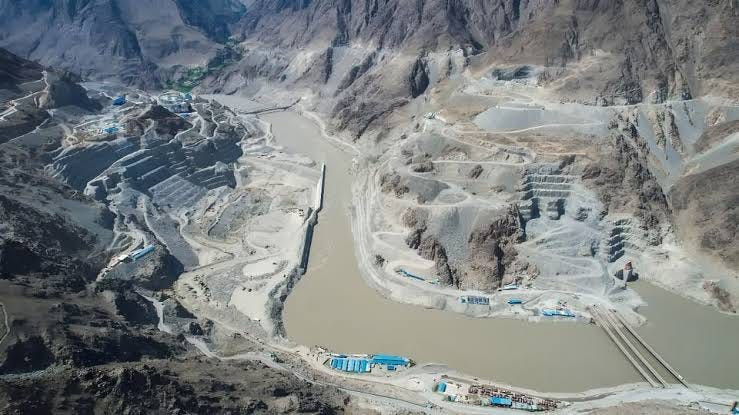
Diamer-Bhasha is being built on the Indus near Chilas. Its planned 272-meter roller-compacted-concrete wall would create 6.4 million acre-feet of live water storage. The original project includes two underground powerhouses, one excavated into each bank, containing twelve 375-MW turbines.
At full development, WAPDA says the plant would produce approximately 18,097 gigawatt-hours a year—about 14 percent of all the electricity Pakistan generated in fiscal 2024–25.
Hydropower is not costless or harmless. Diamer-Bhasha requires immense capital, transmission lines, maintenance, land acquisition and resettlement. It will transform the river and displace communities. Generation would be seasonal, and irrigation requirements can conflict with peak electricity demand.
But the plant would not depend on recurring LNG or coal imports, or on the political situation the the Straits of Hormuz. The reservoir would also regulate flows and increase generation at downstream Indus power stations. Once construction debt was repaid, the public would retain a long-lived electricity asset rather than another fuel contract exposed to foreign exchange shocks.
If the turbines are removed, as is being suggested under the new plan, the public still bears most of the dam’s cost and harm. Families in the reservoir area are still displaced. The Indus is still altered. The state still finances the wall, roads, land and resettlement. Pakistan simply loses the project’s largest direct energy benefit and a future revenue stream.
In that configuration, the dam stores water but leaves the market for electricity to the existing producers.
Why “we will build it later” is not a plan
A civil engineer with knowledge of the Diamer-Bhasha project said the government’s promise rests on a technically true but deeply misleading premise. The generating complex could theoretically be completed after the reservoir fills, the engineer said, but only if the current construction preserves the critical interfaces needed to do so safely and at a manageable cost.
The engineer, who requested anonymity because they were not authorized to discuss the project publicly, explained that the original design does not place the power tunnels underneath the concrete dam. It calls for four enormous headrace tunnels and two underground powerhouses excavated into rock inside the riverbanks. The powerhouses are structurally independent from the dam body.
That distinction makes later construction possible in an abstract engineering sense, the engineer said. It does not make construction before and after impoundment remotely equivalent.
Each headrace is approximately 15.3 meters in diameter and would feed three turbines. Together, the waterways would carry close to 3,000 cubic meters of water per second. At the reservoir’s maximum level, the water above the intake elevation would exert roughly 13 bars of static pressure even before engineers accounted for transient forces.
According to the engineer, a credible staged-construction plan would require the four bell-mouth intakes, isolation gates, bulkhead slots, embedded steel and adequate tunnel stubs to be built now. Those interfaces could then be sealed while workers later excavated the remaining waterways and power caverns from dry access points.
If those structures are omitted or reduced to token works, the engineer said, adding generation later would become an entirely different category of project.
Crews could be forced to excavate toward a live reservoir, stabilize and grout the surrounding rock, leave a protective rock plug, install underwater intake structures and then pierce the plug through a procedure known as lake tapping. They would also have to control sediment, provide emergency isolation, protect the dam and its existing outlets, and model pressure surges and emergency turbine shutdowns across a system of unprecedented size.
The engineer pointed to projects at Koyna in India, Akkats and Lake Mead as evidence that new reservoir intakes can be added after impoundment. But those precedents also show the scale of the proposed gamble. Each of Diamer-Bhasha’s four headraces has more than six times the cross-sectional area of the 6.1-meter Lake Mead tunnel commonly cited as an example.
The issue, the engineer said, is not whether human beings could someday connect new tunnels to the reservoir. With sufficient money, time and tolerance for risk, they probably could. The issue is whether any future Pakistani government would finance four massive high-pressure connections, two underground powerhouses, twelve turbines and a multibillion-dollar transmission system after surrendering the safest and least expensive construction window.
In practical terms, the engineer said, failure to preserve the full intake and waterway interfaces now could amount to a permanent cancellation—even if the government continues to describe the power component as merely deferred.
That assessment supports the source’s account of the political strategy behind the promise. Officials can tell the public that generation remains possible while allowing the project to pass the point at which completing it is financially and politically realistic. By the time that becomes undeniable, public opposition will have been neutralized, the reservoir will be filled and responsibility will belong to a future government.
A cancellation hidden in plain sight
The government has not publicly issued a clean cancellation order but left it ambiguous. The state’s crackdown on free media has ensured that the EAD memorandum canceling the project remains unreported.
The power-generation facilities were approved in April 2023 at an estimated 1.424 trillion rupees, according to a National Assembly response. However, the leaked memorandum records the Power Division’s contradictory recommendation and asks other ministries to confirm it so the Prime Minister’s Office can close the task.
Meanwhile, official plans continue to carry the appearance of a future power project. The draft 2025–35 generation plan schedules all twelve Diamer-Bhasha units between 2032 and 2035. WAPDA continues to advertise 4,500 MW. In February, even after the internal memorandum cancelled the power generation component, it said construction activity included a power intake.
Those facts do not necessarily disprove a cancellation but may show how an effective cancellation is being obscured: keep the project in long-range plans, perform undefined intake work, withhold financing for the generating facilities and transmission, and allow the reservoir to advance until restoring the original design becomes economically implausible.
The decisive evidence is in the engineering details the government has not published.
To address that, WAPDA should release the current issued-for-construction drawings and bill of quantities for the dam contract; identify the exact cutoff between the dam and power packages; disclose the completed length and lining of every tunnel stub; show the intake gates, gate shafts, bulkhead slots and embedded steel; map the tailrace portals; and publish an independent constructability review demonstrating that every future waterway can be completed safely after first filling.
It should also publish all communications, meeting records and presentations used to decide which capacity would be cut from Pakistan’s expansion plan, including representations made by power producers and their trade groups.
The cost of waiting
Pakistan’s 2026 fuel crisis showed what is at stake. When conflict disrupted LNG supplies through the Strait of Hormuz, the country’s power shortfall reached about 4,000 MW and the government imposed load-shedding. The cuts ended only after LNG deliveries resumed. Pakistan’s Petroleum Division said most of the country’s energy supplies pass through the strait.
While Diamer-Bhasha may not prevent every shortage, its planned 4,500 MW would reduce Pakistan’s reliance on fuel routes it cannot control. If the necessary intake and tunnel works are not completed before the reservoir fills, the promise to add generation later may have little practical value. Pakistan would be left with the cost of the dam, continued exposure to imported fuel and no clear path to completing the power station.


