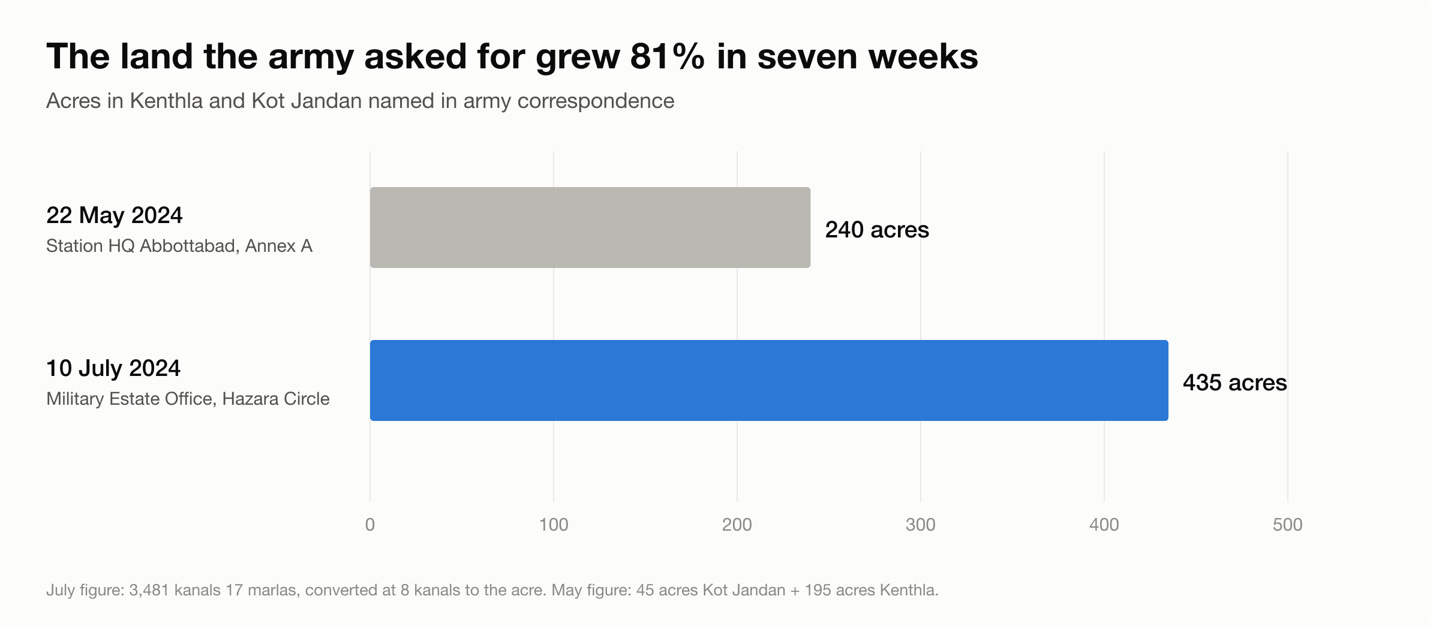
According to military and district records obtained by Brief, the Pakistan Army sought to acquire about 435 acres in two Haripur villages after provincial authorities had already stopped the construction it said threatened its new headquarters. The army’s May 2024 costing sheet covered 240 acres. Seven weeks later, its land office asked Haripur for about 195 acres more. Neither the correspondence nor the federal government’s reply to a High Court challenge explains the increase.
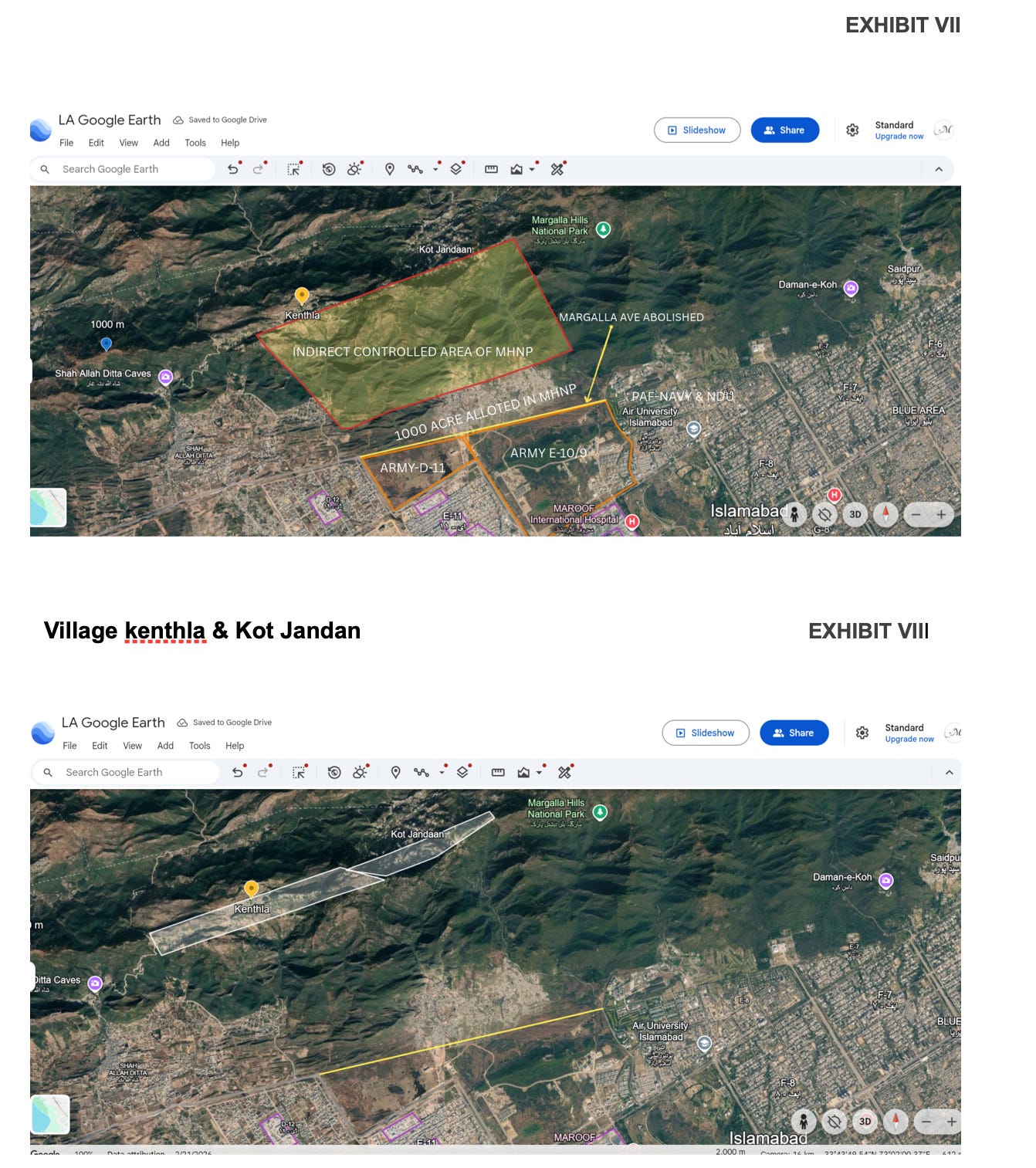
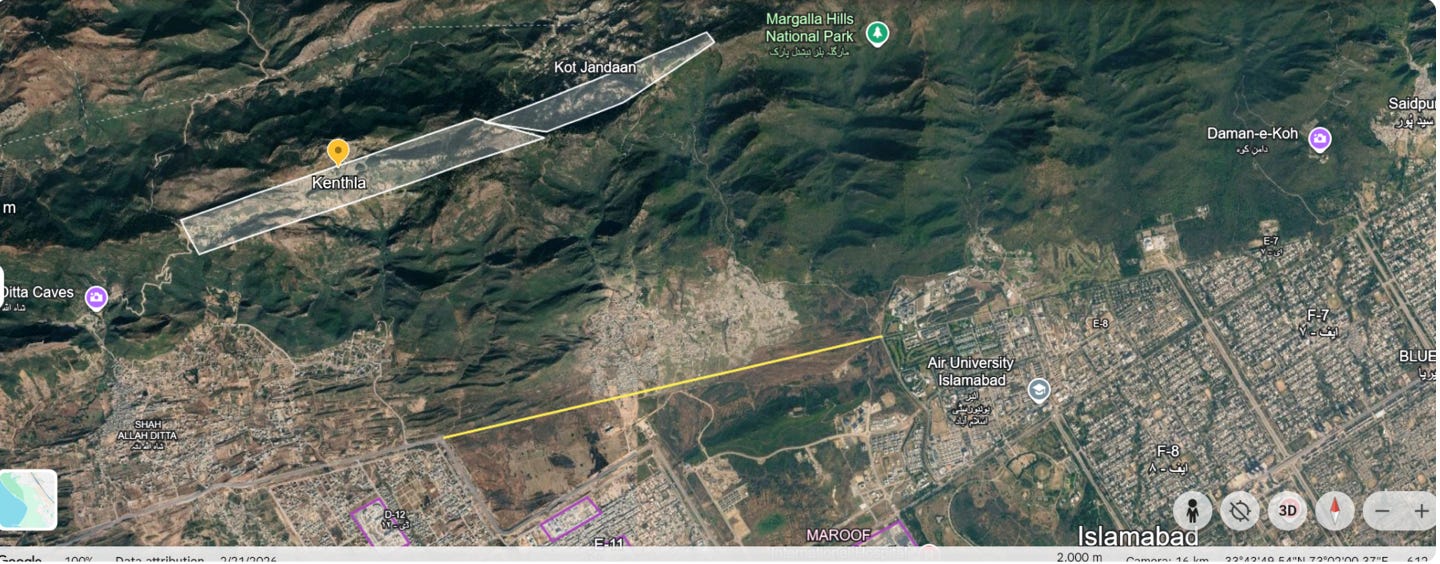
Kenthla and Kot Jandan sit on the Khyber Pakhtunkhwa side of the Margalla ridge, directly above the Defence Complex Islamabad. When Kenthla residents travelled to the Peshawar Press Club in July 2025, Yasir Khan spoke about the well around which the village had grown. Another resident described families living on three to five marlas. They had schools and mosques, and they said they had land papers and payment receipts issued by the revenue department. By the time they spoke to reporters, that same department had already transmitted lists of village plots and their owners to the military. The families told the Associated Press of Pakistan they had been given no plan for where to live if they lost their homes.
The Construction Had Stopped
The paper trail begins with a private housing project on the crest line near Kot Jandan. Defence Complex Islamabad officials took their complaint to the prime minister and the defence minister on July 21 and August 2, 2023, during presentations on the headquarters project. Station Headquarters Abbottabad later recorded that both directed the chief secretaries of Punjab and Khyber Pakhtunkhwa to coordinate and keep the skyline unoccupied to protect sensitive installations.
On September 6, 2023, the Director General of Defence Complex Islamabad briefed the Khyber Pakhtunkhwa chief secretary alongside the provincial forest and local government secretaries, the Hazara commissioner, the Haripur deputy commissioner, and Galiyat Development Authority representatives. According to the meeting minutes in the acquisition file, the authority’s director of buildings told the chief secretary it had issued no no-objection certificate for any housing society on the ridge. The chief secretary ordered a formal inquiry into negligence by local and forest officials, directed the authority to serve legal notices on the developers, and called for road barriers to keep heavy construction machinery off the ridge. The minutes recorded an explicit condition on those barriers: they were to be installed “without causing any inconvenience for the residents of Kot Jandan.”
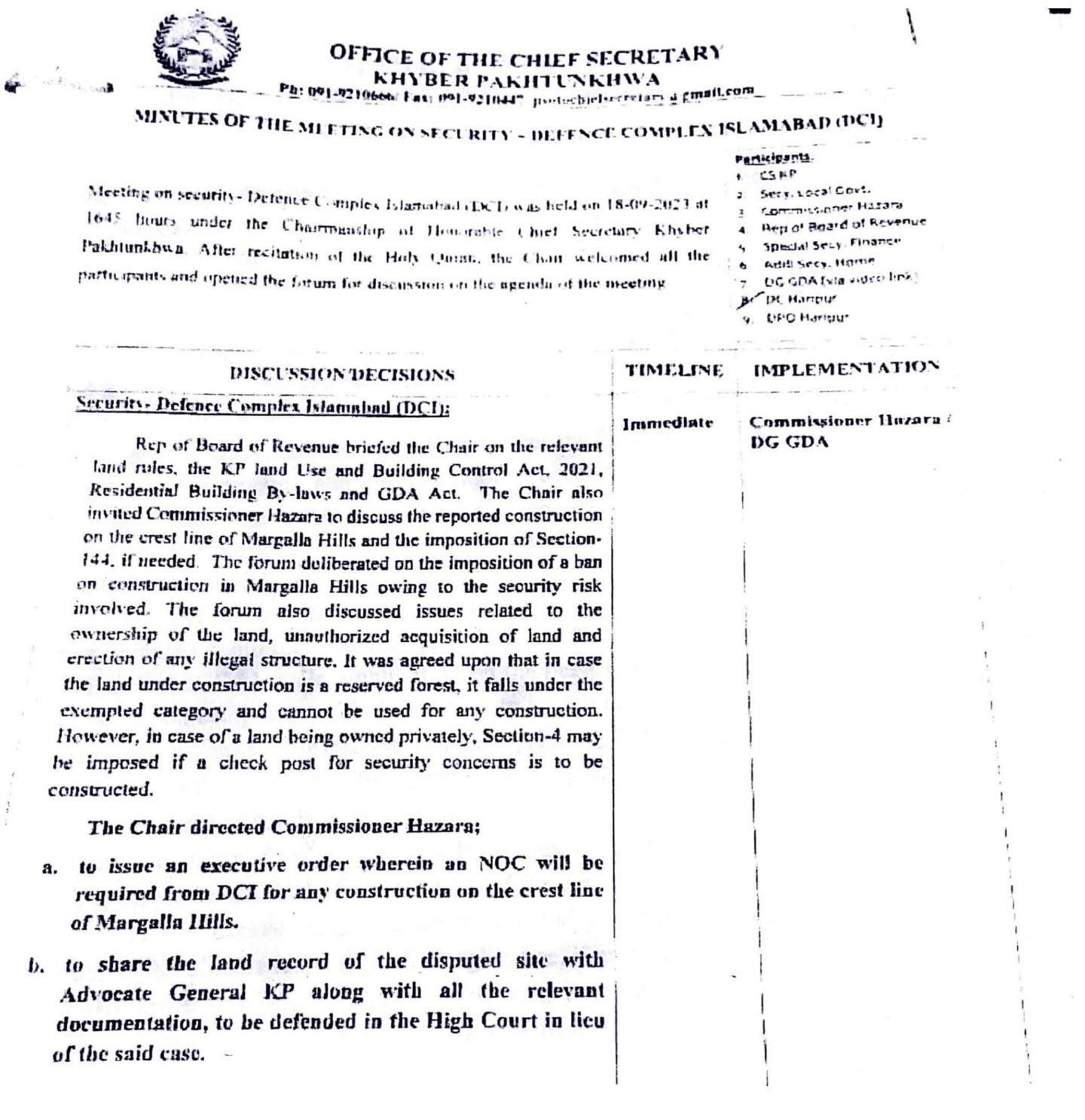
Twelve days later, on September 18, 2023, the chief secretary convened a second session with provincial revenue, finance, home, and local government officials. They reviewed the Khyber Pakhtunkhwa Land Use and Building Control Act of 2021, residential building by-laws, and the possible use of Section 144. The minutes drew a legal distinction between reserved forest land, where construction is prohibited outright, and privately owned plots. On private land, the forum agreed that preliminary acquisition under Section 4 of the Land Acquisition Act could be considered if a security checkpost had to be built. The chief secretary directed the Commissioner of Hazara to issue an executive order requiring written clearance from Defence Complex Islamabad for any construction on the Margalla crest line, and to forward the land records to the Advocate General for High Court defence.
Civilian enforcement followed quickly. Haripur district officers had already visited the headquarters and inspected the terrain on September 7. Khyber Pakhtunkhwa Police set up a checkpost near Kot Jandan, and the Galiyat Development Authority enforced the written clearance restriction. When a follow-up reconnaissance on December 10, 2023 spotted active work at several sites near Kenthla, the district administration, police, and development authority halted it jointly within three days.
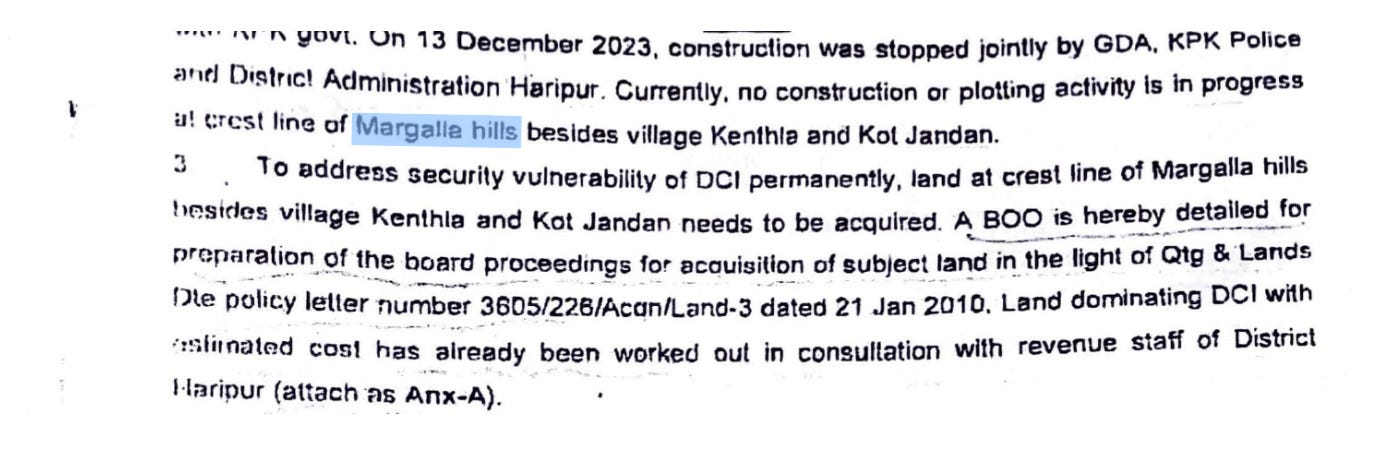
The army put that outcome in writing five months later. On May 22, 2024, Station Headquarters Abbottabad issued a restricted directive acting on instructions from GHQ’s Quartering and Lands Directorate. The letter recounted the inspections and the December 13 shutdown before confirming the state of the ridge.
“Currently, no construction or plotting activity is in progress at crest line of Margalla hills besides village Kenthla and Kot Jandan.”
Station Headquarters Abbottabad, May 22, 2024, Haripur acquisition correspondence, PDF page 11.
In the very next paragraph, Station Headquarters called for the land to be acquired to address the security vulnerability of Defence Complex Islamabad “permanently.” Citing a January 2010 Quartering and Lands policy, it appointed a board headed by a representative of the Frontier Force Regimental Centre, drawing members from military, survey, estate and district revenue offices. The board was ordered to compile acquisition proceedings by June 2024 and submit weekly progress reports. Two days later, Haripur’s deputy commissioner marked the army’s letter “Important/Top Priority,” instructed Tehsil Khanpur revenue staff to assist the board, and nominated Haripur’s Additional Assistant Commissioner-II as a board member.
The costing sheet attached to the May 22 letter counted approximately 45 acres near Kot Jandan and 195 acres near Kenthla, totalling 240 acres. Seven weeks later, on July 10, 2024, the Military Estate Officer for Hazara Circle sent a registered letter to Haripur’s Deputy Commissioner and Land Acquisition Collector requesting 3,481 kanals and 17 marlas, or approximately 435.2 acres, across Kenthla and Kot Jandan for defence purposes. The letter referenced a June 28 communication from Haripur’s district office that does not appear in the supplied file, and copied the Director General of Military Lands and Cantonments in Rawalpindi. Geo Fact Check authenticated the July 10 letter with two district officials, one of whom confirmed that the land was privately owned.
Haripur’s deputy commissioner again stamped the requisition “Important Top Priority” and wrote twice to the assistant commissioner in Khanpur, on July 24 and July 30, ordering revenue field staff to compile computerised ownership records, field books, marked village parcel maps, one-year sale averages, market rates, tree and building valuations, and owner-by-owner khasra lists. On August 2, Station Headquarters summoned the board and civilian district officials to Abbottabad for a progress review three days later, calling in representatives from Haripur’s communications and works, agriculture, and forest departments, district police, the Khanpur Service Delivery Centre, and revenue officers down to the Makhniyal circle gardawar and village patwari.
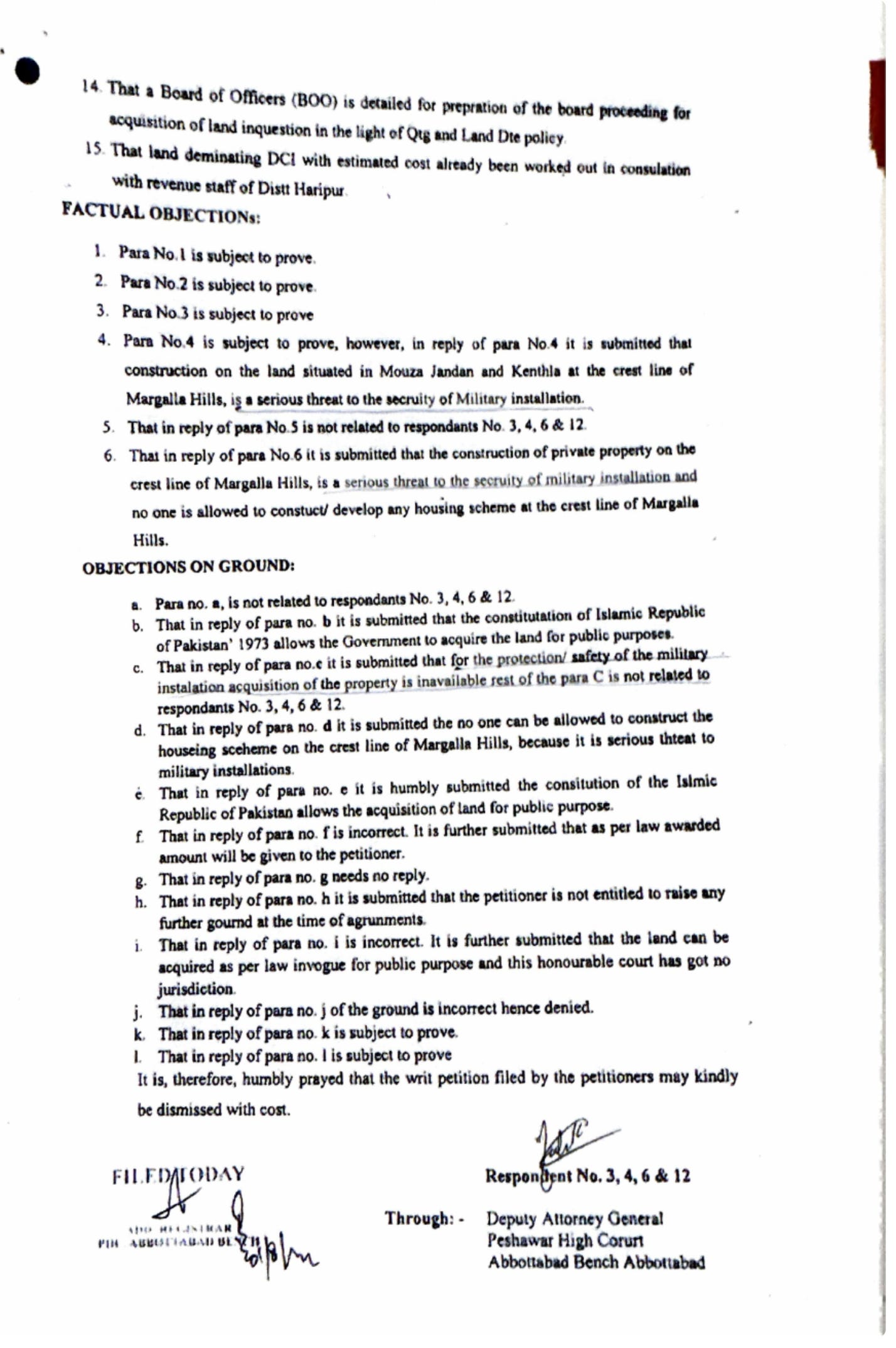
Around the same time, landowners challenged the move before the Peshawar High Court’s Abbottabad bench in Writ Petition No. 648-A/2024 (Engineer Waqar Ahmed Qazi and others v. Secretary, Department of Tourism, Government of Khyber Pakhtunkhwa and others). In written comments submitted through the Deputy Attorney General and supported by an affidavit from the Military Estate Office in Hazara Circle, respondents 3, 4, 6, and 12 retraced the 2023 briefings, the checkpost, and the December shutdown. They argued that private construction on the crest line posed a serious threat to military installations, cited the Constitution’s provision for public-purpose acquisition, stated that the awarded compensation would be paid under the law, disputed the High Court’s jurisdiction, and asked the bench to dismiss the petition with costs. On pages 2 and 3 of the reply, the respondents give no acreage and offer no parcel-by-parcel explanation for why an established police checkpost and a completed construction halt required taking 435 acres of village land.
II: Who Sets the Price
Political resistance in the province moved ahead of the revenue paperwork. In October 2024, the Khyber Pakhtunkhwa Assembly unanimously passed a resolution demanding market-rate compensation for affected landowners. Following a March 5, 2025 meeting chaired by the provincial revenue minister, Haripur’s deputy commissioner wrote to the Military Estate Officer on March 14, 2025, listing the tentative revenue records for both villages: computerised fard jamabandis, marked parcel maps, khasra lists naming landowners, and the district’s 2024–25 valuation schedules.
Haripur’s revenue office reported that no sale deed or mutation had been registered in Kot Jandan during the preceding year. The district proposed using neighbouring Kenthla’s one-year average for Kot Jandan as well. For current market value, the deputy commissioner recommended a four-party committee, comprising representatives from the provincial Board of Revenue, the Military Estate Office, the deputy commissioner’s office, and local residents, to inspect the terrain and assess prices on the ground.
In its May 22, 2024 directive, Station Headquarters had instructed the board that land costs should be calculated on authenticated market value “to avoid payment of additional amount/litigation at later stages.” Yet Annex A attached to that same letter listed two sharply divergent columns for the original 240 acres. Under “DC Rates,” the army quoted Rs 1 million to Rs 2 million per kanal, producing an estimated land bill of Rs 1.92 billion to Rs 3.84 billion. Under “Avg Rates,” the same sheet quoted Rs 300,000 per kanal for Kot Jandan and Rs 340,000 per kanal for Kenthla, putting the total projected bill at Rs 638.4 million.
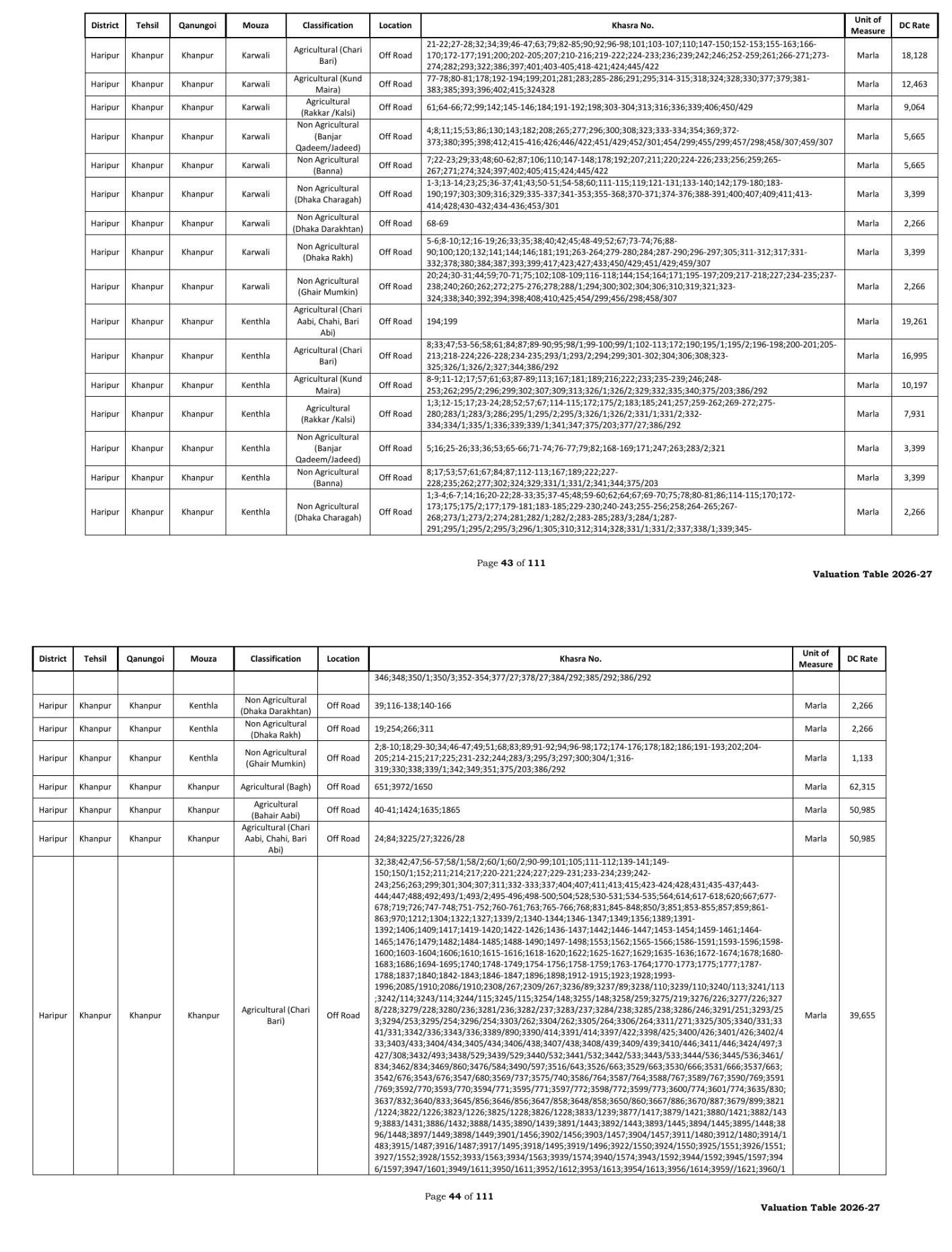
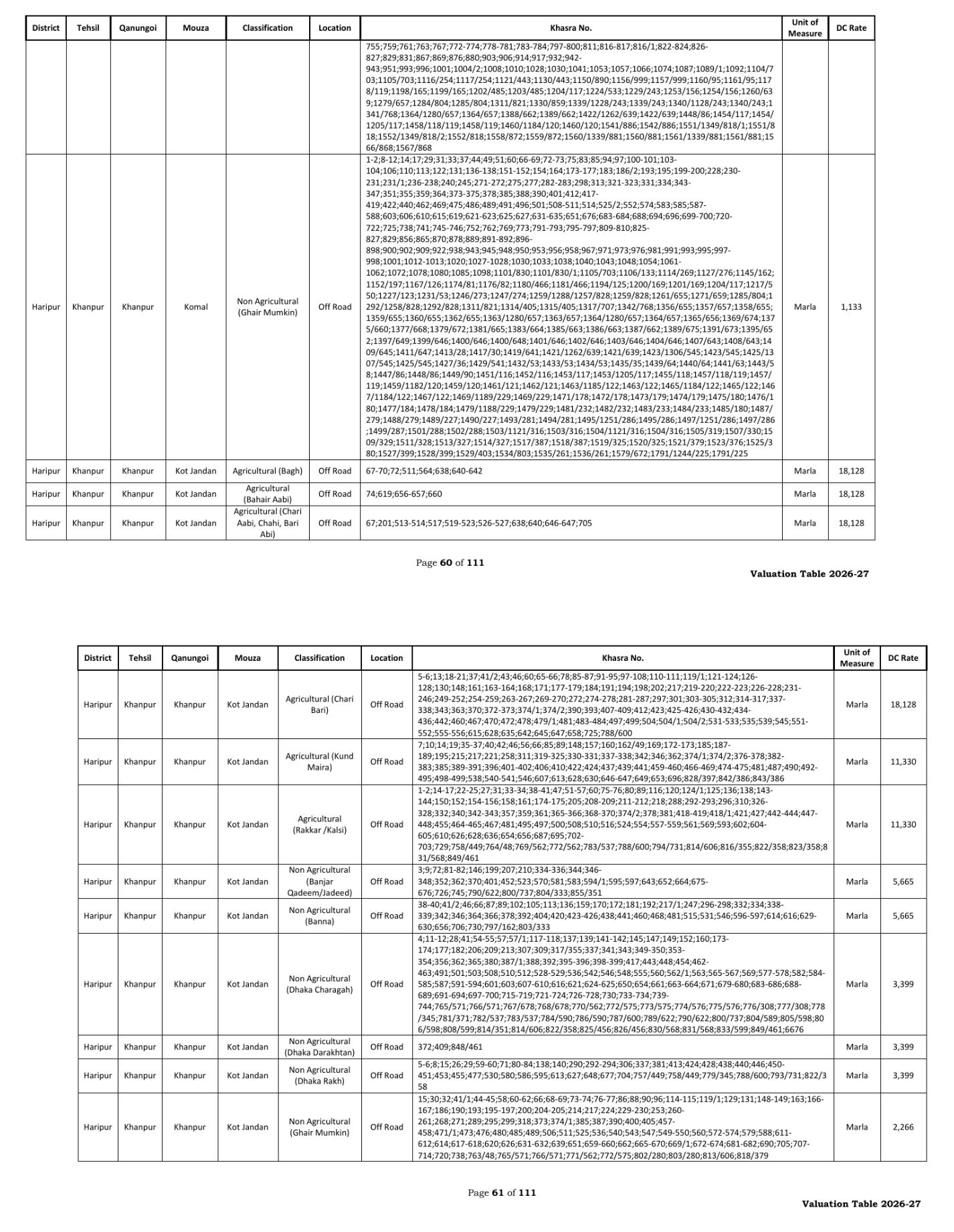
Two years later, Haripur’s Valuation Table 2026–27 (Rural), Tehsil Khanpur lists DC rates by land classification and khasra number in rupees per marla. On pages 43 and 44, Kenthla’s off-road parcels run from Rs 1,133 per marla for land classified as ghair mumkin to Rs 19,261 per marla for a category of agricultural land. At 20 marlas to a kanal, that is Rs 22,660 to Rs 385,220 per kanal. On pages 60 and 61, Kot Jandan’s schedule runs from Rs 2,266 per marla (Rs 45,320 per kanal) for plots classed as ghair mumkin to Rs 18,128 per marla (Rs 362,560 per kanal) for orchards and some other agricultural land.
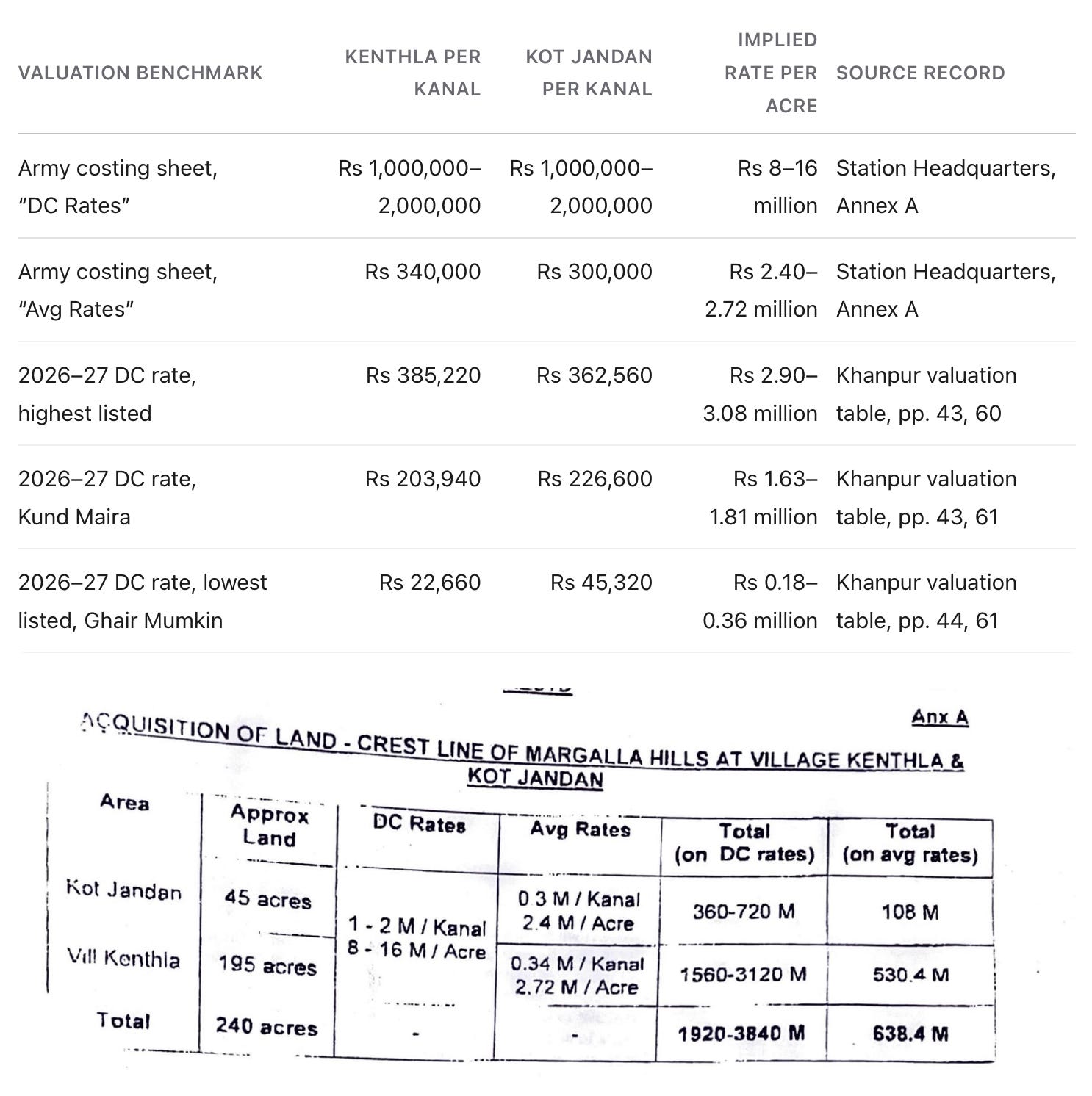
Even the highest agricultural rate in the 2026–27 rural schedule sits roughly 61 percent below the bottom of the Rs 1 million to Rs 2 million range quoted as district rates in the army’s May 2024 sheet. Haripur’s March 2025 letter lists the 2024–25 valuation tables as Annex H and Annex I, but those enclosures are missing from the supplied correspondence. Without the 2024–25 tables, the record cannot establish whether Haripur lowered official rates for identical land classes or whether the army’s “DC Rates” column reflected a different basis for valuation. The figures leave the price of each family’s plot open.
Haripur’s March 14 letter stated that the district would calculate the cost of land, fruit and non-fruit trees, and built-up structures, plus the statutory 15 percent compulsory acquisition charge, after a preliminary notification under Section 4 of the Land Acquisition Act. Under Section 23 of the Act in Khyber Pakhtunkhwa, compensation considers market value at the time possession is taken, with reference to comparable transfers, alongside the additional 15 percent for compulsory public-purpose acquisition. The statute also directs courts to weigh reasonable moving expenses when acquisition forces someone to change residence or move a business. A district valuation table can help officials draft an initial budget, but the collector still needs evidence of comparable sales in a village where the revenue office reported no registered transaction in twelve months.
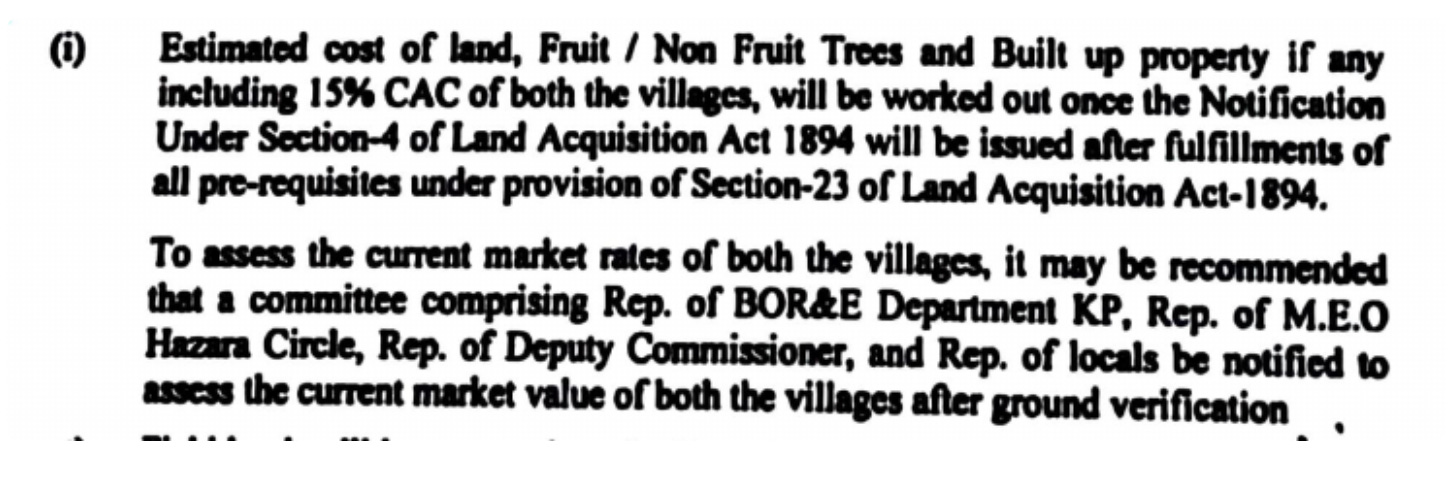
Haripur’s March 14, 2025 letter reports no registered sales in Kot Jandan over the preceding year and proposes a field valuation committee that includes local representation. Haripur acquisition correspondence, PDF page 1.
The dossier asserts that acquisition activity accelerated after governor’s rule was imposed in Khyber Pakhtunkhwa in October 2026. The available correspondence in the Haripur file stops in March 2025, while the 2026–27 valuation table covers rural villages across Tehsil Khanpur. Neither document confirms whether the district has since published a Section 4 notification, made a compensation award, or taken possession.
III: What Islamabad Paid for the Headquarters
The dispute on the Haripur ridge sits atop a half-century land history directly down the slope in Islamabad. In its public account in 2005, the military’s media wing traced the decision to relocate General Headquarters from Rawalpindi to Prime Minister Zulfikar Ali Bhutto in 1972 and the land allocation to the Capital Development Authority in 1981. By 2005, the military stated that roughly 2,400 acres had been acquired along the foothills. Its spokesman assigned 206 acres to the offices of the three armed services and the Ministry of Defence, including 99 acres for GHQ itself, and said the project would house employees from grades 1 to 19 in roughly 14,000 flats.
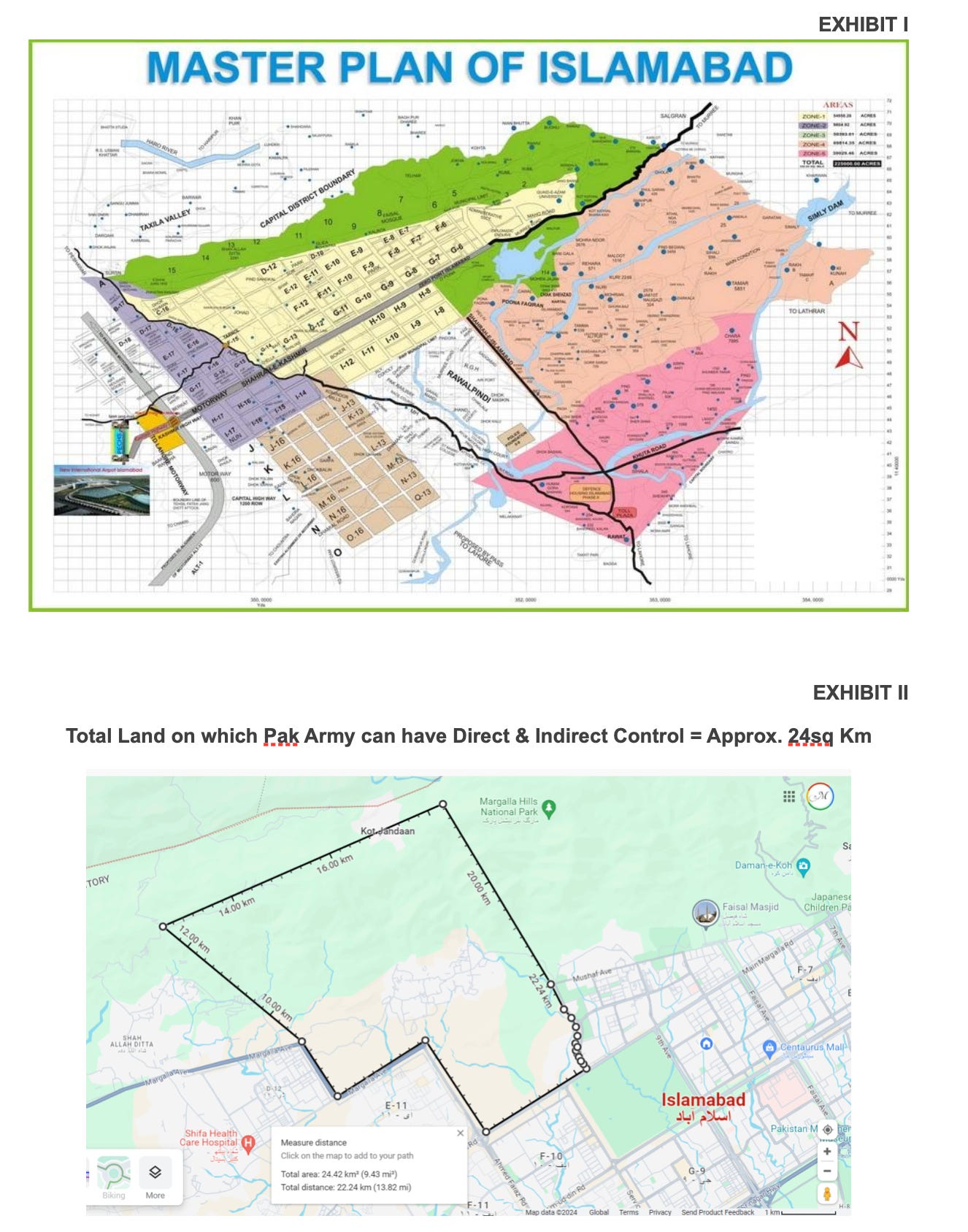
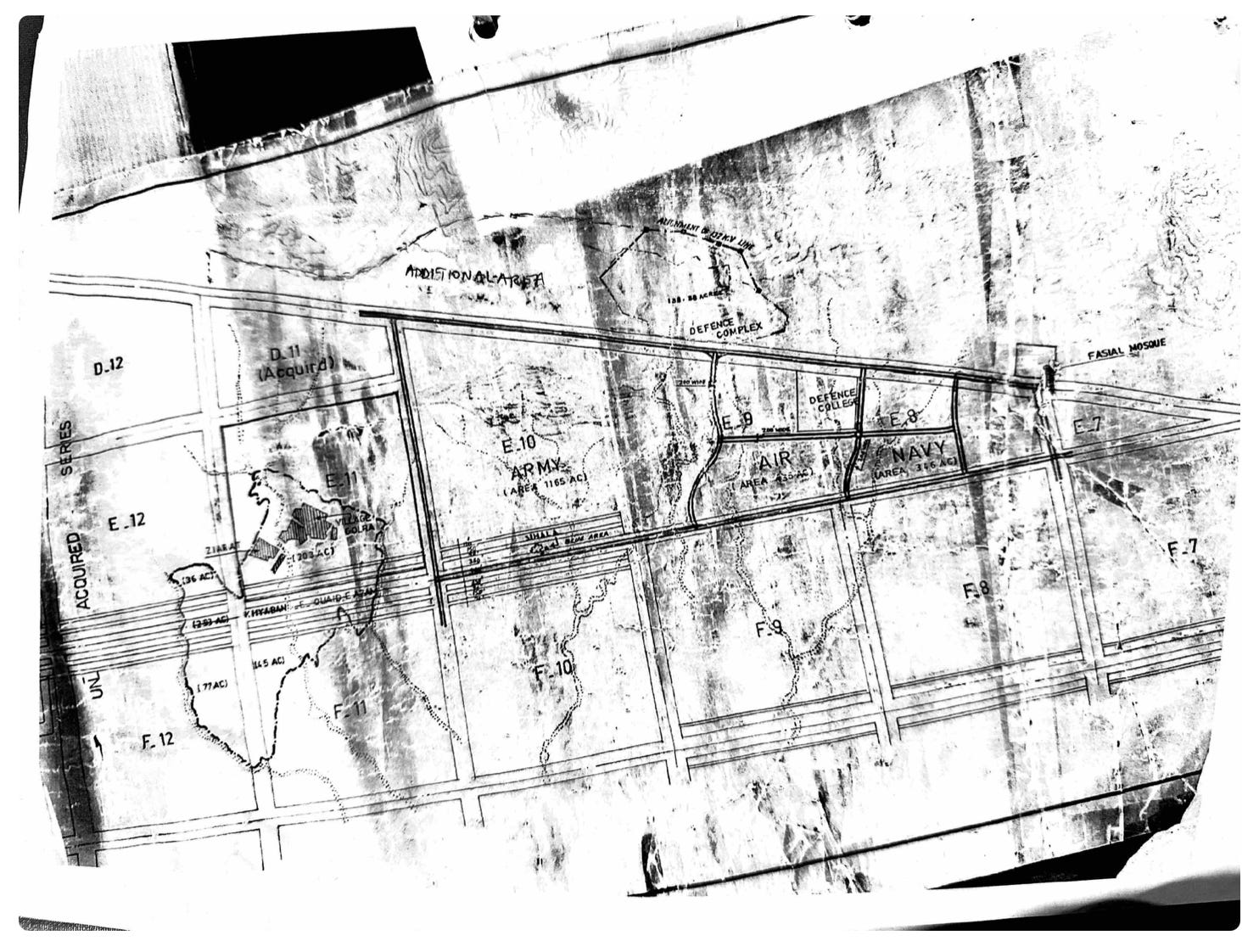
The military’s own planning figures made clear how small a fraction of the footprint was reserved for operational offices. The 870-acre security belt alone exceeded four times the area designated for service headquarters. Opposition lawmakers described blueprintscontaining hundreds of large bungalows, schools, and three lakes. Military spokesmen called the lakes water reservoirs and said the site would contain no private property. The original Defence Complex Islamabad planning map shows areas marked for the army in E-10, the air force and Defence College in E-9, and the navy in E-8, alongside a tract in D-11 labelled “Acquired” and an additional Defence Complex pocket above the sector line.
Opposition senators challenged the concessionary pricing at which public land passed to the complex. When a Public Accounts Committee subcommittee examined the accounts in 2017, audit findings presented to parliament quantified the subsidy on a single parcel. The Capital Development Authority had purchased 870 acres at Rs 1,159 per square yard and allotted them to the military at Rs 200 per square yard. The audit put the difference at Rs 4.034 billion. The authority’s acting chairman told lawmakers that the prime minister of the day had approved the subsidised transfer, and the committee ordered the authority to seek recovery of the full cost. That same hearing was informed that headquarters construction was resuming after the army had suspended the relocation in 2008 during the global financial crisis.
Financial friction between the civilian civic agency and the defence project continued even after work restarted. When Capital Development Authority and Defence Complex officials met in December 2017, the army already held possession of 293 acres in D-11, while ground rent on a 138-acre office tract remained disputed and delay charges sat unpaid on the 870-acre expanse north of E-10 and D-11. The Auditor-General’s defence services auditlater documented Rs 241.24 million in avoidable delay charges paid to the civic authority in 2017–18 despite funds being available in project accounts. Military administrators told auditors they had withheld payment over unresolved possession and encroachment disputes.
Residents living on the Islamabad side faced a far longer ordeal over possession and resettlement. In 2004, Dawn reported that roughly 3,500 homes in Chauntra and adjoining settlements risked demolition without compensation. Twelve years later, the civic authority was still debating whom it was legally obliged to relocate. Board minutes reproduced in an Islamabad High Court judgment recorded approximately 7,000 built-up plots across E-10 and D-11, with two villages surveyed and Chauntra still uncounted while the board discussed shifting families to Sector H-16. The court documented failures in the Capital Development Authority’s acquisition process, including the absence of a credible, transparent survey of rightful owners. When the authority completed its Chauntra survey in 2023, almost two decades after the first demolition warnings, it was still counting homes that remained standing.
IV: The Perimeter Beyond the Allotment
The footprint of the headquarters has shaped land use well past its formal boundary lines. As early as 2007, an environmental official told Dawn that Defence Complex Islamabad’s environmental impact assessment went before the Pakistan Environmental Protection Agency without the usual public hearing because sensitive defence installations enjoyed an exemption. Adjacent areas had themselves been designated sensitive by virtue of their proximity to the complex.
In July 2024, the same month the Military Estate Office sent Haripur its 435-acre requisition, the federal cabinet approved an amendment in principle to convert 375 kanals of planned commercial land near Sector E-10 into a greenbelt, pending a master-plan commission recommendation. Officials cited the security of the headquarters. Across the provincial boundary on the Margalla ridge, Khyber Pakhtunkhwa’s chief secretary had already directed the Hazara commissioner ten months earlier to require Defence Complex Islamabad’s written clearance for construction on the crest.
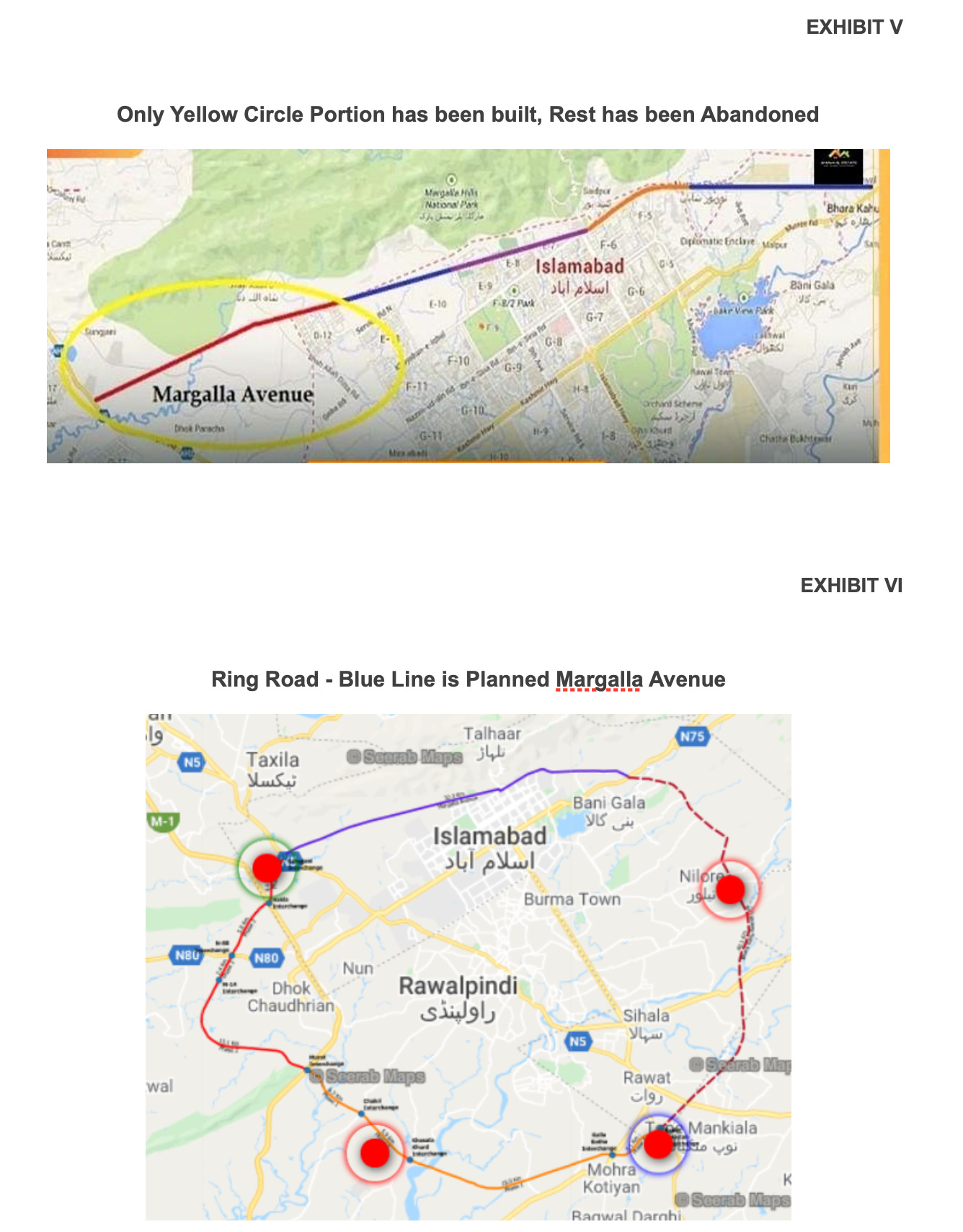
Maps compiled in the dossier also trace alterations in the proposed alignment of Margalla Avenue and show an older Sector D-10 that no longer appears on current sector grids. The dossier’s authors attribute both the road realignment and the disappearance of D-10 to the expanding security perimeter of the complex. Published reporting confirms that the western carriageway reached Sector D-12 while the connecting link toward E-11 encountered delays. Formal route approvals and any allotment orders governing D-10 would resolve what the historical maps leave open. The cabinet’s July 2024 greenbelt decision beside E-10 puts the security rationale on the public record.
V: The Army’s Claim to the Park
Farther east along the same Margalla range, the legal battle over Monal Restaurant demonstrates how a military directorate can assert practical control over contested ground long before courts settle title. GHQ’s Remount, Veterinary and Farms Directorate claimed 8,602 acres inside the notified Margalla Hills National Park, citing a 1910 record and a 2016 Ministry of Defence meeting that it argued had restored the land to military use. The Surveyor General demarcated the boundary and the army put down concrete pillars. A federal government lawyer later told the Islamabad High Court that the federal government had issued no notification returning the tract to military use.
In August 2019, the directorate wrote to Monal proprietor Luqman Ali Afzal directing him to pay it rent dating back to November 2016. Afzal sought clarification from civilian authorities and signed a lease with the directorate the following month. The Islamabad High Court subsequently ruled that the directorate had exceeded its authority in claiming national parkland and collecting commercial rent, and the Supreme Court declared the restaurant leases in the park legally ineffective.
In July 2026, the Federal Constitutional Court set aside key parts of that ruling, leaving park administration with the Capital Development Authority while directing the civil court to decide disputed questions of site ownership, lease validity, and rent entitlement. By the time judges took up those questions, the directorate had already marked the boundary, signed a lease, and received rent. In Haripur, Khyber Pakhtunkhwa’s own September 2023 minutes show another way to exercise control while title remains with private villagers. The province instructed a civilian commissioner to give the headquarters a say in what residents could build on their own plots.
Haripur’s district administration can publish the marked parcel maps it sent to the Military Estate Office, release both the 2024–25 and 2026–27 valuation schedules for Kenthla and Kot Jandan, and state whether a Section 4 notification has been issued. GHQ can explain why its request grew by 195 acres in the seven weeks between the army’s costing sheet and the July requisition. Those records would let families check whether their homes fall inside the proposed boundary and how the district intends to price them. The district already holds the owners’ names, and the federal reply promises payment under the law. If the boundary takes in the homes Yasir Khan spoke about in Peshawar, where will those families go?
Documentary Record
Office of the Chief Secretary, Khyber Pakhtunkhwa. Minutes on unauthorised construction near Kot Jandan, September 6, 2023 (Haripur acquisition correspondence, PDF pages 14–15).
Office of the Chief Secretary, Khyber Pakhtunkhwa. Minutes on Defence Complex Islamabad security, September 18, 2023 (Haripur acquisition correspondence, PDF page 13).
Station Headquarters Abbottabad. Letter of May 22, 2024, with Annex A costing sheet (Haripur acquisition correspondence, PDF pages 10–12).
Deputy Commissioner and Land Acquisition Collector, Haripur. Letters to Assistant Commissioner Khanpur, May 24, July 24 and July 30, 2024, and March 6, 2025 (Haripur acquisition correspondence, PDF pages 9, 6, 5 and 2).
Military Estate Office, Hazara Circle. Registered requisition of July 10, 2024, in English and Urdu (Haripur acquisition correspondence, PDF pages 7–8).
Peshawar High Court, Abbottabad bench. Writ Petition No. 648-A/2024, written comments and supporting affidavit (Haripur court reply, PDF pages 2–4).
Station Headquarters Abbottabad. Letter convening the acquisition board’s progress review, August 2, 2024 (Haripur acquisition correspondence, PDF pages 3–4).
Deputy Commissioner and Land Acquisition Collector, Haripur. Letter to the Military Estate Officer, March 14, 2025 (Haripur acquisition correspondence, PDF page 1).
District Administration Haripur. Valuation Table 2026–27 (Rural), Tehsil Khanpur, Kenthla (pages 43–44) and Kot Jandan (pages 60–61).
Defence Complex Islamabad original sector planning map, showing E-10, E-9, E-8, D-11 and adjoining foothill areas.
Provincial Assembly of Khyber Pakhtunkhwa. Resolution No. 93S05-2024 on market-rate compensation. Land Acquisition Act, 1894 (Khyber Pakhtunkhwa Code), Sections 4 and 23.
Auditor-General of Pakistan. Combined Audit Report on Defence Services (2021–22). Islamabad High Court judgments in W.P. No. 244/2018 and W.P. No. 4245/2014. Federal Constitutional Court review judgment on Monal Restaurant, July 2026.
Additional Exhibits