
Any Third Country
Pakistan’s Six Routes to Iran and the Map Inside the Order
The Transit of Goods through Territory of Pakistan Order 2026 was issued by Pakistan’s Ministry of Commerce on April 25. It is grounded in the Imports and Exports Control Act of 1950, the Customs Act of 1969, and a bilateral road transport agreement with Iran that has existed since 2008 and been unused at scale for eighteen years. It designates six overland routes through Balochistan for the movement of goods from “any third country” through Pakistani territory to Iran. Three thousand containers are sitting at Karachi port. The Strait of Hormuz is blockaded. The order does not name a single originating country.
That omission is not oversight. It is the most significant thing the document contains.
The Six Routes and What They Tell You
The order designates the following corridors. Route 1 runs Gwadar to Gabd, the shortest and most direct path to the Iranian border. Route 2 runs Karachi and Port Qasim to Gabd via the Makran Coastal Highway, through Layari, Ormara, and Pasni. Route 3 runs Karachi and Port Qasim inland through Khuzdar and Dalbandin to Taftan. Route 4 runs from Gwadar through Turbat, Hoshab, Panjgur, Nagg, Besima, and Khuzdar before reaching Quetta and then Dalbandin, Nokundi, and Taftan. Route 5 runs Gwadar through Khuzdar to Quetta and then Taftan. Route 6 connects Karachi and Port Qasim to Gwadar and then to Gabd.
Three routes terminate at Gabd, the newer crossing near Gwadar in southern Balochistan. Three terminate at Taftan, Pakistan’s traditional land border with Iran in Chagai district. The prominence of Gwadar across multiple corridors is deliberate. Three of the six routes pass through or originate at Gwadar, including the direct Gwadar-Gabd corridor which is the fastest overland path to the Iranian border. Pakistan has spent two decades and hundreds of billions of rupees in CPEC financing building toward the argument that Gwadar is a regional logistics hub. The war has provided the demand that promotional roadshows could not. The order is also a Gwadar activation instrument, dressed in humanitarian language.
The order permits cross-stuffing: the physical transfer of cargo from sea containers into road-going trucks. This provision is the operational core. Containers that arrived at Karachi from third countries and cannot reach Iranian ports by sea can be restuffed at container freight stations and driven to the border. The financial mechanism requires an encashable bank guarantee equivalent to Pakistan’s applicable import duties, lodged by the shipper or their authorized customs broker before cargo moves. If transit goods are diverted into Pakistan’s domestic market, the guarantee is encashed by the Federal Board of Revenue. It protects customs revenue. What it does not protect will be addressed below.
The War Behind the Blockade
On February 28, 2026, the United States and Israel launched airstrikes on Iran, assassinating Supreme Leader Ali Khamenei. The Iranian Revolutionary Guard responded by restricting commercial navigation through the Strait of Hormuz, boarding and attacking merchant ships, and laying sea mines. On April 13, the US Navy commenced a blockade of Iranian ports. The result is what analysts have termed a dual blockade: Iran controlling outbound vessel access through the strait, the US Navy blocking inbound cargo to Iranian terminals. Before February 28, the Strait of Hormuz carried approximately 25 percent of the world’s seaborne oil trade and 20 percent of its liquefied natural gas.
The cost of moving anything near this waterway has become structurally prohibitive for commercial operators. Mohammed Rajpar, chairman of Pakistan’s Ship Agents Association, told reporters that war-risk insurance had climbed from approximately 0.12 percent of a vessel’s value before the conflict to roughly 5 percent, when coverage was available at all. For a very large crude carrier valued at 100 million dollars, that is a premium of 5 million dollars per transit. Container trade faces greater disruption than bulk oil shipments, because container margins are thinner and the cargo more time-sensitive. Vessels linked to the United States, Israel, or countries participating in sanctions enforcement are denied access by Iran’s Hormuz-control regime outright. Ships that can theoretically transit are often unwilling to pay the insurance cost or take the physical risk.
A ceasefire between US and Iranian forces took effect on April 8, brokered, as will be discussed, with Pakistani mediation. The ceasefire covers active hostilities between the two militaries. It does not cover the naval blockade. Iranian ports are not receiving international cargo. The strait has not returned to normal commercial operations. Any country that traded with Iran by sea is operating with a functionally closed maritime route, and those goods have to move some other way.
“Any Third Country” and the Country That Phrase Cannot Include
The order’s language is universal. Any third country’s goods, arriving at Karachi or Port Qasim or Gwadar from anywhere, may be transited overland to Iran under the framework it establishes. The document says this plainly and without qualification.
What it does not say is that a prior Ministry of Commerce statutory order, issued on May 4, 2025, after the Pahalgam attack in occupied Kashmir and the subsequent India-Pakistan military standoff, explicitly banned the transit of Indian-origin goods through Pakistan by any mode, the transit of goods going from third countries to India through Pakistan by any mode, and the transit of goods going from India to third countries through Pakistan. That order is still in force. The April 2026 Transit of Goods Order does not repeal it, amend it, or reference it. So “any third country” carries an unwritten restriction: any third country’s goods destined for Iran may transit Pakistan, unless those goods are of Indian origin or connected to Indian trade flows. The universal frame has a prior carve-out that the new order does not acknowledge.
This matters because India has a direct stake in Iranian port access. India’s 500 million dollar investment in Chabahar port, Iran’s only deep-sea port on the Arabian Sea, was built precisely to give India an overland route to Afghanistan and Central Asia that bypassed Pakistan. Chabahar is on Iran’s Sistan-Baluchestan coast. If Iranian ports are blockaded, India’s Chabahar investment is non-functional. The April 2026 order does not provide India any relief. It could not, under the standing restrictions, even if Pakistan wanted it to.
The country that the order can serve, and that has the largest volume of Iranian-bound cargo stranded at Karachi, is China. China is Iran’s largest trading partner, has been purchasing Iranian crude oil at scale through intermediary structures for years, and has a direct commercial interest in maintaining supply chains to Iran regardless of US sanctions posture. Al Jazeera’s reporting on the 3,000 stranded containers identified documents showing that Iran approached Pakistani industry representatives about a land transit arrangement before the Ministry of Commerce issued its order, including Iran’s willingness to compensate Pakistani truckers for full in-country delivery. The TIR transit system that Pakistan activated for the Gabd-Rimdan crossing, through which the April 10 Tashkent shipment moved, charges transit tolls to most participating countries moving through Iran. Pakistan and Malaysia transit through Iran toll-free under the TIR framework. China pays a toll. Cargo moving overland from Karachi through Pakistan to Iran under the new order does not need to transit Iran’s TIR network to enter Iran. It arrives at the border and enters. The toll structure advantage for Chinese-origin cargo entering Iran overland rather than through Iranian maritime points is real and not incidental to the commercial logic of the April 25 instrument.
Balochistan Before Islamabad Moved
The order arrived in Islamabad in late April. What it responded to arrived in Balochistan in late February and looked different on the ground.
Pakistan and Iran share a 909-kilometer border. The communities along it have organized their economies around that proximity for generations. The formal crossings at Taftan and Gabd-Rimdan are where this proximity becomes measurable in customs terms. The informal economy running alongside the formal one, fuel, food, and basic goods at prices lower than Pakistan’s domestic market, is what sustains border towns where government salaries are the ceiling, not the floor.
When the airstrikes began, the border shut. Over 2,000 Pakistani nationals crossed back through Taftan and Gabd-Rimdan in the first four days of March: 1,979 through Taftan, 456 through Gabd-Rimdan, including 37 families of diplomats. Balochistan Chief Minister Mir Sarfraz Bugti placed provincial departments on high alert and arranged transport from the border to home towns. A local Taftan businessman named Kamran Khan told AFP that LPG coming through Taftan was getting short all over Pakistan, not just at the border, and that he was counting his own losses in tens of millions of rupees. A vegetable vendor described commodity prices that had moved from 200-250 rupees per kilogram to 250-400 rupees. Arab News reported food prices in Taftan and surrounding areas had doubled since the border closed in early March.
The Transit of Goods Order 2026 addresses none of this directly. It facilitates the movement of third-country commercial cargo in bonded transit to Iran. It is not a border reopening. The informal economy that sustained Taftan and settlements along 909 kilometers operated through separate channels and those channels remain closed. The Karachi Port Trust waived storage charges at its terminals to reduce the financial burden on cargo owners whose containers are caught in port congestion. There is no equivalent instrument relieving the people who rely on the Taftan informal economy.
The Corridor Pakistan Has Been Building
Pakistan had been constructing this route for reasons that predate the Hormuz crisis by several years. In 2021, escalating border clashes with Afghanistan effectively closed the Torkham and Chaman crossings to reliable commercial transit. The overland route to Uzbekistan, Kazakhstan, and Tajikistan, running north through Afghanistan, became unusable. Pakistan began developing the Iranian alternative.
On April 10, 2026, fifteen days before the Transit of Goods Order, Pakistan sent its first export consignment to Tashkent via Iran. The cargo was frozen beef, transported in refrigerated trucks from Karachi’s BOML Container Freight Station, crossing into Iran at Gabd-Rimdan and continuing north through Iranian road networks to Uzbekistan. The Directorate General of Transit Trade flagged the shipment off in Karachi. Director General Sanaullah Abro said the corridor had been operationalized under the TIR Transports Internationaux Routiers framework, which permits cargo to cross multiple national territories with minimized customs checks at intermediate borders. The International Road Transport Union in Geneva had already activated TIR carnet procedures for Taftan, Rimdan, Sost, and Gwadar. On April 22, the first return consignment from Central Asia arrived in Karachi, coming through China via the Khunjerab Pass. The corridor was already moving cargo in both directions before Iran’s stranded containers became the political occasion for the April 25 order.
This is the infrastructure on which the order runs. Gwadar’s prominence in five of the six designated routes is a statement about where Pakistan intends this corridor to go. The CPEC model had always assumed Gwadar’s regional hub function would be enabled by connectivity north through Afghanistan. Afghanistan closed. Iran is the available alternative. The order activates that alternative for Iran’s stranded commercial cargo, but the corridor it activates was being built for Pakistan’s own export purposes, and will continue to serve them after the current crisis.
Pakistan in the Room
Pakistan’s diplomatic positioning around this order is unusually complicated, and the order’s quiet issuance may be partly explained by how difficult that positioning is to describe in public.
Pakistan brokered the April 8 ceasefire between the US and Iran and hosted the subsequent Islamabad Talks. US Special Envoy Steve Witkoff and Jared Kushner were preparing a second round of negotiations under Pakistani mediation at the time the Transit of Goods Order was issued. Pakistan has simultaneously deployed fighter jets to King Abdulaziz Air Base in Saudi Arabia under a mutual defence agreement, positioning itself alongside the Gulf state that is Iran’s principal regional adversary. Pakistan is the ceasefire broker, the host of peace negotiations, the defence partner of Saudi Arabia, and, as of April 25, the provider of the overland logistics infrastructure enabling Iranian import supply chains to route around a US blockade.
President Trump wrote on Truth Social during the conflict: “Iran is collapsing financially. They want the Strait of Hormuz opened immediately, starving for cash.” The pressure strategy is explicit. Pakistan’s Transit of Goods Order is a direct logistical response to that pressure strategy, issued by a country simultaneously hosting US-mediated negotiations. The Ministry of Commerce did not explain this publicly. The Directorate General of Transit Trade described it as facilitating regional trade and increasing port activity. The documents and the diplomatic calendar sit next to each other without comment. The reader closes the distance.
The Sanctions Exposure and What Pakistan Has Volunteered Into
On April 23, two days before the Transit of Goods Order was issued, the US Treasury Department’s Office of Foreign Assets Control announced sanctions targeting a global network fueling Iran’s oil trade, specifically naming Chinese teapot refineries that had been purchasing Iranian crude at scale and Hong Kong-registered tanker fleets operating in the shadow trade. OFAC described the enforcement action as part of a sustained campaign to deny Iran the financial resources it uses to fund regional proxy networks.
On April 14, a Chinese tanker named Rich Starry became the first sanctioned vessel to exit the Strait of Hormuz after the US blockade began, sailing through US interdiction positions. Simultaneously, ship-tracking data showed an Iranian cargo vessel, the Ashkan3, transmitting its position near Karachi port in mid-April, during the precise period when the 3,000 containers were accumulating at Pakistani terminals. Parallel to the Transit of Goods Order, discussions were underway on a proposed Pakistan-Iran-Oman trade bloc using Gwadar as a re-export hub. Oman has the longest institutional history in the Gulf of serving as an informal financial and commercial buffer for Iranian trade, including functioning as an intermediary during the nuclear deal era.
What the encashable bank guarantee mechanism in the April 25 order does not address is which Pakistani bank holds that guarantee, under what legal advice, on what assurance that doing so will not damage its correspondent banking relationships with US financial institutions. Iran has been under comprehensive US sanctions since 2018. The Treasury enforcement action two days before the SRO was issued is not background noise. The Chinese teapot refineries OFAC targeted were doing precisely what the April 25 corridor would enable overland: receiving Iranian-associated goods through third-country intermediary arrangements. The bank guarantee requirement protects Pakistan’s customs revenue. It does not constitute a legal opinion on secondary sanctions exposure for the Pakistani financial institution that holds it.
Pakistan’s method for navigating this tension in previous iterations was studied ambiguity: informal arrangements, working relationships that were never formalized on government paper, and the deliberate absence of a statutory instrument that could be pointed to. The Transit of Goods Order 2026 is a statutory regulatory instrument, gazetted on April 25, publicly available on the Ministry of Commerce website, grounded in a named bilateral agreement, and signed by the federal commerce secretary. It does not conceal Pakistan’s role. It announces it. That is a different calculation than Pakistan has historically made in these situations, and the person or office that made it has not been named in any public record.
What the Road Actually Costs
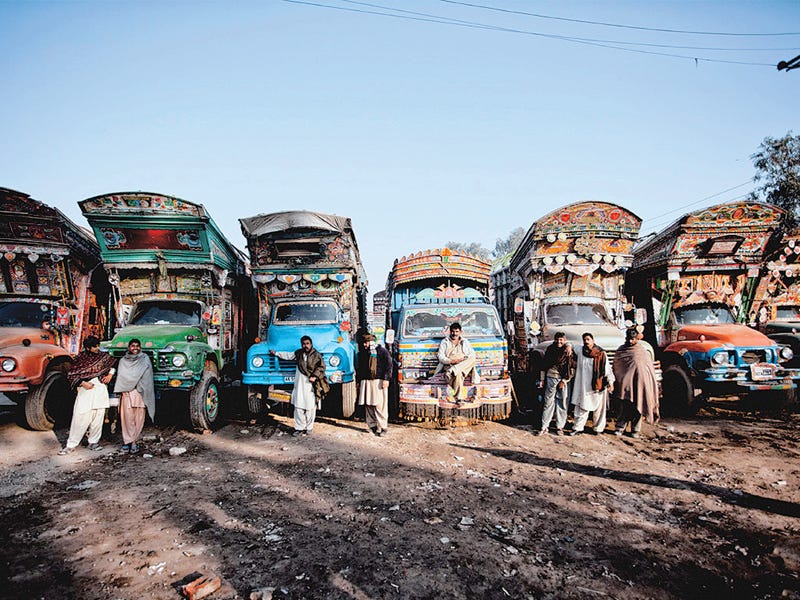
The six routes in the order traverse interior Balochistan on road infrastructure that has not improved in proportion to the policy ambition surrounding it. The N-40 highway from Karachi to Quetta and the secondary roads toward Turbat, Panjgur, and the Makran coast carry trucks alongside decades of deferred maintenance. Transit time from Karachi to Gabd runs to multiple days under normal conditions. Security costs are borne by the carrier. The TIR framework is designed to minimize checkpoint delays across multiple national borders, but Pakistan’s TIR implementation is in its early operational phase. The frozen beef shipment to Tashkent on April 10 was the first consignment this corridor had ever moved at scale.
Iran’s willingness to pay Pakistani truckers additional rates for full in-country delivery, as the Al Jazeera documents showed, changes the per-trip economics for individual carriers. It does not change the road surface, the weight restrictions that are routinely disregarded, or the chronic underfunding of Balochistan’s transport infrastructure that CPEC was supposed to address and has addressed selectively and on terms that have benefited Chinese construction contractors more than Baloch road users.
The ceasefire is active. The blockade is not over. The 3,000 containers are waiting to move. The six routes are designated. The document says any third country.
What the Pakistani bank will be told when the first encashable guarantee is lodged for cargo that originated in Shenzhen and is destined for a buyer in Tehran is the question the order’s four pages declined to answer, and the question that will determine whether April 25 was a wartime transit measure or the first instrument of something considerably more permanent.


