
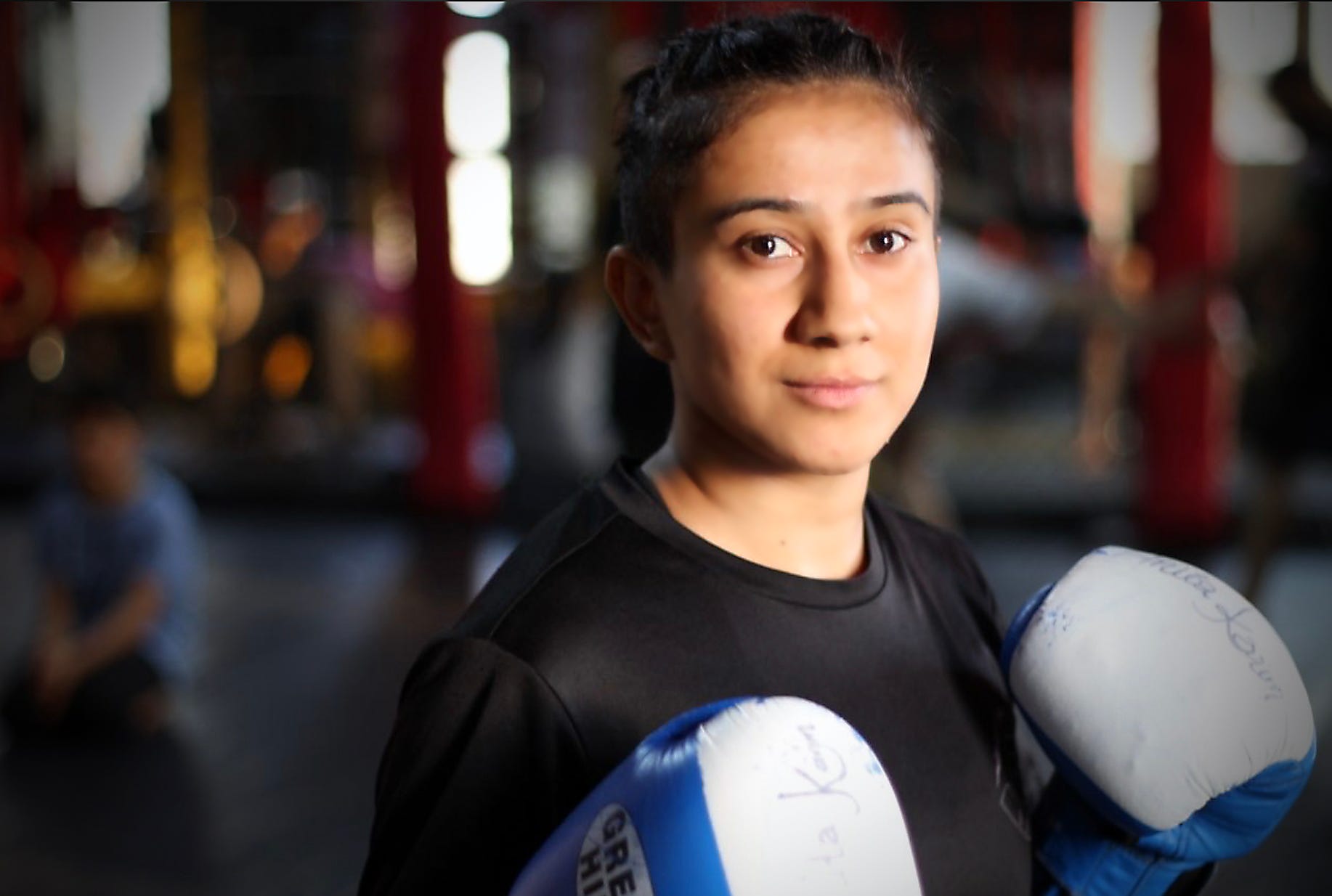
Anita Karim and Pakistan’s MMA Revolution
How a fighter from Hunza spent a decade building a pathway for women’s combat sports in Pakistan
On January 13, 2026, in a makeshift cage in Islamabad, Anita Karim knocked out an Iranian opponent in the first round and claimed Pakistan’s first professional women’s mixed martial arts title. The victory was historic by any measure: the country’s first sanctioned women’s MMA bout, its first female champion, its first professional win by a Pakistani woman inside the cage. But the real knockout happened years earlier, in a series of quieter battles fought in living rooms, university hallways, and remote training camps where the question was never whether Karim could fight, but whether she would be allowed to.
Her story is not simply one of athletic achievement. It is a case study in how individual acts of defiance can crack open social structures that appear immovable, and how geography, family, and sheer stubborn will can converge to produce outcomes that rewrite the script for an entire generation.
Anita Karim was born on October 2, 1996, in Karimabad, a town of roughly 15,000 people in the Hunza Valley of Gilgit-Baltistan, Pakistan’s northernmost region. The detail matters because Hunza is not representative of Pakistan writ large. It is a pocket of exceptionalism: a predominantly Ismaili Shia Muslim community with a 95 percent literacy rate in a country where the national average hovers at 61 percent, and where educational opportunities for girls match those for boys. This is a rarity in Pakistan’s rural and remote areas.
This is the environment that produced Karim and, crucially, allowed her to imagine a life beyond the narrow confines typically prescribed for Pakistani women. In much of the country, women’s participation in public sport is constrained by a tangle of religious interpretation, cultural norms, and family honor codes. According to United Nations data, only one in five women in Pakistan hold jobs, and over 80 percent have experienced public harassment. The idea of a woman engaging in full-contact combat sport, entering a cage in shorts and grappling gloves, absorbing punches to the face, choking opponents unconscious, is not merely unconventional. In many communities, it would be unthinkable.
But Hunza is different. “The village where I come from, they support women fighters,” Karim has said, acknowledging that even there, awareness of MMA was initially nonexistent. What mattered was the cultural foundation: a community where female modesty codes are more relaxed, where girls are educated alongside boys, and where physical capability is valued rather than suppressed. Gilgit-Baltistan has quietly become an incubator for Pakistani female athletes, producing not just Karim but taekwondo champions Maliha and Maneesha Ali, and according to regional government figures, at least five female MMA fighters. Geography, in other words, was destiny, or at least it was the precondition for Karim to choose a different destiny than the one typically assigned to women born elsewhere in Pakistan.
If place provided permission, family provided infrastructure. Karim’s father, Isar, worked as a security guard but harbored a deep passion for combat sports. Her three older brothers, Uloomi, Ehtisham, and Ali Sultan, trained in MMA and eventually founded Fight Fortress, one of Pakistan’s first dedicated MMA gyms, in Islamabad. This was not a household where a daughter’s interest in fighting would be met with horror. It was, instead, a household where fighting was the family business.
Uloomi Karim, Anita’s eldest brother and one of Pakistan’s most recognized male MMA fighters, has described their upbringing as one where physical toughness was expected regardless of gender. “We knew that she could take it and we did not have any issues with her training with any guy,” he told reporters. The brothers pulled no punches during childhood sparring sessions, treating their younger sister as a legitimate training partner rather than a fragile participant.
This is a critical detail often overlooked in narratives of female athletes breaking barriers: Karim did not overcome her family. She was enabled by them. The typical story arc of the pioneering woman athlete involves rebellion against patriarchal authority, a dramatic rupture with tradition. Karim’s story is different. Her family built the gym, trained her, coached her, and shielded her from the broader societal backlash that might otherwise have crushed her ambitions before they took root.
That said, the decision to pursue MMA professionally was still hers alone, and it came at a cost. In 2017, while enrolled at university in Islamabad, Karim faced a choice familiar to countless educated Pakistani women: complete her degree, prepare for marriage, step into the life her community expected. Instead, she walked away from university and into the cage. “Once a girl reaches a certain level of education, people assume the next step is marriage and children,” she later explained. “Martial arts was something I had always known, and I wanted to build a career in it.”
The backlash was immediate. “A lot of people close to me criticized me,” Karim has said, recalling the flood of judgment from extended family and community members who saw her choice as a rejection of social norms. “They said it’s a men’s game exclusively and a woman cannot do that one.” But the criticism, she noted, was “part of the game,” and over time, as victories accumulated and recognition followed, the voices quieted. “Now misogynistic comments and criticisms have stopped,” she said in a 2025 interview.
At Fight Fortress, Anita trained as the only woman on the mats, sparring exclusively with men who often outweighed her by 20 or 30 pounds. She competed in local grappling and striking tournaments, developing a submission-heavy style that earned her the nickname “The Arm Collector” for her relentless pursuit of armbars and keylocks. “They could have tapped to stop the fight, but they didn’t, so I went through with it,” she said, describing the decisiveness required to finish a submission.
In July 2018, she became the first Pakistani woman to compete in an international MMA bout when she entered the ONE Warrior Series in Singapore. The fight itself was overshadowed by a surreal moment: the referee initially refused to let her compete unless she rolled her leggings above the knee, a demand rooted in the organization’s uniform standards but experienced by Karim as yet another negotiation over how much of her body she would be allowed to control. She complied. She fought. She lost.
Seven months later, she returned to the same promotion and defeated Indonesia’s Gita Suharsono by unanimous decision, securing Pakistan’s first international women’s MMA victory. The government of Gilgit-Baltistan awarded her a cash prize and official recognition, a rare acknowledgment that a woman representing the nation in a combat sport was worthy of state support. But recognition at home did not translate into infrastructure. Pakistan had no women’s MMA scene, no training partners at her weight class, no pathway to high-level competition. To continue, Karim would have to leave.
In 2019, after her breakthrough win, Karim signed with Fairtex Training Center in Pattaya, Thailand, one of Asia’s premier facilities for Muay Thai and MMA. The move marked the beginning of what she now describes as the most difficult and isolating period of her career. Fairtex is not a gym built for comfort. It is a factory for elite fighters, overseen by founder Philip Wong, who is known for pushing athletes to the edge of their physical and psychological limits. Karim went from training in a family-run gym where her brothers offered encouragement and cultural familiarity, to a hyper-competitive international environment where she was alone, far from home, and expected to perform at a level she had not yet reached.
“I treated my problems like puzzles,” she said, describing how she learned to cope with injuries, homesickness, and self-doubt. She trained alongside world-class fighters, including MMA and Muay Thai champion Stamp Fairtex, absorbing techniques and conditioning protocols that transformed her from a regional prospect into a legitimate international competitor. Over five years in Thailand, she fought five times and won four, sharpening her striking to complement her grappling foundation.
But the loneliness never fully receded. At the end of each training day, Karim developed a private ritual: she would take a selfie, play Burushaski music, her native language, through her headphones, and mentally transport herself back to Hunza, to the clear air and apricot orchards and the sound of family. It was a survival mechanism, a way of holding onto identity in a place that demanded total submission to the grind. The Thailand years were essential. They turned Karim from a pioneer into a professional. But they also underscored a harsh reality: to be Pakistan’s first female MMA fighter, she had to leave Pakistan entirely.
When Anita Karim stepped into the cage at Islamabad’s Infinite Championship event on January 13, 2026, she was not fighting simply for a title. She was validating nearly a decade of sacrifice, proving that women’s MMA could exist in Pakistan, and demonstrating in the most visceral way possible that a woman from Hunza could stand in the center of the nation’s capital and fight for something the country had never seen before.
Her opponent was Parisa Shamsabadi of Iran, another pioneer navigating the intersecting constraints of gender and conservative society. The fight was brief. Karim dropped Shamsabadi with punches and forced a first-round knockout, claiming the 52 kg women’s strawweight title and etching her name into the record books as Pakistan’s first professional women’s MMA champion. The crowd included families, children, and young women in hijabs pressed against the cage railings, an image that would have been inconceivable just a few years earlier. The win triggered a wave of media coverage, social media tributes, and official recognition from sports authorities who had, until that moment, been largely silent on the question of women’s combat sports in Pakistan.
Anita Karim’s professional record as of January 2026, five wins and two losses, matters less than the infrastructure her career has begun to construct. At Fight Fortress in Islamabad, young women now train alongside men, citing Karim as the reason they were able to convince their families to let them step into the gym. “Anita is a role model for us,” said Bushra Ahmed, one of Karim’s training partners, in a 2025 interview. Promoters who once built all-male fight cards are now factoring in women’s bouts, emboldened by the reaction to Karim’s title win and the market it revealed. The Professional MMA League’s decision to stage Pakistan’s first women’s title fight was a bet that the country was ready to watch women fight. The sold-out crowd and media response suggest the bet paid off.
But Karim is careful not to overstate the shift. “I didn’t set out to break records,” she has said repeatedly. “I just wanted to be my best at something I loved and make my parents proud.” The framing is deliberate. She positions herself not as a revolutionary but as a daughter fulfilling a personal ambition, a narrative more palatable in a society still negotiating the boundaries of acceptable female behavior.
Yet the revolutionary work is being done regardless. Karim recently recounted an incident in which she physically confronted a man harassing her in an Islamabad market, leaving him “with his face stained with blood.” It is a small, violent story, but it carries symbolic weight: a woman trained to fight, choosing to fight, and succeeding. In a country where over 80 percent of women report experiencing public harassment, the image of Karim defending herself in public space is as subversive as anything she has done in the cage.
It is tempting to frame Anita Karim’s achievements as evidence that Pakistan is opening up, that barriers are falling, that change is inevitable. The reality is more complicated. Karim’s success is tightly bound to the specific conditions of her life: the regional culture of Hunza, the support of a family deeply embedded in combat sports, the availability of international training opportunities, and her own exceptional determination. Other Pakistani women seeking to follow her path will not have these advantages. They will face families that forbid physical activity, communities that punish visible athleticism, and a national sports infrastructure that remains overwhelmingly male-dominated. Karim herself has acknowledged that even after her historic title win, women’s MMA in Pakistan exists in a precarious space, dependent on the continued willingness of promoters, sponsors, and audiences to sustain it.
But the door is open. And that, finally, is what matters. Anita Karim did not dismantle Pakistani patriarchy. She did not single-handedly transform the country’s approach to women’s sports. What she did was prove that a girl from a mountain town could enter a cage, absorb punishment, deliver it in return, and walk out with a championship belt around her waist. For the next generation of Pakistani athletes watching from the railings, that proof may be enough.


