
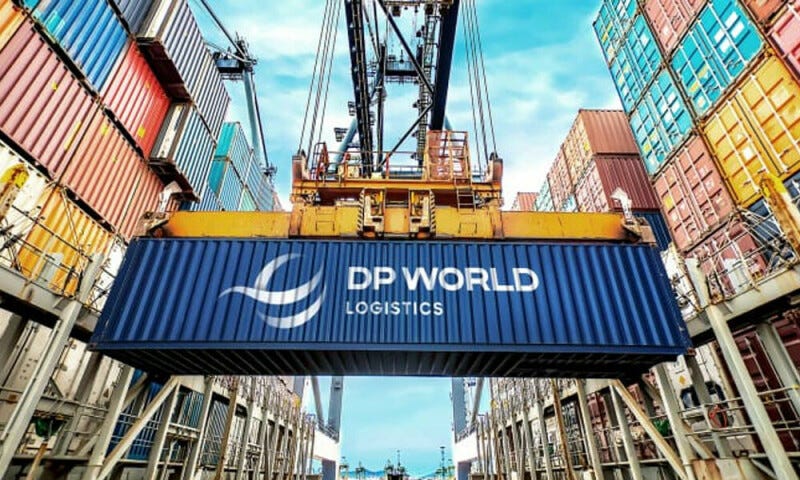
An Investigation into DP World and the UAE Dominance of Pakistan’s Container Trade
How the UAE’s Flagship Port Operator Turned Pakistan’s Maritime Lifeline into a Lever of Foreign Power
Pakistan’s maritime infrastructure is the backbone of its integration into global markets, with over 95 percent of the country’s total trade moving by sea. Within this system, the Qasim International Container Terminal (QICT), operated by Dubai based DP World, has become the primary gateway for Pakistan’s containerized trade. While DP World promotes its presence as delivering world class efficiency and modern port services, the consolidation of Pakistan’s maritime gateways under United Arab Emirates (UAE) state owned entities raises critical questions about economic sovereignty, national security, and the distribution of benefits between Pakistan and foreign operators.
This investigation traces the historical evolution of DP World’s operations in Pakistan, examines the financial mechanisms that underpin its influence, documents major legal and regulatory controversies, and analyzes the broader strategic implications of permitting a foreign state owned enterprise to manage infrastructure that constitutes the commercial lifeline of the country. The evidence points to a crisis driven concession model in which short term fiscal relief and debt rollovers are repeatedly prioritized over long term policy autonomy and institutional integrity.
Historical Evolution and Operational Dominance
From Privatization to Emirati Control
Modern containerized trade in Pakistan emerged in the context of economic liberalization in the 1990s, when the government opened key sectors to private and foreign investment. Qasim International Container Terminal was conceived through a government tender to establish Pakistan’s first dedicated international container terminal at Port Muhammad Bin Qasim. The wider Port Qasim project was one of the largest port privatization initiatives in the country’s history and marked a clear shift to the Build Operate Transfer (BOT) model.
In 1995 the concession for QICT was awarded to P and O Ports, a United Kingdom based operator, and commercial operations commenced on 10 August 1997. Initially, this arrangement framed the port as a public private partnership with a foreign commercial entity. The landscape changed in 2006, when DP World acquired P and O Ports globally and inherited QICT as part of its Subcontinent portfolio. Since DP World is majority owned by the Government of Dubai, this acquisition effectively transformed the relationship from a commercial concession with a private firm into a strategic asset controlled by a foreign state owned enterprise.
Under DP World’s stewardship, QICT has grown from a converted multipurpose facility into a high capacity container terminal complex. The first terminal was created by converting three existing multipurpose berths with a quay length of around 600 meters into a two berth container facility at an investment of roughly 100 million US dollars. A second terminal was added under a 2006 implementation agreement, at an estimated cost of about 211 million US dollars. Together, the two terminals provide design capacity of roughly 2 million TEUs per year, making QICT the largest container handling facility at Port Qasim.
Operational Capacity and Infrastructure Metrics
The scale and technical characteristics of DP World’s operations at QICT illustrate its competitive advantage over older terminals at Karachi Port.
QICT Terminal Specifications
QICT is the only container terminal in Pakistan that operates with its own dedicated private labour force, rather than relying on external stevedore pools. DP World presents this as a mechanism to reduce operating costs, increase flexibility, and maintain tighter control over performance and labour discipline.
A key differentiator is the presence of the Integrated Cargo Container Control (IC3) program, a joint initiative with United States Customs and Border Protection under the Safe Freight Initiative. Through IC3, all United States bound containers handled at QICT are subject to scanning prior to departure, a capability not replicated at other Pakistani ports. This effectively gives DP World a lock on a critical segment of export cargo that must meet US security requirements, reinforcing its central role in Pakistan’s container trade.
From Terminals to Corridors: The 2024 and 2025 Frameworks
Dedicated Freight Corridor and Logistics Integration
A major turning point in the UAE Pakistan relationship came at the World Economic Forum in Davos in January 2024, when both governments signed an inter governmental framework agreement that expanded the UAE’s role from port operator to logistics integrator. The framework envisaged a Dedicated Freight Corridor (DFC) linking Karachi Port to the Pipri Marshalling Yard, development of logistics parks, and an economic zone near Port Qasim.
In January 2025 a high level DP World delegation, led by Group Chairman and Chief Executive Officer Sultan Ahmed bin Sulayem, visited Pakistan under the Special Investment Facilitation Council umbrella. During this visit, a term sheet was signed to move the DFC project into the implementation phase. The corridor is being structured through a partnership of DP World, the National Logistics Corporation, and Pakistan Railways, combining foreign capital with domestic logistics capacity.
Initial investment for the corridor is expected at around 20 million US dollars, with total investments projected to approach 400 million US dollars as the project matures. The DFC is intended to shift a substantial portion of container traffic from Karachi’s congested road network to rail, reducing urban congestion, cutting transport times, and lowering logistics costs for shippers. It also embeds DP World deeper into Pakistan’s inland transport architecture, giving the company influence beyond the port perimeter.
Ancillary Infrastructure: Economic Zones and Power
Alongside the DFC, the broader UAE Pakistan framework includes:
An economic zone at Port Qasim aimed at attracting several billion dollars of FDI into manufacturing and logistics linked to maritime trade.
Capital dredging of Port Qasim’s navigation channel to allow larger, deeper draft vessels to call at QICT and neighboring facilities.
Development of multimodal logistics parks and inland freight hubs connected to both Karachi and Port Qasim.
In December 2025, DP World reached an agreement with K Electric to build a dedicated 132 kilovolt grid station at Port Qasim. The grid station is expected to provide around 26 megawatts of reliable power directly to QICT and associated terminals. This step strengthens the operational resilience of DP World’s facilities and reduces their exposure to wider grid instability and load shedding that routinely affects Pakistan’s domestic consumers and smaller industries.
Collectively, these moves shift DP World from being just a terminal operator to functioning as a central node in Pakistan’s entire maritime logistics chain, with influence over rail corridors, industrial zoning, and energy dedicated to port operations.
The Economic Mirage: FDI, Profit Repatriation, and Debt
FDI Inflows Versus Profit Outflows
At the macro level, Pakistan has experienced a modest rise in FDI inflows over the last three fiscal years, but foreign profit repatriation has also rebounded sharply as foreign exchange controls were relaxed.
FDI and Profit Repatriation Trends (Illustrative, FY 2023 to FY 2025)
After the State Bank of Pakistan loosened tight capital controls that were imposed during the 2022 to 2023 foreign exchange crisis, monthly profit and dividend outflows surged. Transport sector remittances, including those from port operations and logistics, spiked in July 2024 and remained high through 2025, even as the broader economy continued to struggle with inflation, low growth, and fiscal consolidation.
Globally, DP World reported strong financial performance. In 2024, its ports handled a record volume of containers and its revenues and EBITDA rose to historic highs. In the first half of 2025, the company recorded revenue around 11 billion US dollars with double digit growth in earnings, and projected that 2026 would be another growth year despite continued geopolitical tensions and tariff disputes. These numbers underline the extent to which DP World’s Pakistan operations are nested within a profitable global portfolio, with local revenue contributing to a broader pattern of robust returns and substantial profit repatriation.
External Debt and the Rollover Bargain
This investment model is bound up with Pakistan’s external debt predicament. Between 2024 and 2027, the country faces external debt repayments estimated at about 100 billion US dollars. For fiscal year 2024 to 2025 alone, scheduled external debt servicing requirements were in the range of 18 to 19 billion US dollars, compelling Pakistan to seek rollovers and new credit from bilateral partners and multilateral institutions.
The UAE has played a prominent role in this equation. In early 2025, it agreed to roll over about 2 billion US dollars of deposits held at the State Bank of Pakistan, maintaining the pattern of annual rollovers that help Pakistan avoid immediate default but do not reduce the overall debt stock. Similar arrangements with Saudi Arabia, China, and other creditors produce a situation in which Pakistan repeatedly monetizes public assets and grants long term concessions over strategic infrastructure to secure short term liquidity. Port concessions and logistics partnerships with UAE entities thus operate as stabilizing instruments within a broader strategy of debt management, but at the price of cumulative erosion of economic sovereignty.
Corruption, Gatekeeping, and the Port as Shadow Economy
The Missing Containers Scandal
Allegations of systemic corruption and regulatory failure have persistently surrounded operations at Karachi and Port Qasim. Among the most notorious cases is the “missing containers” scandal, which unfolded between 2006 and 2007 and later widened in scope.
In one phase, at least 265 containers carrying high value goods, including electronics and miscellaneous consumer items, were clandestinely removed from Port Qasim under the guise of transshipment. Investigations by the Federal Board of Revenue (FBR) alleged that these containers were released by port staff on the basis of fake manual goods declarations and forged documentation bearing counterfeit signatures and stamps of the National Logistics Cell. Many of the consignments were later traced to warehouses in Faisalabad and Lahore, illustrating a breakdown of gate controls and collusion between elements of port management, clearing agents, and organized smuggling networks.
As probes deepened, officials disclosed that tens of thousands of containers imported under the Afghan Transit Trade regime or for NATO and ISAF supplies had gone missing between 2007 and 2010. FBR officials informed parliamentary committees that roughly 24,000 to 29,000 containers could not be accounted for, with estimated duty and tax losses running into tens of billions of rupees. The scale of the leakages highlighted how port infrastructure, if poorly governed, can become a central node for shadow trade, tax evasion, and potential security risks.
Demurrage, Detention, and Alleged Extortion
In 2020, the National Accountability Bureau launched an inquiry into a multi billion rupee scam involving DP World controlled QICT and Maersk Pakistan. The case focused on allegations that the terminal operator and shipping line had illegally collected demurrage and detention charges from importers on a massive scale, despite customs laws providing for waivers when delays were caused by state agencies.
Customs authorities can issue “delay and detention certificates” to importers when clearance is held up due to inspection, documentation, or other state related reasons. Under the Customs Act, terminal operators and shipping lines are not permitted to levy demurrage or detention in such circumstances. The NAB inquiry and related reporting alleged that QICT and Maersk systematically refused to honor these certificates, using the threat of holding or auctioning cargo to pressure importers into paying large sums. Estimates of the total amount extracted through such practices reached into the hundreds of billions of rupees.
In 2024, customs officials at Port Qasim registered a case against the management of QICT and associates over the illegal removal of auction cargo based on fake documents. At the same time, independent investigations and reportage pointed to long standing disputes between Sindh Revenue Board and major logistics and shipping companies over unpaid sales tax on services, suggesting that large portions of the sector operate in a grey zone that blends legal services with illegal revenue extraction.
Institutional Weakness and Limited Accountability
Despite periodic high profile investigations, progress toward accountability has been slow. Legislative and media scrutiny repeatedly uncovered missing containers, tax evasion, and misuse of authority at ports and airports, yet convictions and structural reforms have been rare.
A 2025 governance and corruption diagnostic report prepared for international financial institutions concluded that Pakistan’s anti corruption institutions are fragmented, under resourced, and subject to political influence. It found that enforcement agencies such as NAB frequently prioritize politically salient cases over complex corporate and tax evasion schemes, while coordination with revenue authorities and sectoral regulators remains weak. Surveys by civil society organizations and Transparency International Pakistan continue to rank customs, police, and land administration among the most corruption prone departments, with respondents reporting a high incidence of bribery and abuse of discretionary powers.
In the port sector specifically, the failure of customs authorities to consistently enforce delay and detention certificates against powerful terminal operators illustrates the mismatch between the formal legal framework and practical enforcement. This gap allows private actors, including foreign controlled entities, to capture rents at the expense of the national exchequer and importers.
Performance Versus Sovereignty
Efficiency Gains and International Recognition
From an operational standpoint, DP World’s management has contributed to raising Port Qasim’s performance. The World Bank’s Container Port Performance Index for 2024 ranked Port Qasim among the top 20 most improved container ports globally, noting a performance score increase of more than 35 points between 2020 and 2024. The index attributed these gains to reductions in ship turnaround times, improved berth productivity, and better coordination in yard and gate operations.
This recognition has been used domestically to validate Pakistan’s broader port modernization agenda, which includes digitalization, infrastructure upgrades, and the introduction of private operators under BOT arrangements. For shippers, the combination of reduced delays, more predictable schedules, and additional capacity at QICT and other terminals translates into lower direct costs and fewer indirect losses from congestion.
Uneven Capacity Utilization and Lock In
However, the efficiency story is not evenly distributed across Pakistan’s container terminals.
Comparative Terminal Capacity and Utilization (FY 2023, Illustrative)
While the Karachi Port trust operated and private terminals at East and West Wharves often function near or above their notional design capacity, QICT at Port Qasim has significant spare capacity. Yet DP World still handles a large share of total containerized trade, partly due to its technical capabilities and partly due to structural lock ins such as exclusive US bound scanning. This suggests that market share is driven not solely by efficient use of installed capacity, but by regulatory and commercial arrangements that channel cargo toward particular operators.
International Arbitration and Policy Externalization
The trade off between efficiency and sovereignty becomes more visible when examining the legal structure of port concessions. In 2023 Pakistan signed a 50 year concession agreement with Abu Dhabi based AD Ports Group for operations at Karachi Port’s East Wharf. The agreement created a joint venture in which Karachi Port Trust has no representation on the operating company’s board, while disputes are subject to international arbitration under foreign rules.
Similar patterns appear in other concessions and framework agreements with UAE entities. Long term control of key berths, terminals, and now inland freight corridors is being vested in companies whose ultimate accountability lies with foreign governments and international arbitration panels rather than with Pakistani institutions. This structure limits the ability of Pakistan to shape port operations directly in line with broader industrial, trade, or security strategies, and raises the costs of any attempt to revise or revoke concessions in the future.
Tariffs, Charges, and the Cost of Trade
Landing Charges and Fuel Adjustments
The cost of moving containers through QICT is shaped by a complex tariff schedule that includes landing charges, scanning fees, fuel adjustments, and demurrage.
QICT General Cargo Tariff Comparison (20 foot container, 2024 vs 2025, Illustrative)
Headline landing charges on some commodities have seen marginal reductions, but fuel adjustment charges and other surcharges have increased. For importers, the combined effect can be substantial, particularly when compounded by delays and the associated demurrage bill.
Demurrage and Free Time
Demurrage rates at QICT rise steeply after a short free period, especially for import containers.
QICT Demurrage Structure (Illustrative, 20 foot and 40 foot import containers)
Importers contend that delays caused by customs inspections, documentation issues, or system failures are not always recognized through delay and detention certificates, leaving them vulnerable to rapidly escalating demurrage charges. For small and medium sized businesses, these costs can constitute up to a quarter of the total landed cost of imported goods, eroding competitiveness and feeding inflation in the domestic market.
Security Risks and Geopolitical Implications
Information Asymmetry and Maritime Domain Awareness
Foreign control over key elements of port infrastructure and information systems has significant security implications. Port operators have access to detailed cargo manifests, vessel schedules, and routing information that collectively form a core component of maritime domain awareness. When such data is held and processed primarily by foreign state linked entities, domestic intelligence and security agencies risk becoming dependent on their cooperation for a complete picture of maritime activity.
The IC3 program at QICT, for instance, generates detailed intelligence on United States bound cargo flows from Pakistan. While this enhances compliance with US security regulations and reduces the risk of trade disruption, it also consolidates sensitive trade data within a foreign operated system. Similar concerns arise when port community systems and terminal operating systems are run and maintained by foreign vendors whose priorities may not always align with domestic security needs.
Dual Use Infrastructure and Regional Rivalries
Port infrastructure inherently has dual use potential. Facilities optimized for high volume commercial shipping can also support naval logistics, surveillance, and rapid deployment. In the Indian Ocean Region, growing strategic competition among the United States, China, India, and Gulf states has turned commercial ports into potential nodes of military influence.
Pakistan is at the intersection of this competition. Gwadar Port is heavily associated with Chinese strategic interests through the China Pakistan Economic Corridor, while Karachi and Port Qasim have come under the operational control or influence of UAE entities that maintain close political and security ties with Western allies. India, for its part, continues to invest heavily in its navy and maritime domain awareness systems, seeking to project power from the Arabian Sea to the wider Indo Pacific.
In this environment, the cumulative effect of foreign control over Pakistan’s major commercial ports, and potentially over its principal international airport, raises questions about the country’s ability to conduct an independent maritime strategy. Concerns have been voiced in policy and defense circles about the appointment of foreign nationals to sensitive positions in port management, and about the possibility that Pakistan’s maritime infrastructure could be used as leverage in broader regional power politics.
The Crisis Managed Governance Model
The PTCL Precedent
The pattern seen at Pakistan’s ports echoes earlier experiences in other strategic sectors. In 2005, the government sold a 26 percent stake in Pakistan Telecommunication Company Limited (PTCL) alongside management control to the UAE based Etisalat. The 2.6 billion US dollar deal included an upfront payment of about 1.8 billion US dollars and a remaining tranche of 800 million US dollars conditional on transfer of certain properties.
For years, disputes over property transfer valuations and documentation delayed the final payment. Despite the protracted disagreement and the state’s failure to secure full proceeds, Etisalat retained management control of PTCL throughout. This outcome set a precedent in which a foreign state controlled operator could maintain long term control of a strategic Pakistani asset even while contractual obligations remained unresolved.
Incremental Monetization of Sovereignty
Since the mid 2000s, successive Pakistani governments have repeatedly turned to asset sales, long term concessions, and privatizations to bridge financing gaps. Ports, telecommunications, power plants, and financial institutions have all been offered to foreign investors, often under government to government deals that partially bypass competitive bidding and domestic parliamentary scrutiny.
By 2023, UAE linked companies operated or were poised to operate Pakistan’s two most significant commercial ports. In 2024 and 2025, they moved to secure stakes in inland freight corridors, special economic zones, and even financial institutions such as First Women Bank. Plans advanced in 2025 to transfer operations of Islamabad International Airport to UAE management for up to 20 years, in another long term public private partnership.
Each of these decisions, viewed in isolation, can be rationalized as a response to immediate fiscal constraints and the need for external capital. Viewed together, they amount to a strategy in which sovereignty over critical infrastructure is gradually monetized in exchange for short term liquidity, debt rollovers, and the promise of investment.
Synthesis: Maritime Sovereignty in the Balance
The case of DP World and its dominance of Pakistan’s container trade captures the central paradox of Pakistan’s current developmental trajectory. On the one hand, DP World’s presence has helped deliver notable improvements in operational efficiency, connectivity, and physical infrastructure at Port Qasim. International recognition for performance gains, the expansion of dedicated rail and power infrastructure, and the attraction of new investments into logistics and allied sectors all attest to tangible benefits.
On the other hand, these gains have come within a governance framework that heavily favours foreign capital over domestic oversight. Profit repatriation has surged as soon as foreign exchange controls were relaxed, even as Pakistan remains heavily indebted and vulnerable to external shocks. Allegations of large scale tax evasion, customs fraud, and unlawful demurrage practices highlight the extent to which regulatory enforcement has lagged behind the pace of privatization. Legal and contractual arrangements that route disputes to foreign arbitration and exclude Pakistani institutions from meaningful oversight exacerbate the imbalance.
The cumulative effect is a maritime ecosystem in which Pakistan enjoys improved operational performance but diminished strategic and policy autonomy. Ports, freight corridors, and economic zones, instead of serving primarily as tools of national development strategy, risk becoming extensions of foreign state led commercial empires. The question facing Pakistan is whether it will continue to manage its ports and logistics infrastructure as collateral in a perpetual debt and liquidity game, or whether it can build the institutional and regulatory capacity necessary to reconcile foreign participation with genuine sovereignty.
For now, the evidence suggests that the balance is tilting towards dependency, and that without a deliberate effort to strengthen domestic institutions and renegotiate the terms of engagement with foreign operators, Pakistan’s maritime sovereignty will remain in a precarious state.
References
1. Port Qasim Authority, “Key Information: Qasim International Container Terminal” and related facility descriptions.
2. Port Qasim Authority, “Facilities” and implementation agreement details for QICT Phase II.
3. Business Recorder and other Pakistani business press reporting on QICT as Pakistan’s first dedicated international container terminal and its technical specifications.
4. World Bank and S and P Global, Container Port Performance Index 2024, and associated coverage in Pakistani media discussing Port Qasim’s 35.2 point improvement and ranking among most improved ports.
5. Federal Board of Revenue reports and parliamentary briefings on missing containers, Afghan Transit Trade leakages, and related tax losses.
6. National Accountability Bureau inquiries and media coverage concerning alleged illegal demurrage and detention charges involving DP World/QICT and Maersk Pakistan.
7. Federal Board of Revenue and Sindh Revenue Board documents, press briefings, and investigative reporting concerning fake and flying invoices and sales tax evasion in the logistics and shipping sectors.
8. State Bank of Pakistan statistics on foreign direct investment and profit and dividend repatriation by sector and month for fiscal years 2023 to 2025.
9. Pakistan government and UAE official statements and press releases on the 2024 inter governmental framework, the Dedicated Freight Corridor to Pipri, and related term sheets signed in January 2025.
10. News reports on DP World’s global financial results and container volumes for 2024 and the first half of 2025.
11. Pakistani and international media reporting on the 50 year concession agreements with AD Ports Group at Karachi Port East Wharf and their arbitration and governance provisions.
12. Government statements, cabinet decisions, and press coverage regarding UAE deposit rollovers, external debt servicing requirements between 2024 and 2027, and the role of asset monetization.
13. Governance and corruption diagnostic reports on Pakistan produced for international financial institutions, including assessments of NAB, customs, and other accountability mechanisms.
14. Pakistani media, government releases, and corporate announcements related to DP World’s power infrastructure partnership with K Electric and plans for a 132 kilovolt grid station at Port Qasim.
15. Policy papers and strategic analysis on Pakistan’s land centric defense posture, maritime security, and the implications of foreign control over critical port infrastructure in the Indian Ocean Region.


