
An Ally's Port
Pakistan has spent decades condemning Israel and refusing to recognize its existence. The terminal handling most of its trade is run by Israel's closest Arab ally.
The statement from Pakistan’s Ministry of Foreign Affairs arrived on March 1, 2026, hours after American and Israeli aircraft began striking Iranian nuclear installations: Pakistan “strongly condemns the unjustified and illegitimate aggression by Israel against the Islamic Republic of Iran.” The language was formal and unequivocal, consistent with a position Pakistan has maintained without interruption since 1947, when its delegation voted against the United Nations Partition Plan for Palestine. The country has never recognized Israel as a state. It has never opened diplomatic channels with it. When the bombs fell on Iran, Pakistan’s government said what it has always said.
What the statement did not mention, and what no Pakistani official has been publicly asked to address in any forum, is that the container terminal handling the majority of Pakistan’s trade with the world is operated by a company wholly owned by the Government of Dubai, which signed a formal normalization agreement with Israel in September 2020, and which has since constructed with Israel one of the most operationally developed bilateral relationships in the Arab world: a free trade agreement, a joint intelligence platform, shared military exercises under a unified American command architecture, and a defense-industrial partnership that includes the transfer of Israeli drone technology to Emirati production facilities. The entity running Pakistan’s primary trade gateway is, by formal treaty and documented practice, an ally of the state whose aggression Pakistan has condemned.
The Terminal
The Qasim International Container Terminal, known as QICT, sits at Port Muhammad Bin Qasim on the Arabian Sea, twenty-eight nautical miles southeast of Karachi. It handles more than 1.2 million twenty-foot equivalent units annually, connects to the national rail network through six dedicated tracks, and runs its own off-dock facility in the city, a dry port in Lahore linked by rail, and a Container Freight Station at Port Qasim. Since May 2008, it has also operated the IC3 Programme under US Customs and Border Protection, scanning every container bound for an American port before it leaves Pakistani soil, a facility the US government subsequently confirmed would be the only one of its kind operating in the country. This means that every container leaving Pakistan for the United States passes through a screening protocol administered by an American federal agency, at a terminal owned by a Dubai sovereign entity that is in formal intelligence cooperation with Israel, under a framework that integrates the terminal directly into American border security operations. What questions that raises about data flows and the uses of scanning intelligence within an alliance architecture that explicitly includes UAE-Israel intelligence sharing is a matter Pakistani officials have never publicly examined.
The history of how this terminal came to be operated by Dubai is not, strictly speaking, a history of Pakistan. In 1995, the Government of Pakistan awarded a build-own-operate concession for what would be the country’s first dedicated international container terminal to P&O Ports, a British company with long roots in Asian maritime trade. The terminal opened on August 10, 1997. For nine years, the arrangement was between Pakistan and a British firm.
In March 2006, DP World, the port operating arm of the Dubai sovereign apparatus, purchased P&O in a global acquisition valued at £3.9 billion. When the US Congress objected to a Gulf state sovereign entity controlling American ports, DP World sold those terminals and kept everything else. QICT transferred, by corporate succession, from British ownership to Dubai ownership, with no change to the concession terms and no Pakistani participation in the transaction. Pakistan was not a party to the acquisition. The relationship between the terminal and the state it served had been restructured by a deal conducted entirely in London and Dubai.
DP World is not a publicly traded company. It was delisted in 2020 and is entirely privately held. Its owner is the Government of Dubai, through the Ports, Customs and Free Zone Corporation, a subsidiary of Dubai World. The ownership chain terminates at Sheikh Mohammed bin Rashid Al Maktoum, the ruler of Dubai and simultaneously the Vice President and Prime Minister of the United Arab Emirates, and there is no meaningful separation between a strategic decision made by DP World and one made by the Government of Dubai. When DP World negotiates an expansion of its operations in Pakistan, and the negotiating record shows it doing this with increasing ambition, it is a sovereign negotiating with a sovereign, regardless of the commercial language in which the agreements are written.
The Alliance
The depth of the UAE’s relationship with Israel is not a matter of inference. It is documented in bilateral agreements, defense procurement filings, and official statements. The Abraham Accords, signed on September 15, 2020, in Washington, made the UAE one of the first Arab states to formally recognize Israel since Jordan in 1994. The two countries moved quickly after that. In 2022, they concluded a free trade agreement, the first Israel had ever signed with an Arab state. A joint intelligence platform, publicly referred to as Crystal Ball, was established to enable shared cybersecurity operations, with UAE and Israeli officials describing the relationship in terms that suggested close operational coordination rather than diplomatic formality. A security framework was institutionalized under United States Central Command, to which Israel was formally transferred in 2021, placing it within the same military architecture as the Gulf states. In April 2025, the UAE sent Mirage 2000-9 fighter jets to join US and Israeli air forces in a multinational exercise in Greece.
The defense-industrial dimension deepened further. A reported agreement for the UAE’s Edge Group to procure Israel’s Hermes 900 surveillance and combat drone from Elbit Systems, with technology transfer and localized production by an Emirati subsidiary, was described as the first major defense-industrial partnership between the two countries, enabling the UAE to eventually move from importer to manufacturer of Israeli military technology. In 2024, Israel’s defense exports to Abraham Accord countries reached twelve percent of its total exports, up from three percent the year before, in a year when Israeli defense exports hit a record $14.8 billion globally. The UAE had supplied Israel with missile defense assistance in 2022 during Houthi attacks and participated in the regional air-defense network that, by documented accounts, played an operational role in countering Iranian missile strikes on Israel in April and October 2024 and during the June 2025 Iran-Israel conflict.
The Abraham Accords were always as much about Iran as about Israel. The shared threat perception that drove normalization had been developing for a decade before the documents were signed, and the architecture built afterward treated Iran as the primary adversary to be contained. Pakistan, which shares a 900-kilometer border with Iran, has described the collapse or fragmentation of the Iranian state as a development that “greatly, and rightly, worries Islamabad,” and houses the world’s second-largest Shia Muslim population. It sits awkwardly in a regional order being reorganized around an alignment it has no part in and considerable reason to resist. Its Foreign Ministry’s condemnation of Israeli aggression against Iran was the natural expression of that position, and also the most direct public acknowledgment of where Pakistan stands relative to the architecture its own trade infrastructure is embedded in.
The Debt
While the strategic picture has this shape, the financial arithmetic has its own urgency, arriving this month in three installments. The Abu Dhabi Fund for Development, a sovereign instrument of the UAE, placed $3 billion in deposits with Pakistan’s State Bank in three tranches. The oldest, $450 million, dates to 1996 and 1997, when it was extended for one year. Pakistan could not repay it at maturity and has been rolling it over, at approximately six percent interest, for nearly three decades. A second tranche of $2 billion arrived in 2018, structured as a one-year instrument, and rolled over annually since then at 6.5 percent. A third tranche of $1 billion was extended in 2023, when Pakistan needed to bolster its State Bank reserves to satisfy the conditions of a $7 billion IMF program, under which the UAE, Saudi Arabia, and China jointly committed to maintaining $12.5 billion in combined deposits with the central bank until the program expires in September 2027.
Through 2024 and into 2025, Pakistan sought to convert this arrangement into something more durable. The SBP Governor formally requested a two-year rollover at around three percent interest. The UAE declined and rolled the deposits for one month. Pakistan’s Prime Minister personally requested an extension. The deposits were extended two months, to April 17, 2026. By then, the regional war had started. Officials in Islamabad said the US-Israel strikes on Iran had accelerated the UAE’s posture: an ally of a belligerent, navigating its own financial exposure in a widening conflict, asked for its money back. Pakistan will return $450 million on April 11, $2 billion on April 17, and a third tranche of $1 billion in July, drawing from foreign exchange reserves the central bank describes as standing at $16.4 billion. Combined with a $1.3 billion Eurobond due April 8, Pakistan’s external debt payments for April alone reach $4.8 billion.
Discussions continue in parallel about converting $1 billion of the outstanding debt into equity in companies linked to the Fauji Fertilizer Group, a transaction that would end Pakistan’s cash repayment obligation on that portion by replacing it with UAE ownership of Pakistani industrial assets. Some senior officials have framed this as a favorable resolution. Whether it is depends on which aspect of the arrangement one is weighing: Pakistan retires a debt obligation and Dubai acquires a productive stake in the Pakistani economy, a pattern not entirely unlike the one that produced the terminal at Port Qasim.
The Expansion
While the debt was cycling through monthly rollovers and Islamabad was drafting its condemnation of Israeli aggression, DP World was deepening its presence in Pakistan’s logistics infrastructure with the active encouragement of the government. In 2024, Pakistan and the UAE signed two intergovernmental framework agreements covering more than $3 billion in planned investments: a dedicated rail freight corridor and an economic zone near Karachi, with DP World designated to act on behalf of Dubai, and Pakistan Railways and the Port Qasim Authority on behalf of Pakistan. In September 2025, the first phase of a $400 million freight corridor was formally launched, covering fifty kilometers of dedicated double-track rail from Karachi Port to the Pipri marshalling yard.
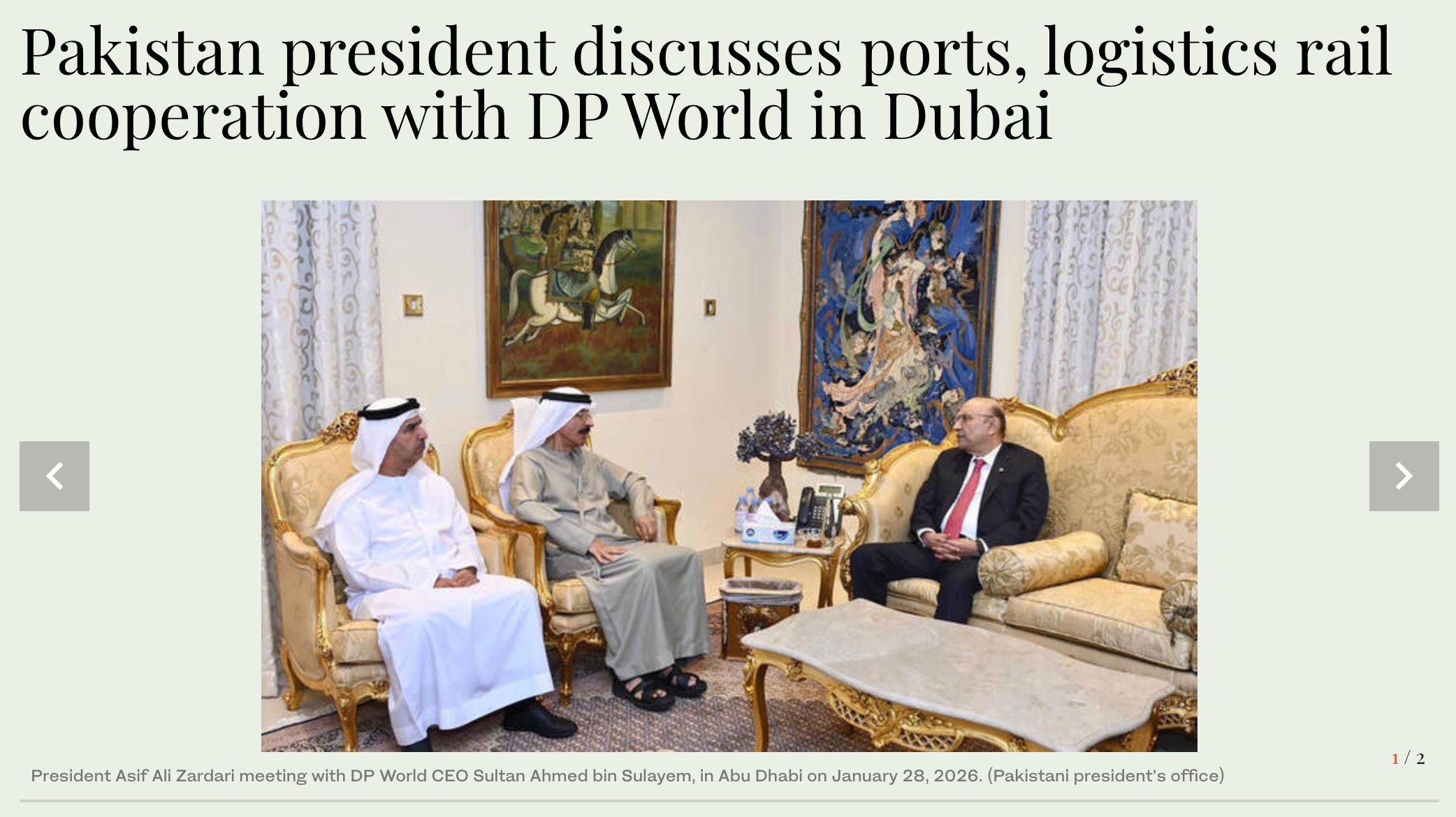
In January 2026, President Asif Ali Zardari traveled to Abu Dhabi and met DP World’s Group CEO Sultan Ahmed bin Sulayem. Zardari’s office described the meeting as a discussion of bilateral cooperation in port and rail logistics and committed Pakistan to “institutional facilitation and fast-track approvals” for DP World’s operations in the country. Six weeks later, Pakistan’s Foreign Ministry issued its condemnation. The two statements, the approval commitment and the condemnation, were produced by the same government, in the same season, about an entity whose closest strategic partner is the state named in the second statement as an aggressor.
Pakistan’s civil-military Special Investment Facilitation Council, the hybrid body established in 2023 to accelerate foreign investment decisions, has managed the DP World negotiations throughout. UAE officials have noted that the Council moved on approvals within days. When the freight corridor is complete, the terminal currently handling the majority of Pakistan’s containerized trade and the primary inland rail distribution hub will be connected by dedicated infrastructure designed, funded, and operated by the Dubai sovereign entity, extending an operational footprint that began with a British company’s concession in 1995 and has been expanding, without a single public parliamentary review, ever since.
The Cumulative Question
The logical question is not why any of this happened. Each individual arrangement had its own rationale. A British company won a concession in 1995 through a competitive tender. DP World acquired that company in 2006 in a transaction that reshaped the global port industry. The UAE formalized its relationship with Israel in 2020, in an agreement brokered by Washington and driven by shared threat assessments about Iran. The freight corridor was proposed to address a genuine inefficiency in Pakistan’s logistics chain. No single decision required anyone to confront the aggregate picture, and Pakistani governments of every political configuration have been more interested in the individual arrangement on the table than in the structural condition those arrangements were quietly assembling.
But the aggregate picture exists, and it is this: Pakistan’s primary trade gateway is operated by an entity in formal security alliance with Israel, integrated into American border security infrastructure, expanding through a freight corridor that will give it deeper operational control over how Pakistan’s goods move, at a moment when the state that owns that entity is calling in its loans because its Israeli ally is at war with Pakistan’s neighbor. Pakistan does not recognize Israel, has formally condemned its actions, and is attempting to position itself as a neutral mediator between Tehran and Washington, while simultaneously committed, in writing, to delivering fast-track approvals for the expansion of the terminal that Dubai’s sovereign entity operates on its coast.
Liang Qichao, writing at the turn of the twentieth century while in exile from a China he believed was losing its sovereignty through a thousand seemingly rational institutional concessions to foreign powers, argued that the most dangerous transfers of structural capacity are the ones that arrive wearing the language of development and modernization, because they are accepted without the scrutiny that open force would invite. He was describing a different century and a different country, but the process he named, the incremental yielding of structural position under the cover of bilateral investment agreements, bears a family resemblance to the accumulation that has produced, at Port Muhammad Bin Qasim in 2026, a situation that Pakistan’s government has no public account of and no apparent framework for examining.
The $3.5 billion being repaid this month will eventually leave the balance sheet. The terminal will not.


