
A Commentary …
The morning after Pakistan’s army chief spent the night brokering a ceasefire between the United States and Iran, Pakistan’s foreign ministry spokesperson was asked to confirm that any of it had happened. “We do not comment,” Tahir Andrabi said, “on these individual, specific incidents.”
A country’s army chief worked the phones until dawn, called the American Vice President, called the American special envoy, called the Iranian Foreign Minister, drafted a two-page memorandum, transmitted it electronically to two warring governments, and by morning had produced the document that the world’s press was calling the Islamabad Accord. The civilian foreign ministry that governs the capital in whose name the accord was named could not confirm that any specific incident had occurred.
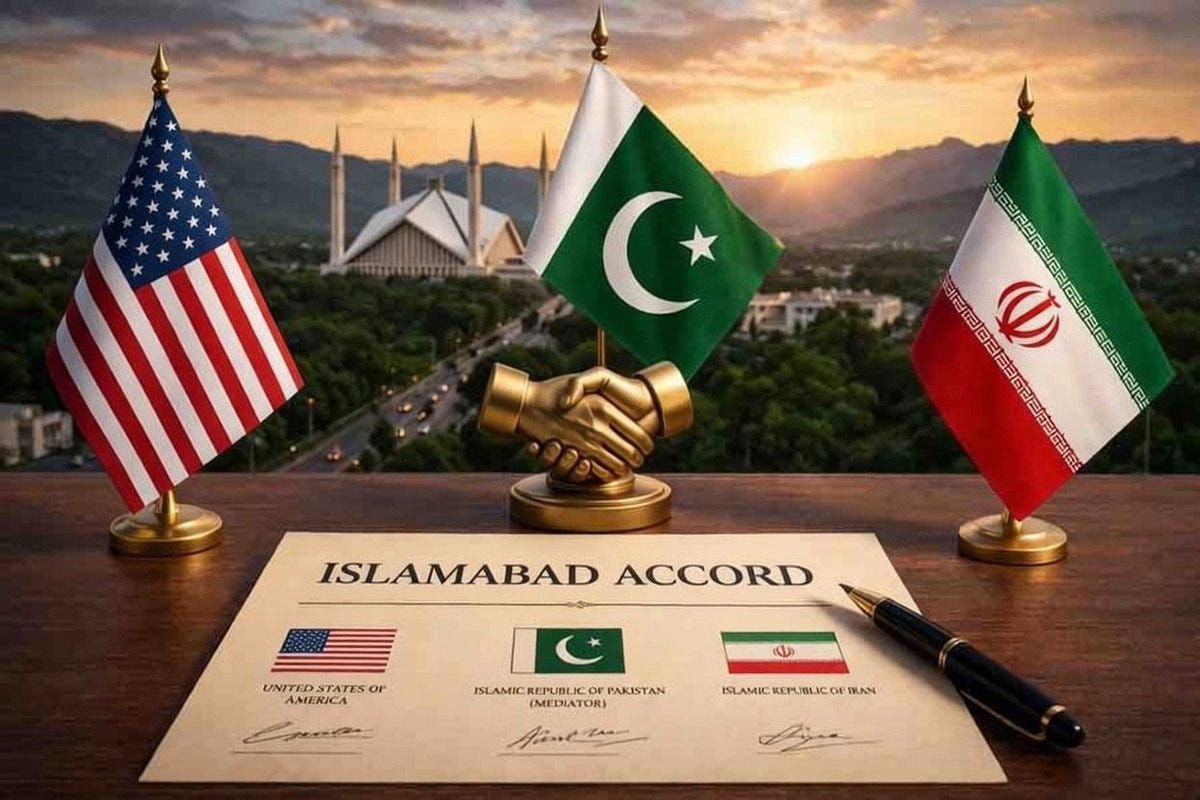
This is the Islamabad Accord: a document whose existence Pakistan’s own foreign ministry would not acknowledge, named after a city whose fuel queues had not moved in three weeks, submitted under a civilian government that the army chief does not technically work for, to a White House that reportedly pushed Pakistan to produce it. The talks it produced begin tomorrow, Saturday April 11, in a capital that will host them because an institution that does not appear in Pakistan’s constitutional order decided that this was useful.
Start with what Asim Munir was actually asked to deliver, because it has not been stated plainly in the celebrations.
The Islamabad Accord’s final phase requires Iran to commit to abandoning its nuclear program. This is in the framework Pakistan drafted and transmitted. Sanctions relief and frozen assets in exchange for nuclear disarmament: the American demand, repackaged as a Pakistani proposal, sent to Tehran under Islamabad’s name.
Pakistan’s nuclear program was built against American pressure. Zulfikar Ali Bhutto said the country would eat grass and leaves rather than give it up. When America sanctioned Pakistan under the Pressler Amendment for pursuing that program, Pakistan pursued it anyway. On May 28, 1998, Pakistan tested five nuclear devices in Chagai and the country called it Youm-e-Takbir, the Day of Greatness. It is a national holiday. It is what sovereignty looks like when a country decides it will not be told what weapons it may possess.
Asim Munir, the Field Marshal who spent the night of April 6 on the phone with JD Vance, is the custodian of that same program. The country he represents is now the chosen vehicle through which Washington is trying to extract from Iran the surrender that America failed to extract from Pakistan by sanctions, threats, and thirty years of pressure. The irony is not incidental. It is the arrangement’s central architecture.
Sohail Ahmed is twenty-seven and delivers things by motorcycle to support a family of seven. He is not strategic. He is not a diplomat. When Al Jazeera found him in Islamabad in March, he had one concern: diesel. “That increases the cost of every little thing,” he said. Diesel is at five hundred and twenty rupees a litre.
On April 4, the government announced the largest fuel price increase in the country’s history: petrol up 42.7 percent overnight, to four hundred and eighty-five rupees. Motorcycles formed queues outside fuel stations before the sun rose. By April 5, after protests, the Prime Minister walked the petrol price back to three hundred and seventy-eight rupees. He made a television address. “I promise I will not rest,” he said, “until your life is back to normal.” Diesel stayed at five hundred and twenty.
State-run buses in Islamabad were made free for thirty days at a cost of three hundred and fifty million rupees, the Interior Minister announced on X as an emergency measure, while the army chief was on the phone arranging the architecture of a regional ceasefire. LNG shipments to Pakistan had collapsed from twelve arrivals a month in January to two in March. Pakistan imports more than eighty percent of its oil. Its fuel reserves stood at twenty-six days of petrol coverage and twenty days of diesel.
This is not background to the Islamabad Accord. This is the domestic condition of the mediating government in the week it chose to insert its name into history.
On Sunday April 6, Axios reported that Washington, Tehran, and regional mediators were discussing a 45-day ceasefire in two phases, with talks channeled through Pakistan and finalized in Islamabad. That same night, Munir was on the phone with Vance, Steve Witkoff, and Abbas Araghchi. By morning, Pakistan had shared its framework with both governments. Iran said it was reviewing it and that negotiations were “incompatible with ultimatums and threats to commit war crimes.” Washington did not officially respond. Trump had set a hard deadline of Tuesday, April 7, at eight in the evening Eastern, after which he would, as he put it on Truth Social, destroy Iran’s bridges and power plants. He signed off: “Glory be to GOD.”
With ninety minutes remaining before that deadline, Trump announced on Truth Social that he had agreed to a two-week ceasefire. Hours later, Araghchi confirmed it on X, expressing gratitude to Prime Minister Sharif and Field Marshal Munir for their “tireless efforts.” Trump said he had agreed “based on conversations” with Sharif and Munir, adding that they had “requested that I hold off the destructive force being sent tonight to Iran.”
Read that sentence in the context of Pakistan’s jubilation and hold it for a moment. Trump was sending destructive force. Islamabad asked him to hold off. He agreed. The favor, as he describes it, flows one direction. Pakistan is the petitioner, the one making the request, the one to whom the gift of restraint is extended. This is not the language of a country that has leverage over a superpower. It is the language of a useful intermediary whose usefulness was recognised, honoured, and whose bill will be presented at a time of Washington’s choosing.
The Financial Times reported, citing its own sources, that the United States had pushed Pakistan to broker the temporary ceasefire. That is a different story from the one Pakistani television is telling. A country pushed to produce a document is not the author of the settlement. It is the drafter.
India’s External Affairs Minister S. Jaishankar called Pakistan a dalal. The word means broker, fixer, the one who carries messages between parties who will not speak directly to each other. He deployed it with all the contempt he intended. Islamabad’s response was immediate and warranted: the remark was irresponsible, unbecoming of a foreign minister, and reflected the bitterness of a government watching its rival accumulate diplomatic visibility it has spent years trying to deny. The Indian fury was real. India was handed one phone call from Trump, with Elon Musk apparently listening in, while Pakistan’s army chief was on his third hour with Vance. That asymmetry produced the insult.
The insult was wrong in tone. It was accurate in structure. What Pakistan’s rebuttal did not say was that the discomfort underneath the word, the structural relationship it names, is precisely what this week’s triumphalism has declined to examine.
Trump called Munir his “favorite Field Marshal.” This is not admiration. It is a management technique deployed by a president who has found in Pakistan’s army chief what he always wants in a foreign interlocutor: a hard-power operator with direct access to both the White House and a government Washington cannot talk to, who will produce results without asking too many questions about what the results cost the people he governs. The general who is useful gets the compliment. The compliment does not appear on the balance of payments.
What did Pakistan extract?
Trump extended his bombing deadline by ten days in early April, citing “diplomatic progress,” progress Pakistan provided. Pakistan’s petrol prices did not fall during those ten days. The IMF’s staff-level agreement of March 29 remains intact, but the Fund has simultaneously told Islamabad to eliminate petroleum price distortions and phase out the emergency subsidy cap. Pakistan’s Finance Minister is flying to Washington this week for IMF and World Bank spring meetings where significant recalibration of the 2026-27 macroeconomic framework will be required. It is the same government that just bought Washington time to avoid diplomatic collapse, negotiating its twenty-fifth IMF programme with the same Washington whose bombing campaign caused the crisis.
Five million Pakistanis work in the Arab Gulf. Their remittances run roughly equal to the country’s total export earnings. The war Pakistan is now facilitating the diplomatic resolution of put every one of those workers, and every one of those remittances, inside the blast radius of a conflict their government has been managing on Washington’s behalf. There is no public record that Pakistan demanded Gulf remittance protections as a condition of its mediation. There is no public record it demanded IMF renegotiation room, or gas supply commitments from the Gulf states who attended its own meeting in Islamabad on March 29, as conditions of lending this infrastructure. The public record is that Pakistan produced a document, named it after itself, and received, in return, a compliment from a man who was about to bomb a country into agreeing to talk.
The ceasefire was under strain before the ink was dry. On April 8, the first day of its operation, Israel launched what observers described as its largest wave of strikes on Lebanon since the war began. Netanyahu’s office stated Lebanon was not covered by the ceasefire, a position confirmed by Trump and Vance despite Sharif’s public claim to the contrary. Iran halted Hormuz traffic in response. Iran’s Supreme National Security Council called the ceasefire an “undeniable, historic, and crushing defeat” for the United States, while warning that “our hands are on the trigger.” The parliamentary speaker, Qalibaf, said the negotiations were cover for a ground invasion. The Iranian ambassador to Pakistan, this week, said the talks had reached a “critical, sensitive stage.”
Iran’s position has not changed since February 28. It wants a permanent ceasefire, binding guarantees against future American and Israeli attack, war reparations, and sovereignty over the Strait of Hormuz. Washington wants the Strait open as a precondition rather than an outcome, and nuclear disarmament as the deal’s final phase. The Islamabad Accord asks Iran to give Washington its precondition first and receive its guarantees last, under a framework with no enforcement mechanism Iran controls. Tehran rejected a fifteen-point American plan as excessive before Pakistan’s version arrived. It has agreed to two weeks of talks. That is not the same as having agreed to the terms.
One Pakistani official told Al Jazeera this week that what Islamabad was dealing with was “essentially a schoolboy brawl.” The two combatants are the United States and Iran. Pakistan is the prefect asked to separate them.
Tomorrow, the delegations arrive in a capital whose fuel queues are in their third week. The Islamabad Accord is named after a city that has been offering free bus rides as emergency relief since the war those delegations are here to manage sent petrol to five hundred rupees a litre. Sohail Ahmed will still be on his motorcycle, navigating the city’s rearranged security corridors, doing the math on diesel at five hundred and twenty rupees, supporting seven people on the logic that every delivery he makes is one the price of everything depends on.
Pakistan has not been given the answer to Bhutto’s question, what is the grass worth, and who gets to eat it, since 1998. The bomb Pakistan built against American pressure is now the model Washington wants Iran to surrender. Pakistan is the messenger. The messenger has not said what the message cost.
What Pakistan receives for any of this, beyond the name on the document, is the question the evidence has raised and not yet answered.


