
A Pact for What Was Already Done
Pakistan and Saudi Arabia have signed a defense pact. The defense relationship is sixty years old.
A protocol signed in December 1982 between Pakistan and Saudi Arabia is still in force. It has never been suspended, never been reviewed in open session, and never been explained in full to any parliament. Under its terms, Pakistani troops are stationed in the Kingdom performing what the Inter-Services Public Relations directorate calls “training and advisory” functions. As of February 2018, that contingent stood at 2,600. The only reason anyone in Pakistan knew the number was that the Senate chairman, Raza Rabbani, found out about the latest troop increment through a press release. He described this as an insult to the legislature. The legislature noted its insult and moved on.
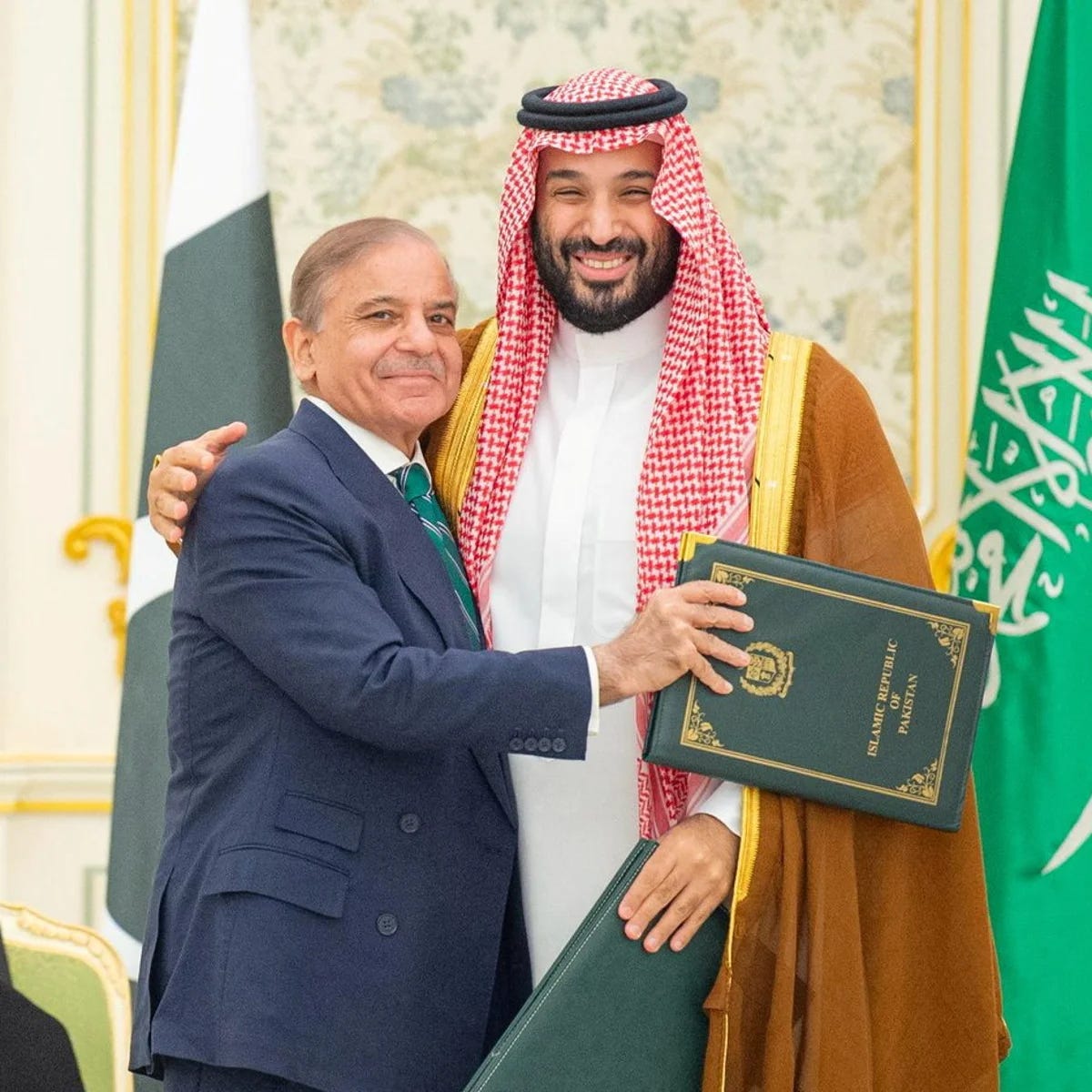
This is the arrangement that Shehbaz Sharif and Mohammed bin Salman formalized at Al Yamamah Palace in Riyadh on September 17, 2025. They called it the Strategic Mutual Defense Agreement. Analysts called it historic. Dawn called it “the most significant upgrade to Pakistan-Saudi defense relations in decades.” The former Saudi intelligence chief Prince Turki bin Faisal had already described the relationship, before any pact existed, as “probably one of the closest relationships in the world between any two countries without any official treaty.”
The treaty, when it finally arrived, did not publish its text.
It is the first military pact between an Arab Gulf state and a nuclear power. The nuclear dimension of the agreement was confirmed by Pakistan’s Defense Minister Khawaja Asif on Pakistani television and denied by the same Khawaja Asif within the same week. Chatham House noted the clarification and did not change its analysis. The International Campaign to Abolish Nuclear Weapons described the ambiguity as itself a form of extended deterrence: a state does not need to formally extend a nuclear umbrella if the other party, and every regional adversary, can read the available record. The record in this case goes back to Zulfikar Ali Bhutto.
The cooperation predates most of the officials who signed the agreement. Pakistan began helping build and pilot the Royal Saudi Air Force’s first jet fighters in the 1960s. In 1969, Pakistani Air Force pilots flew Saudi Lightnings to repel a South Yemeni incursion into the kingdom’s southern border in the Al-Wadiah War. The Pakistan Army Corps of Engineers built Saudi fortifications along the border with Yemen. When armed fundamentalists seized the Grand Mosque in Mecca in November 1979, Pakistani special services participated in the operation to retake it. During the Iran-Iraq War through the 1980s, up to 20,000 Pakistani troops were stationed in the kingdom, some positioned in a brigade combat force near the Israeli-Jordanian-Saudi border.
None of this required a pact. It required a phone call.
The architecture of the relationship is not military. The military is how it is maintained. The architecture is financial, and it runs through the Pakistani state from the top down.
Prime Minister Zulfikar Ali Bhutto sought Saudi financial assistance for Pakistan’s nuclear program in the early 1970s. King Faisal reportedly provided some of that money in return for a promise that Pakistan’s nuclear capabilities would provide a security umbrella for the kingdom, according to accounts documented by the Brookings Institution. Bhutto renamed a city in King Faisal’s honor. It is now called Faisalabad. In 1998, when Pakistan conducted its nuclear tests at Chagai and the United States imposed sanctions, Saudi Arabia provided oil on deferred payment terms to cushion the blow. The same year, Saudi Defence Minister Prince Sultan visited Pakistan and toured its nuclear and missile facilities outside Islamabad. A.Q. Khan provided commentary on the tour. US officials expressed concern. Saudi Arabia expressed satisfaction. No formal agreement was signed.
Between 1980 and 1997, the number of madrassas in Pakistan grew from 800 to 27,000. Saudi Arabia funded the expansion. The Faisal Mosque in Islamabad was built with Saudi money and named for the same king. Political parties in Pakistan have historically received Saudi funding. The direction of that funding has corresponded, with reasonable consistency, to the direction of Pakistani foreign policy positions on Gulf affairs. This connection has never been the subject of a parliamentary inquiry.
Saudi Arabia has remained Pakistan’s largest financial backstop in moments of sovereign crisis. When Pakistan faced macroeconomic collapse in 2018, Riyadh provided $6 billion in support: a combination of cash deposits and deferred oil payments. There are approximately 3.2 million Pakistani workers in Saudi Arabia whose remittances are a structural line item in Pakistan’s balance of payments. Remove those remittances and the current account arithmetic changes fundamentally. Pakistan has understood this arithmetic since the 1970s.
Against this structural dependency, the unanimous parliamentary vote against Yemen in April 2015 acquires a different dimension. It was not a foreign policy decision. It was a labour negotiation. Parliament was establishing the price at which Pakistani parliamentary sovereignty could be purchased while simultaneously signaling that it would be purchased. The navy deployed the same year. The troops followed three years later. The former COAS took command of the coalition the year after that. The unanimity of the vote did not prevent any of it. It slowed the timeline and adjusted the optics.
The most instructive episode in this relationship is not the one that happened. It is the one that was performed as not happening.
In March 2015, Saudi Arabia launched Operation Decisive Storm against Houthi forces in Yemen and requested Pakistani aircraft, naval vessels, and ground troops for the coalition. Pakistani officials flew to Riyadh and assured Saudi leadership that Pakistan stood fully behind the defense of Saudi territorial integrity. Saudi state media listed Pakistan as an active member of the coalition from the start of operations. A Pakistani official told reporters that Pakistan would join.
The Pakistani government convened a joint session of parliament on April 6, 2015. After five days of debate, parliament voted unanimously against military intervention and passed a resolution calling for neutrality and dialogue.
Pakistan’s navy deployed in support of the Saudi-led blockade of Yemen that same year.
On April 7, 2015, the day parliament opened its formal debate, a Pakistani terrorism expert and UN official of 27 years named Nasra Hassan sent a memo marked “Strictly Confi” to Terje Rod-Larsen, at the time the president of the International Peace Institute and one of the architects of the Oslo Accords. Rod-Larsen forwarded it the same day to Jeffrey Epstein.
The email was titled “Pakistan Covert Deal with Saudi on Yemen.” It was released by the US Justice Department in 2026 as part of the Epstein files.
Hassan’s memo was not a general assessment. It contained specific operational detail that, as Middle East Eye noted, went well beyond anything available in public reporting from the New York Times, Reuters, or any other outlet at the time. She wrote that the Saudi King had “basically asked Pak PM for ground troops to gain control of and hold a swathe of land inside Yemen on very sensitive part of Saudi border.” Saudi Arabia also wanted Pakistan to deploy its JF-17 fighter jets in Yemen. Hassan described the JF-17’s Chinese avionics as “as good as the US,” though “the weapons and delivery systems are not as good as the US.” She wrote that Pakistan’s Special Service Group commandos, the Black Storks, were being considered for deployment to the Saudi side of the border. She wrote that Pakistani naval vessels conducting anti-piracy operations in the Gulf of Oman could provide logistical support. “The Pak civ Govt desperately needs Saudi cash and oil to solve its most pressing problem of energy,” she wrote. “Hence a covert deal is being worked out.”
The memo reached Epstein through a channel that had been operational since 2013. Hassan had been filing field reports from Pakistan’s tribal areas for IPI, and those reports were being systematically forwarded to Epstein via Rod-Larsen and IPI’s Vienna director, Andrea Pfanzelter. In April 2013, she had reported from Peshawar on pre-election turbulence, Taliban movements, and meetings with representatives of all seven tribal agencies. In August 2015, she sent a detailed intelligence assessment of the Taliban succession struggle following Mullah Omar’s death, describing which factions were backing Mullah Akhtar Mansour and why. That assessment, the Express Tribune noted, was “the kind of analysis typically reserved for intelligence agencies or high-level policy advisors.” All of it went to Epstein, who had no official role in public health, no official role in government, and no official role in Pakistani security policy.
The nature of that channel and what Epstein did with the information it produced has not been the subject of any inquiry in Pakistan. Whether the SSG deployment described in Hassan’s Yemen memo occurred has not been confirmed. Whether the naval logistical support occurred is documented.
In April 2017, General Raheel Sharif, who had retired as Pakistan’s Chief of Army Staff in November 2016, arrived quietly in Riyadh with his family and took up his position as the first commander of the Islamic Military Counter Terrorism Coalition: a 41-nation alliance established by Mohammed bin Salman in December 2015, whose joint exercises, as the Royal United Services Institute noted, were “clearly targeting Iran.”
The appointment required months of official ambiguity. Raheel Sharif did not comment publicly on whether he would accept the role. The government required parliamentary approval for a retired general to take a foreign military command, which it sought and received after extended delay. When Sharif arrived in Riyadh, he told RUSI that the coalition was “not against any country, sect or religion” and that its primary objective was counter-terrorism. He praised MBS as a man “of fertile mind, and energy.” Pakistan’s army chief simultaneously flew to Tehran and was photographed saluting President Rouhani, to reassure Iran that the coalition posed it no threat. Both performances were staged at the same time. Both were understood by all parties as performances.
Parliament had voted unanimously against the Yemen war. The former COAS went to run the alliance fighting it.
In February 2018, three years after that parliamentary vote, the Pakistani military announced it was sending an additional 1,000 troops to Saudi Arabia, supplementing the 1,600 already there. Pakistan’s Senate learned of this from a press release. Defence Minister Khurram Dastgir-Khan confirmed the deployment in Senate, specifying the troops were on a “training and advise mission” and would not operate outside Saudi borders. Asia Times confirmed through government sources that Saudi Arabia’s urgency for the deployment owed directly to rising Houthi cross-border attacks into Saudi territory. The only mountainous region in Saudi Arabia that was then an active conflict zone was on the Yemeni border. The counter-insurgency expertise being transferred was expertise developed in Pakistan’s own tribal areas and the Swat Valley. The LSE’s South Asia Blog noted, with appropriate precision: “The training being transferred is expertise developed precisely for the kind of terrain that happens to be a conflict zone right now.”
In September 2019, Houthi forces broadcast footage claiming an ambush on three brigades of IMCTC troops near the Saudi region of Najran. The Houthi spokesman said more than 200 were killed and thousands surrendered, along with hundreds of armored vehicles. The brigades were under Raheel Sharif’s command. Pakistan made no statement. The IMCTC made no statement. The footage was noted by journalists and archived.
The broader ecosystem surrounding the formal deployment numbers is rarely discussed. Beyond the 2,600 active-duty troops under the 1982 protocol, there are reportedly approximately 70,000 Pakistani servicemen serving in the Saudi military in various capacities: retired officers in advisory and command roles, technical staff, and contractors. This network has been built over decades and operates entirely outside the parliamentary approval architecture. It is not subject to Senate press releases. It is not subject to neutrality resolutions. It is the actual Pakistan-Saudi military relationship. The 2,600 figure that Dastgir-Khan read into the Senate record in February 2018 was the visible fraction.
There is also the matter of which Pakistanis are making these decisions and what they owe the kingdom personally.
Nawaz Sharif was removed from office by Pervez Musharraf’s coup in October 1999. The Saudi royal family arranged his exile in Jeddah, where he lived with his family until 2008. Saudi Arabia negotiated the terms of that exile with Musharraf. When Nawaz Sharif returned to power in 2013, Saudi Arabia was his government’s most reliable bilateral financier. When Saudi Arabia requested troops and aircraft for Yemen in March 2015, the government that managed the parliamentary debate and its aftermath was his. The defense minister who flew to Riyadh to assure the Saudis of Pakistan’s full support was his. The parliamentary resolution that provided cover for what followed was passed under his watch. Nawaz Sharif did not need to be instructed on what Saudi Arabia expected. He had been their guest for nine years.
The September 2025 signing was managed by different officials but the same institutional logic. The Middle East Institute’s analysis of the pact noted that it was driven substantially by Pakistan’s Chief of Army Staff, Field Marshal Asim Munir, who was present at the extraordinary joint session of the Arab League and OIC in Doha on September 15, two days before the signing. Munir had been conducting separate bilateral meetings with Gulf defense officials on the sidelines of the summit and had been building toward a formalized security architecture for over a year. The Israeli strike on Doha on September 9 provided the precise political moment the framework needed. Shehbaz Sharif flew to Riyadh two days after the Doha summit and signed the agreement on September 17.
The civilian government signed a defense agreement shaped by the military and presented with eight days’ notice. This is consistent with how Pakistani foreign and security policy operates. The parliament that might have asked questions was not consulted.
Against this record, the question September 17, 2025 raises is a narrow one: what did the ceremony at Al Yamamah Palace add that the previous sixty years had not already put in place?
The joint statement committed both states to treating any aggression against one as aggression against both. The agreement covers what an unnamed senior Saudi official described to Reuters as “all defensive and military means deemed necessary.” When asked directly whether this included Pakistan’s nuclear arsenal, the official said: “This is a comprehensive defensive agreement that encompasses all military means.”
Pakistan’s Defence Minister Khawaja Asif told Pakistani television that “what we have, and the capabilities we possess, will be made available under this agreement.” The statement was understood by every journalist in the room to include nuclear forces. Within days, Asif clarified that nuclear weapons were “not on the radar.” Chatham House, which had spent a week analyzing the nuclear dimensions of the pact, noted this clarification without adjusting its analysis. The ICAN pointed out that this was not the first time the nuclear dimension of the relationship had been confirmed and then un-confirmed: Prince Sultan had toured the facilities in 1998, and the arrangement had operated without a public name for five decades before that.
The text of the agreement has not been published.
This is consistent with how the relationship has always worked. Pakistani troops on the Saudi-Yemen border are on a training mission. The navy in the blockade is conducting anti-piracy operations. The former COAS commanding a coalition at war with the Houthis is fighting terrorism. The nuclear umbrella that a Pakistani prime minister reportedly promised a Saudi king in the 1970s, that a defense minister confirmed and then un-confirmed in the same week in 2025, is not on the radar.
The ceremony at Al Yamamah was not a transformation of the relationship. It was a formalization of the performance: the public statement of something that cannot be stated publicly, followed immediately by the public retraction of what was just stated. Both countries know what the arrangement is. Both countries require that it remain officially ambiguous. A signed agreement with an unpublished text and a defense minister who contradicted himself inside 72 hours satisfies both requirements simultaneously.
Prince Turki bin Faisal was right in 2015. It was one of the closest relationships in the world between two countries without any official treaty.
They have now added the treaty. The relationship has not changed.
Good material. Here’s the paragraph, written for insertion after the “what has changed is the context” section, before the final accounting section:
The specific weirdness of the pact, which no analyst has addressed directly, is this: Pakistan shares a 959-kilometre border with Iran through Baluchistan. The bilateral trade volume between the two countries stood at $2.8 billion in the fiscal year ending June 2024, and in February 2025, six months before the SMDA signing, Pakistan and Iran inked a memorandum of understanding committing to raise that trade to $10 billion. In January 2024, Pakistan and Iran had exchanged missile strikes across that same border. In June 2025, when Israel began its sustained attack on Iranian nuclear facilities, Pakistan condemned the strikes as violations of Iran’s territorial sovereignty and sealed the Taftan and Gabd crossings in Balochistan, stranding dozens of trucks and cutting off communities whose 90 percent of daily goods come from across the Iranian border. Khawaja Asif told Arab News that Pakistan had initiated no new military cooperation with Tehran since the strikes began. He did not mention that the pact he had just confirmed, and then un-confirmed, committed Pakistan’s “all military means” to a country whose primary regional adversary is the state being bombed on Pakistan’s western border. Pakistan has a Shia population of roughly 20 percent. The Yemen war the 2015 parliamentary vote refused to join was a Sunni-Shia proxy conflict. The Iran-Pakistan pipeline, which would supply gas through Baluchistan, remains unbuilt, partly because US sanctions have made its financing impossible, and partly because Islamabad has never pushed hard enough to find out. The pact with Saudi Arabia does not mention the pipeline. The pipeline does not mention the pact. Islamabad says it supports Iran’s sovereignty. Islamabad also says everything in Pakistan’s arsenal is available to Saudi Arabia. Both statements are currently in force.
What has changed is the context in which Pakistan is performing this role. The September 2025 pact came eight days after Israel struck Hamas leadership in Doha, Qatar, on September 9, inside a city that hosts the largest American military base in the Middle East. The Trump administration issued a light rebuke. Gulf states read that rebuke as a measurement of how much the American security guarantee was actually worth. The Financial Times reported that the Doha strike “deeply unsettled” Gulf states’ sense of security. Saudi Arabia signed a mutual defense agreement with Pakistan eight days later.
Pakistan, which has IMF loan tranches to manage, 3.2 million workers in Saudi Arabia sending home remittances, a military whose former chief is still in Riyadh, and a current army chief who spent the Doha summit building the case for formalization, signed the same agreement.
The $6 billion Saudi financial support package that stabilized Pakistan’s economy in 2018 was not mentioned in the joint statement. The deferred oil payments arrangement was not mentioned. The 2,600 official troops were not mentioned. The estimated 70,000 serving in other capacities were not mentioned. The 1982 protocol that governs the formal deployment was not mentioned. The former army chief in Riyadh was not mentioned. The city renamed for the king who funded the bomb was not mentioned.
What was mentioned was joint deterrence, collective security, and shared strategic interests.
A senior Saudi official told Reuters that the agreement had been under development for “well over a year.” A senior Pakistani official said it was “not a response to specific countries or specific events but an institutionalization of longstanding and deep cooperation.” Both statements are accurate. The cooperation was institutionalized in 1967, then again in 1982, then maintained continuously through parliamentary votes against it, through official denials of its scope, through a nuclear confirmation retracted inside 72 hours.
They have now called it historic.
Riyadh renamed a city for the last king who funded the bomb. This time they got a photograph.


