A Nation Still Waiting to Govern Itself
Pakistan cannot survive as a functioning state until it dismantles the structures that were never built to serve it
There is a particular kind of exhaustion that settles over a city like Karachi in the early months of a year when nothing has changed and everyone already knew nothing would. It is not the exhaustion of effort. It is the exhaustion of waiting, of watching the same institutions fail the same people in the same ways for the seventy-seventh year in a row, and being told, again, that next time will be different.
Every chai-wala between Lyari and Lahore’s Model Town could tell you without consulting a data set: public trust in Pakistan’s federal government is gone. The National Assembly, the Senate, the superior judiciary, the police, the bureaucracy, all of them operating somewhere in the range of functional contempt from the population they nominally govern. This is not a crisis of communication. It is not a crisis of leadership personality. It is a structural diagnosis that the country has been refusing to read correctly for three-quarters of a century.
Pakistan is not a failed state in the sense that phrase is used lazily by Western analysts who have already decided the answer. It is something more specific and more treatable, if there were the political will to treat it: it is a successfully colonized administrative structure that has never been asked to serve the people living inside it. The British built what they built to extract, to control, to move resources from the periphery to the center. They left. The center moved to Rawalpindi and Islamabad. The extraction continued.
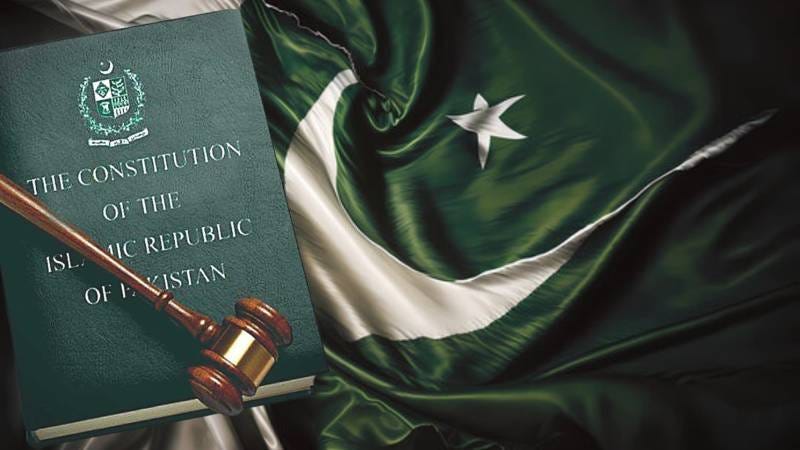
The 1973 Constitution, celebrated as Pakistan’s democratic covenant, operates through an administrative and legal architecture inherited almost wholesale from the Government of India Act of 1935. That document was not a charter of self-governance. It was a management framework for a subordinate territory, designed to create the minimum conditions for stability while concentrating real power at the apex. Pakistan’s Civil Service is the direct institutional descendant of the Indian Civil Service, which Macaulay designed in 1854 to produce a class that was, in his own documented phrase, Indian in blood and colour but English in tastes, opinions, morals and intellect. The phrase is famous. What is less discussed is that the institutional design was never revised after independence. The CSP became the CSP. The district officer remained the district officer. The patwari stayed the patwari. The instruments of colonial management were simply repainted and handed to a new set of owners.
This is the first thing that must be said plainly: Pakistan’s institutional failures are not accidents or corruption problems or competence gaps in isolation. They are the predictable output of institutions designed to govern a subject population, not to serve a sovereign citizenry. When Pakistanis say they do not trust the government, they are expressing, without necessarily theorizing it, the correct intuition that these institutions were never built for them.
The colonized mind is the primary instrument of its own subjugation. This is not a poetic observation. It is a political mechanism. A ruling class that thinks in frameworks imported from its former occupiers does not know how to ask the questions that would free the people it governs, because the frameworks themselves do not contain those questions.
Pakistan’s economic policy is designed by institutions whose foundational models were developed in Washington and London. Its legal system argues in English. Its elite sends its children to universities in the United Kingdom and the United States, where they learn to see Pakistan from the outside, as a problem to be managed, a risk to be hedged, a market to be accessed, rather than from the inside, as a civilization to be built. They return fluent in the language of governance and innocent of the society they are supposed to govern. This is not coincidence. This is the pipeline.
On March 3, 2026, Pakistan is simultaneously managing the following external relationships, each of which carries a structural demand on the state’s behavior.
The International Monetary Fund, whose $7 billion Extended Fund Facility carries conditionalities that constrain Pakistan’s fiscal autonomy with a specificity that no elected parliament voted on. The energy pricing structure, the tax-to-GDP targets, the subsidy elimination timeline, these were negotiated between technocrats answerable to Washington’s Bretton Woods institutions and a Finance Ministry that knows its tenure depends on compliance. The Pakistani public was informed after the fact, as a condition of keeping the lights on.
The United States, which continues to treat Pakistan as a logistics and intelligence node for its regional architecture, rewarding compliance with market access and military hardware and punishing deviation with the kind of quiet pressure that never appears in diplomatic cables but shapes every decision made in GHQ. The relationship is documented, not speculated: the Kerry-Lugar-Berman Act of 2009 contained provisions conditioning civilian assistance on Pakistani compliance with specific security-sector demands, making explicit what had previously been conducted informally. The formula has not changed; only the dollar amounts have.
Saudi Arabia and the United Arab Emirates, which provide balance-of-payments support in the form of deferred oil payments and direct deposits that keep Pakistan’s foreign exchange reserves from hitting zero, and which extract from this position a consistent alignment on regional policy, on Yemen, on Iran, on the Palestinian question, on the internal treatment of sectarian communities, that a sovereign government would not necessarily choose if it were free to choose. The Gulf does not need to issue explicit instructions. The financial dependency speaks for itself.
China, whose CPEC investment has built infrastructure that Pakistan’s own budget could never have financed, but which operates under contract terms that Pakistan’s parliament has consistently refused to make fully public, that prioritize Chinese labor imports over Pakistani employment, that route profits through structures designed to minimize Pakistani sovereign returns, and that have created a debt architecture whose renegotiation timeline is controlled in Beijing, not Islamabad.
The question is not which of these relationships is more or less legitimate. Each one operates within its own transactional logic. The question is what it means for a country to simultaneously carry the structural demands of all four at once, when those demands regularly conflict with each other, and when the domestic political class has no coherent framework for adjudicating between them other than survival.
What it means, in practice, is this: Pakistan cannot have an independent foreign policy because its finances require Gulf alignment. It cannot have a fully independent security policy because its military hardware requires American parts and American approval. It cannot have an independent energy policy because the IMF has defined what subsidies it is permitted to offer. It cannot fully exercise its constitutional authority over CPEC because the contract terms were signed before the parliament that would enforce them was elected. The government is not governing. It is managing competing external obligations while the population pays the bill.
The connection between external dependency and internal institutional failure is not theoretical. It runs through the budget.
Pakistan spent approximately 7.3 trillion rupees on debt servicing in fiscal year 2024-25. That figure represents more than half of total federal revenue. Every rupee that services a loan from a multilateral institution or a bilateral creditor is a rupee that does not build a school that works, a hospital that has medicines, a court that resolves a case in less than a decade, or a water system that delivers clean water to the forty percent of Pakistani children who currently drink contaminated supplies. The connection is arithmetical. The country is bleeding out through its debt obligations, and the political class, because its own interests are insulated from that bleeding, has no structural incentive to stop it.
The healthcare system is the most direct evidence of what this costs. In Sindh’s rural districts, the Basic Health Units that exist on paper as Pakistan’s primary care infrastructure are non-functional in more than sixty percent of cases: absent doctors, absent medicines, absent basic diagnostic equipment. These are not buildings that were bombed or flooded. They are facilities that were never resourced, because the budget that should have resourced them was committed elsewhere before the fiscal year began.
Pakistan’s out-of-school children population stands at over twenty-six million, the second highest in the world. These are not statistics about poverty. They are statistics about political priority. Countries with lower per-capita income than Pakistan have achieved near-universal primary enrollment because they made the institutional choice to do so. Pakistan has not made that choice because the class that controls the educational budget sends its own children to private schools and abroad, and therefore has no personal stake in whether the government school in Muzaffargarh has a teacher in the classroom.
Pakistan’s ruling class is not merely corrupt in the ordinary sense of individuals taking money they should not. It is structurally oriented toward foreign patrons and its own reproduction, rather than toward the population it governs. The corruption is systemic because the class formation is systemic. It was trained, educated, and socialized to think in exactly this way.
There is a version of decolonization rhetoric that is cosmetic: change the street names, add Urdu signage to government buildings, issue speeches about sovereignty on August 14th. This country has performed that version continuously since 1947. It has not helped.
The decolonization that would actually change things is institutional, legal, economic, and psychological. It is also politically dangerous to everyone who currently benefits from the existing arrangement, which is why it has not happened.
Institutional decolonization means redesigning the administrative structure of the state so that it serves citizens rather than extracts from them. The colonial district officer model, in which a single appointed official exercises executive, revenue, and judicial authority over a territory with no accountability to its inhabitants, was designed to control a subject population. It is structurally incompatible with democratic governance. Pakistan has modified this system incrementally since independence; it has not reformed it. The 18th Amendment moved some functions to provinces, but the bureaucratic culture, the appointment mechanisms, the accountability structures, and the service delivery models remain largely inherited from a framework that Macaulay and Curzon would recognize.
Legal decolonization means replacing a court system that operates in a language the overwhelming majority of litigants do not speak, resolves cases on timelines measured in decades, and serves as an instrument of elite delay rather than popular justice. The Supreme Court’s docket backlog has exceeded fifty thousand pending cases. That is not a resource problem alone. It is a structural design problem: a system built to be inaccessible to ordinary people is working exactly as it was designed to work.
Economic decolonization is the most urgent and the most difficult. It means building domestic fiscal capacity so that the state does not depend on external creditors whose conditionalities override democratic decision-making. Pakistan’s tax-to-GDP ratio, hovering around nine percent, is among the lowest in the world for a country of its size and complexity. This is not because Pakistan is poor. It is because Pakistan’s landowning and commercial elite has successfully prevented the taxation of agricultural income and resisted the documentation of the informal economy for seventy-seven years. The IMF demands fiscal consolidation; the political class extracts fiscal consolidation from the salaried middle class and the poor through indirect taxes while continuing to protect the agricultural income of the feudal interests that fund its campaigns. This is not a failure of program design. It is a documented feature of Pakistan’s class politics.
Psychological decolonization is the most difficult to legislate but the most necessary to begin. A people that knows its own worth and acts from its own center, rather than from a permanent posture of supplication to external authority, cannot be created by government circular. But it can be cultivated by an education system that teaches Pakistani history as a living civilizational inheritance rather than as a colonial afterthought, that treats Urdu and regional languages as full intellectual instruments rather than as vernacular approximations of real thought, and that produces graduates capable of asking what Pakistan needs rather than what Pakistan can offer to Washington, London, Riyadh, and Beijing.
The political situation as it stands today is as follows: the largest political party by popular vote count is governed from prison, its leaders facing trials whose procedural legitimacy is disputed by bar councils, retired judges, and independent legal observers. The government in power was formed through a coalition that required post-election negotiation of sufficient creativity to produce a parliamentary majority from an election whose results were contested in real time. The institution that has managed transitions of this kind since 1958 maintains its customary position as the unelected final arbiter of political outcomes. The judiciary, which intermittently asserts independence and intermittently demonstrates the limits of that independence, continues to process cases whose resolution depends partly on which bench they land in front of.
The public has concluded, correctly, that this system does not represent them. The question is not whether the conclusion is correct. The question is what follows from it.
What follows from it, if the country is serious, is a constitutional and institutional reckoning of the kind that Pakistan has always found reasons to delay: the subordination of the military establishment to genuine civilian oversight with accountability mechanisms that cannot be suspended by emergency proclamation; the reform of the civil bureaucracy to break the elite’s stranglehold on administrative appointments; the taxation of agricultural income and real estate at rates that reflect actual economic activity; the full public disclosure of all sovereign debt contracts including CPEC agreements; the transfer of genuine fiscal authority to local governments below the provincial level; and the systematic replacement of English as the language of legal and bureaucratic power.
None of this is culturally alien to Pakistan. All of it is constitutionally achievable. None of it will happen while the class that benefits from the current arrangement controls the terms of the conversation about reform.
The rule is the Constitution of 1973, which vests sovereignty in the people of Pakistan. The departure is seventy-seven years of governance in which sovereignty has been exercised by a rotating coalition of military establishments, feudal political dynasties, urban commercial interests, and external creditors. The authority that has permitted this departure is every government, civilian and military, that chose institutional self-preservation over constitutional fidelity.
Pakistan is a country of two hundred and thirty million people, the world’s fifth largest population, sitting on a civilization that is among the oldest continuously inhabited on earth, with nuclear capability, with one of the largest armies in the world, with a diaspora that generates over forty billion dollars in annual remittances, with agricultural land that feeds the region, with a youth population whose median age is under twenty-three.
This is not a country that cannot afford to function. This is a country whose functioning has been systematically prevented by the convergence of an internally captured ruling class and externally imposed fiscal architecture, both of which have a direct interest in keeping the population dependent, indebted, and convinced that their only choices are between different managers of the same arrangement.
The decolonization that Pakistan needs is not a rhetorical declaration. It is a political project. It requires a ruling class that is willing to be replaced, an institutional architecture that is willing to be redesigned, and an educational system that is willing to produce citizens rather than subjects. It requires the military to understand that genuine national security is built on a functional state, not a functional patronage network. It requires politicians to understand that electoral mandates are the beginning of accountability, not an escape from it.
And it requires the public, which already knows all of this, to insist on it with the same consistency and force that it has brought to every other moment when this country’s survival was in question.
Pakistan has survived things it should not have survived. The question for 2026 is not whether it can survive. It is whether it will choose to live on its own terms, or continue to lease its existence to whoever is currently offering the best rate.
The lease is due for cancellation.